

You paid a collection to get ready for a mortgage, then checked your score and saw little change. That's confusing, and it's common for homebuyers. Paid off collections can change payment status, scoring treatment, or lender review, but those are four different things. Payment alone doesn't guarantee deletion, a score increase, or loan approval. The calm next step is to check what changed on your report and what your lender still needs.
Table of Contents
- What Paid Status Changes on Your Credit Report
- Key Terms in Plain English
- What Mortgage Lenders Check After You Pay
- Choosing Between Paying, Negotiating and Disputing
- How to Negotiate Terms Before You Send Payment
- Why a Paid Collection Still Shows Up
- Answers to Common Paid Collection Questions
- Confirm Your Mortgage Readiness Before You Apply
What Paid Status Changes on Your Credit Report
A buyer pays an old collection in full, watches the balance change to zero, then refreshes the score and waits for a jump that may never come. The confusion is reasonable: payment can update the account's status while the collection entry, the score model's treatment, and the lender's review each follow their own logic.
A Homebuyer Scenario
Say you pay a collection before applying for a home loan and expect the file to look clean the next week. If your lender uses an older scoring version, the paid account may still count in the calculation. If the lender uses a newer version, the same zero-balance collection may be treated differently, even though the history remains visible on the report.
How Newer FICO Models Treat Paid Accounts
According to FICO's guidance on collections and credit scores, FICO Score 9 disregards paid third-party collection accounts, so a collection reported with a zero balance may no longer be included in that score's calculation. FICO Score 10 and the FICO 10 suite also disregard third-party collections reported as paid, and settled third-party collections with a zero balance are treated as paid for these models.
| Scoring model | Treatment of paid collection | What still applies |
|---|---|---|
| FICO Score 9 | Disregards paid third-party collection accounts | Zero-balance collection may be excluded from the score |
| FICO Score 10 and FICO 10 suite | Disregards paid third-party collections; settled zero-balance collections treated as paid | Missed payments on the original account can remain relevant |
| Lender's own underwriting | Reviewed under the lender and loan program rules | Lender may request documentation for outstanding accounts |
Limits You Should Expect
Payment changes the status field first. It does not automatically delete the entry, restore the original account's payment history, or answer the underwriter's questions. Missed payments tied to the original creditor can still matter, and a third-party collection can remain visible for years after the original delinquency even when the balance shows zero.
Medical collections follow separate bureau reporting rules, and those rules have shifted in recent years. A paid medical collection may be treated differently from a paid credit card or utility collection, so check each bureau report directly instead of relying on the receipt.
Practical rule: Confirm the status shown on each bureau report instead of assuming payment removed the account.
For broader habits that support a stronger file, these practical credit score tips for 2026 can complement the account-by-account review. Results vary by credit file, lender, scoring model, documentation, and current credit behavior.
Key Terms in Plain English
These terms come up in almost every collection decision. Knowing them helps you ask a collector or lender a precise question.
- Collection account: An unpaid debt a creditor has handed to a third-party collector to recover.
- Charge-off: A creditor's accounting decision that a debt is unlikely to be collected, usually after a long period of missed payments. The balance can still be owed.
- Payment status: Whether an account shows as open, paid, settled, or unpaid on your report.
- Pay-for-delete: A request to remove the entry from your credit report in exchange for payment. A creditor isn't required to agree.
- Settlement: An agreement to accept less than the full balance. It should be confirmed in writing.
- Debt validation: A written request asking the collector to prove the debt is yours and the amount is correct.
- FICO score: One of several credit scoring models. Lenders may use different versions.
- Credit utilization: The share of available revolving credit you're using, often shown as a percentage.
- Debt-to-income ratio: Monthly debt payments compared with gross monthly income, used in mortgage underwriting.
- Underwriting: The lender's review of a loan file to decide whether to approve it and on what terms.
- Statute of limitations: The legal time limit to sue over a debt. It varies by state and debt type.
Alongside collection work, practical tips to improve your credit can help you keep current accounts stable while you sort out older items.
What Mortgage Lenders Check After You Pay
A lender can require payment or documentation even when a scoring model treats a paid collection favorably. Score treatment and underwriting are separate reviews, and only the lender decides eligibility.
FHA Collection Thresholds
Under HUD's FHA collection account guidance, a lender capacity analysis is required when the combined outstanding balance of collection accounts is $2,000 or more, while medical collections and charge-offs are excluded from this specific calculation. If no creditor-approved arrangement exists, the lender includes 5% of each outstanding collection balance as the assumed monthly payment.
That math matters for affordability. $8,000 of unresolved collections can create a $400 qualifying monthly obligation under the 5% method, even if your score is otherwise acceptable.
Conventional Manual Underwriting
Under Fannie Mae's guidance on debts paid at or prior to closing, non-medical collection accounts and non-mortgage charge-offs generally don't have to be paid before closing when each individual account is below $250 or the combined balance is $1,000 or less. Accounts above those limits generally must be paid at or before closing, and delinquent credit affecting the lender's position must generally be paid by closing, subject to applicable exceptions.
| Rule | Threshold or formula | What it means |
|---|---|---|
| FHA combined collection balances | $2,000 or more | Lender capacity analysis is required; medical collections and charge-offs are excluded |
| FHA 5% method | 5% of each outstanding collection balance | $8,000 unresolved equals $400 monthly obligation when no arrangement exists |
| Fannie Mae non-medical collections | Each account under $250, or combined $1,000 or less | Generally need not be paid before closing |
| Fannie Mae larger collections | Above the $250 or $1,000 limits | Generally paid at or before closing |
| Delinquent credit affecting the lender's position | Subject to applicable exceptions | Generally must be paid by closing |
Documents and Borrowers
Lenders may request a payoff statement, proof of payment, or a creditor letter confirming a payment arrangement. They may also ask for explanations of outstanding accounts, particularly in manual underwriting. Count collections for all borrowers on the loan, not only the primary applicant.
FHA, VA, USDA, and conventional programs don't apply identical rules, and lenders can add overlays. VA and USDA loans follow their own program rules, so confirm with your lender which standard applies before you pay anything. For a deeper look at mortgage underwriting with unpaid collections, review the treatment before you apply.
Our review covers inaccurate personal information, collections, charge-offs, late payments, high utilization, repossessions, medical collections, student-loan reporting, bankruptcy or foreclosure history, and account comments that may affect mortgage underwriting.
Choosing Between Paying, Negotiating and Disputing
The account decides the action, not a general promise about deleting debt. Start with accuracy, then match the account to one path.
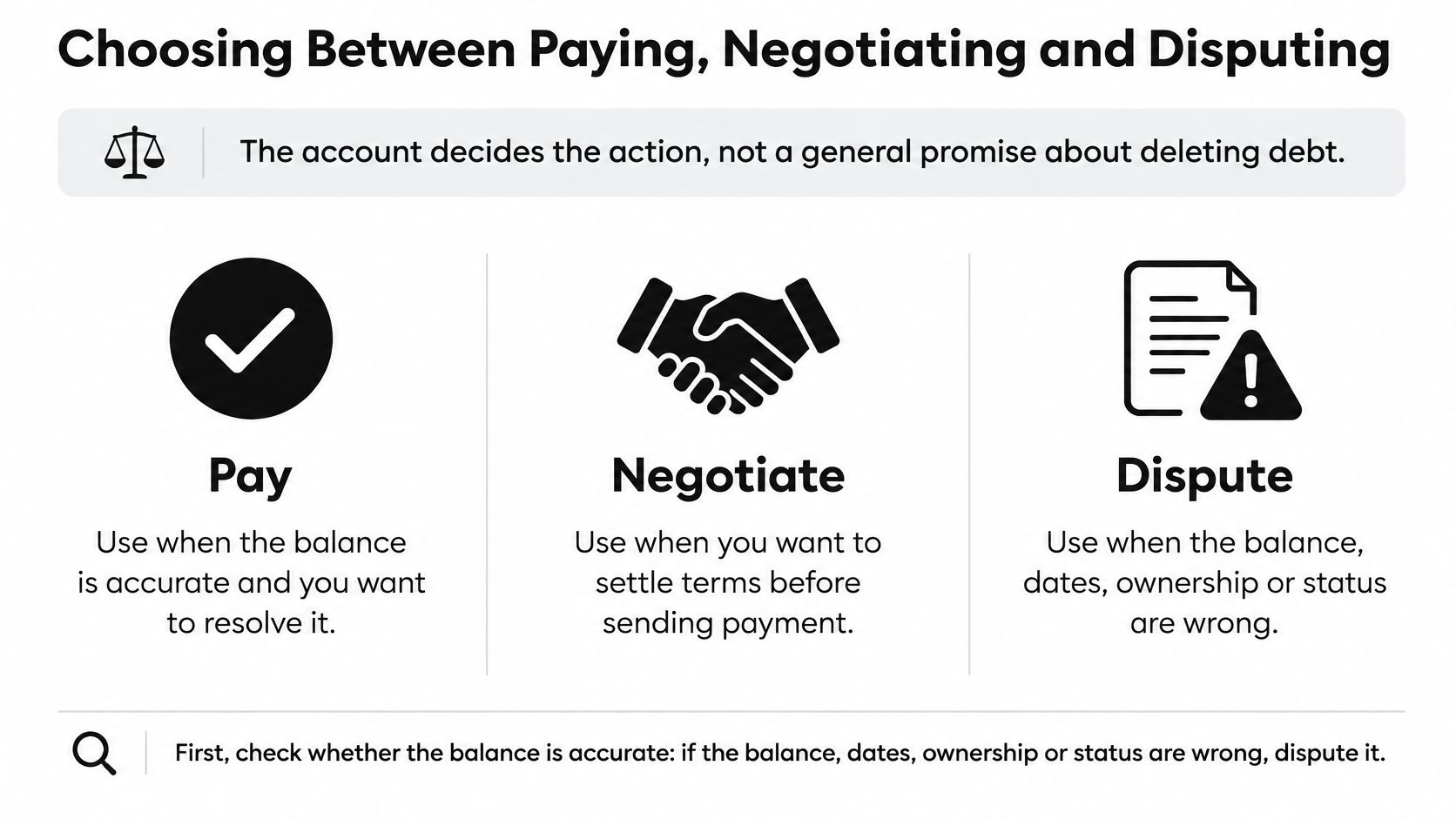
If the balance, dates, ownership, or status are wrong, dispute with documents rather than paying first. If the debt is accurate and a lender needs it cleared before closing, paying in full is the direct route, though it uses cash and doesn't guarantee deletion.
If the balance is accurate but the collector may accept less, a negotiated settlement can close the account. A settled status may still appear, so get the terms in writing. Pay-for-delete is an option only when the creditor agrees in writing before any money moves, and the creditor can decline.
| Option | Best fit | Main trade-off | Document to keep |
|---|---|---|---|
| Pay in full | Accurate balance that a lender requires to be paid | Uses cash; deletion is not guaranteed | Payoff statement and proof of payment |
| Negotiate a settlement | Accurate balance the collector may accept for less | Settled status may still appear | Signed settlement letter |
| Request pay-for-delete | Creditor may agree to remove the entry | Creditor can decline; no guaranteed deletion | Written agreement before any payment |
| Dispute inaccurate entry | Wrong balance, dates, ownership or status | Succeeds only on factual errors | Statements, collection notices and bureau reports |
Some accurate negative accounts fit none of these paths. Each account is reviewed separately, and an accurate negative account may need rebuilding, payment strategy, documentation, or time rather than another dispute.
Before choosing, find your monthly debt-to-income ratio so you can see how a payment arrangement could affect qualifying. If you're unsure whether to validate or dispute, review collection reporting issues before mortgage approval and label each collection with one path and the document that path requires.
How to Negotiate Terms Before You Send Payment
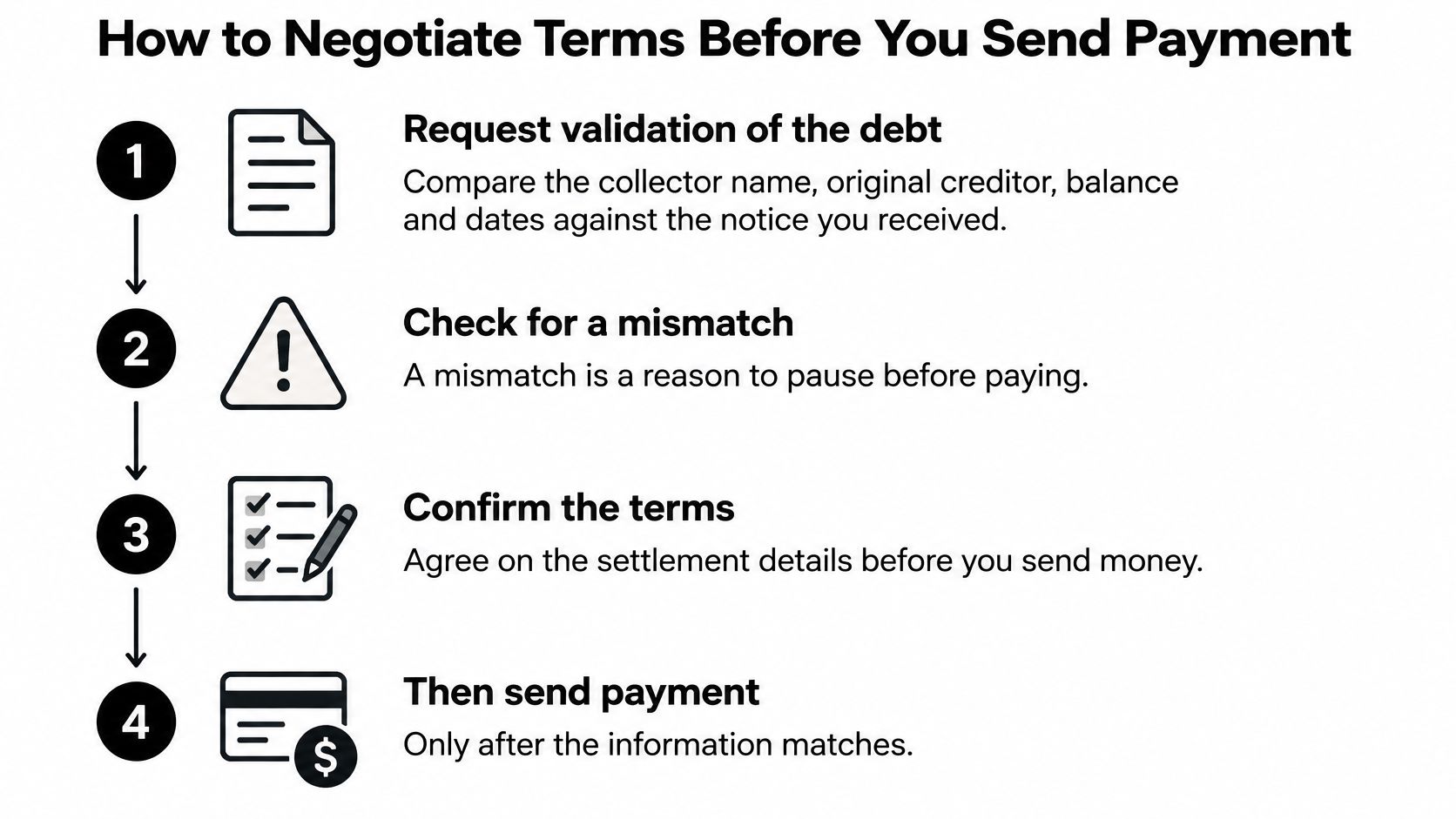
Negotiation works best as a paper-first process. Don't send money until the debt, amount, and reporting terms are clear.
Steps to Follow in Order
- Request validation of the debt. Collection entries are checked by comparing the collector name, original creditor, balance, account status, and dates against the notice received. A mismatch is a reason to pause because you may be looking at the wrong account or amount.
- Ask for an itemized balance. Ask the collector to show principal, interest, and fees separately. An unexplained total can change what you agree to pay and can create a dispute later.
- Make any pay-for-delete request in writing. State exactly what you're asking the creditor to do and by when. A spoken promise is hard to verify after payment.
- Get the agreement in a signed letter before sending money. The letter should state the amount, due date, and how the account will be reported. This letter is your proof if the status updates incorrectly.
- Pay only with traceable funds. Use a bank transfer or check rather than an untraceable method. Traceable payment also helps a mortgage underwriter verify the source and completion of payment.
- Save every record. Keep the payoff or settlement letter, payment confirmation, and all correspondence in one folder. You'll need these records if a bureau doesn't update the account.
- Check the bureau reports afterward. Confirm each bureau shows the agreed status within the timeframe in the letter. If it doesn't, send the letter and proof of payment with your correction request.
An unwritten promise can't be verified later, and undocumented funds can raise underwriting questions.
Documents to Gather First
Accuracy documents include current three-bureau credit reports, creditor statements showing balances, limits, dates, and payment history, and collection letters, settlement records, student loan records, or debt-buyer notices. Gathering them first makes validation faster and keeps you from negotiating from memory. It also helps you spot a balance that doesn't match your own statements before you've committed to terms.
Why a Paid Collection Still Shows Up
The most common confusion is simple. You paid, but the account still shows an open status or a balance.
Start by allowing reporting time, since creditors can update status on different schedules. Then pull all three bureau reports, because the bureaus may not match, and log each difference in balance, status, and dates.
Common Causes to Check
A duplicate entry is next. A debt buyer and the original creditor may both report the same debt, and the duplicate can be disputed with the collection notices. Also compare the original delinquency date against your statements, since a date error can change how long an account stays on your file.
If the balance is higher than the amount paid, request an itemized balance and compare it with your agreement. Interest or fees may not match what was agreed.
| Symptom | Likely cause | Next step |
|---|---|---|
| Still shows a balance after payment | Creditor has not updated the status | Allow reporting time, then request an updated report |
| Paid on one bureau only | Bureau differences in reporting | Pull all three reports and record each difference |
| Duplicate entry for one debt | Debt buyer and original creditor both report it | Dispute the duplicate with the collection notices |
| Wrong original delinquency date | Reporting date error | Compare to statements and dispute with documents |
| Balance higher than the amount paid | Interest or fees not in the agreement | Request an itemized balance and compare it to the agreement |
Disputes should target factual errors supported by documents rather than the existence of an accurate debt. In the CFPB annual report on consumer credit reporting complaints, inaccurate or incomplete information was the most common credit-reporting complaint category, while complaints about attempts to collect debt not owed rose sharply in 2025.
We commonly review collections, charge-offs, late payments, repossessions, medical collections, identity errors, high utilization, inaccurate balances, duplicate reporting, incorrect account status, and bureau differences. Charge-off review also covers balances, sale or transfer status, reporting dates, and creditor documentation. Work symptom by symptom, and tie each correction to a document you can show the bureau or lender.
Answers to Common Paid Collection Questions
1 Will Paying a Collection Raise My Score
It depends on which of the four moving parts you are asking about. Paying changes the account's status. Whether your score moves is a separate question that belongs to the scoring model. Newer models may disregard a paid third-party collection, while older models and any late payments on the original account can still factor into the result. No specific increase can be promised.
2 Do I Have to Pay a Collection Before Applying for an FHA Loan
Not always. The answer depends on the combined balance, whether a creditor-approved payment arrangement exists, lender overlays, and your cash reserves. Check the FHA capacity rules with your lender before paying. Paying with undocumented funds or draining reserves can create a new problem at underwriting, which is the opposite of what the payment was meant to fix.
3 What Changed for Paid Medical Collections
The nationwide bureaus have changed how they handle paid medical collections, but that does not mean every medical account is gone from every file. In LendingTree's January 2025 medical debt report, 50% of U.S. consumers who currently had or previously had medical debt said an account had been sent to collections, based on a November 2024 survey of 2,016 consumers. A rule about the bureaus tells you nothing about your own reports. Pull yours and match any remaining medical entry against your notices and statements.
4 Should I Pay an Old Collection That May Be Past the Statute of Limitations
That is a legal question as well as a credit question. Qualified legal advice is recommended when collection litigation, repossession, title, or identity rights are involved. Do not make a payment decision on an old account until you understand both the reporting and legal effects, because the age of the debt can change what a payment means in each system.
For practical next steps, see the debt payoff guidance from Superior Credit Repair. Results vary by credit file, documentation, creditor responses, account history, and current credit behavior.
Confirm Your Mortgage Readiness Before You Apply
You can make a useful decision this week without guessing. Build one documented list, then confirm the rules with your lender.

- Pull all three reports: Check Experian, TransUnion, and Equifax for paid off collections and unpaid items.
- List each collection: Record the balance, dates, status, collector, and original creditor.
- Match each item: Pair every entry with a notice, statement, or payoff letter.
- Choose one path: Mark each account pay, negotiate, pay-for-delete, or dispute.
- Build one folder: Keep reports, letters, and payment proof together for your lender.
- Ask your lender: Confirm which collection rules apply to your loan program and all borrowers.
For buyers, we review collections, late payments, utilization, dispute comments, and credit-report issues before mortgage preapproval or underwriting. Superior Credit Repair can review your credit report, help identify inaccurate or questionable items, and explain a step-by-step plan for improving your credit profile. You can request a free credit analysis or consultation to better understand your options.
Results vary by credit file, documentation, creditor responses, and current credit behavior. No approval, deletion, or score outcome is guaranteed.
If this information helped you better understand your credit report or your next steps, we would appreciate your honest feedback. You are welcome to share your experience with Superior Credit Repair on our Google Business Profile. https://share.google/ePRpFvtCXwCjiJwOK
If you're preparing for a mortgage and paid off collections are still creating questions, we can review your reports, help you identify inaccurate or questionable reporting, and outline a documented credit restoration plan. Visit Superior Credit Repair to request a free credit analysis and discuss your next steps.