


On a $250,000 home, moving from a 500 to 579 credit range to 580 or higher on an FHA loan can change your down payment from $25,000 to $8,750. That $16,250 difference is why the credit score for first time buyer decisions can't be reduced to one magic number. You're really matching three things, your middle mortgage score, the loan program you want, and the strength of the rest of your file.
You're also not an unusual case if you start with an FHA loan. In 2025, HUD data reported by Lower found that more than 83% of FHA-insured forward purchase mortgages went to first-time homebuyers. Lower down payment programs exist for buyers like you, but each one reads your credit file differently, prices risk differently, and asks for different proof. The hopeful part is practical, once you know which row you fit today, you can build a calm, step by step plan to become lender ready without guessing.
Table of Contents
- Credit Scores First-Time Buyers Need by Loan
- What Mortgage Lenders Weigh Besides the Number
- How Credit Problems Change Mortgage Readiness
- A Realistic Timeline to Become Lender Ready
- Thin Credit Files and Buyers With Little History
- When a Compliance-Based Credit Review Helps
- Frequently Asked Questions Before You Apply
Credit Scores First-Time Buyers Need by Loan
There's no single national cutoff that fits every first-time buyer. Start by finding the loan row that matches your current file, then treat that score as a starting line, not a promise of approval. Lenders can add their own requirements, called overlays, on top of a program's baseline rules.
Credit Score Expectations by First-Time Buyer Loan
| Loan program | Score threshold | Down payment effect | What a stronger score changes |
|---|---|---|---|
| FHA | Below 500 not eligible; 500 to 579 limited; 580 or higher for maximum financing | About 10% down from 500 to 579 versus about 3.5% at 580 or higher; on $250,000 that is $25,000 versus $8,750 | More lender choices; pricing still improves as the file strengthens |
| Conventional | Many lenders look for about 620 | Often 3% to 5% or more, depending on the program | Pricing and lender choice improve as the score rises |
| VA | No single VA-set minimum; many lenders look around 580 to 620 | 0% down may be available for eligible veterans and service members | Residual income, reserves, and clean recent history can support a modest score |
| USDA | Set by the lender under USDA underwriting, with automated review favoring stronger scores | 0% down in eligible rural areas when the full file qualifies | A higher score widens the lenders willing to review the file |
| Portfolio or non-QM | Set by the individual lender holding or structuring the loan | A larger down payment is common | An option when standard programs do not fit; terms vary widely |
How to Read the FHA Row
FHA uses a term you'll hear from loan officers, Minimum Decision Credit Score. In plain English, it's the single score the lender uses to make the FHA decision for your loan. According to HUD guidance on FHA credit scores, a borrower with a Minimum Decision Credit Score below 500 is not eligible for FHA-insured financing, a score from 500 through 579 may qualify with a maximum 90% loan-to-value ratio, and a score of 580 or higher is eligible for maximum FHA financing.
Loan-to-value, often shortened to LTV, is the loan amount divided by the home's price or value. If the maximum LTV is 90%, you generally bring the other 10% as a down payment. At 580 or higher, that FHA minimum down payment is generally 3.5%, before closing costs, prepaid taxes and insurance, and other required funds.
Say you're buying for $250,000. At 3.5% down you need $8,750 for the down payment itself, while at 10% down you need $25,000. Crossing from 579 to 580 doesn't guarantee approval, but it can change how much cash you must bring and how many lenders will seriously review the file.
Why Your Middle Score Matters More Than Your App Score
Mortgage lenders usually pull scores tied to Equifax, Experian, and TransUnion. With three scores, FHA uses the middle score, the one that falls between the highest and lowest. With two scores, the lower score is used, and with one score, that score becomes the decision score.
That rule surprises many buyers. You might see a encouraging number in a free app, yet your mortgage decision score could be lower if a different bureau reports a higher card balance, an older late payment, or a collection the other bureaus don't show. One weak bureau report can pull your middle score down even when another report looks clean.
Circle the loan row that matches your middle score today, then ask what would need to change for you to fit the next stronger row.
Reading the Other Loan Rows Without Overpromising
Conventional loans usually reward stronger scores with better pricing and more choices, and many lenders start their review around 620. VA loans help eligible veterans, service members, and some surviving spouses, often with no down payment, but the lender still checks income left over after debts, recent payment history, and reserves. USDA loans can also offer no down payment in eligible rural areas, yet income limits, property location, and lender underwriting still apply.
Portfolio and non-QM loans sit outside the standard agency boxes. A lender may accept a file that doesn't fit FHA or conventional rules, but it often asks for a larger down payment, more reserves, or a higher rate to offset risk. If your score is still rebuilding, it helps to explore home loans with imperfect credit so you understand the tradeoffs before you apply rather than after a denial.
Your first decision is simple. Match your middle score to a program, confirm the cash you'd need at that level, and decide whether applying now or improving the file first gives you the stronger path. Results vary by lender, program, and the full application, even when two buyers share the same score.
What Mortgage Lenders Weigh Besides the Number
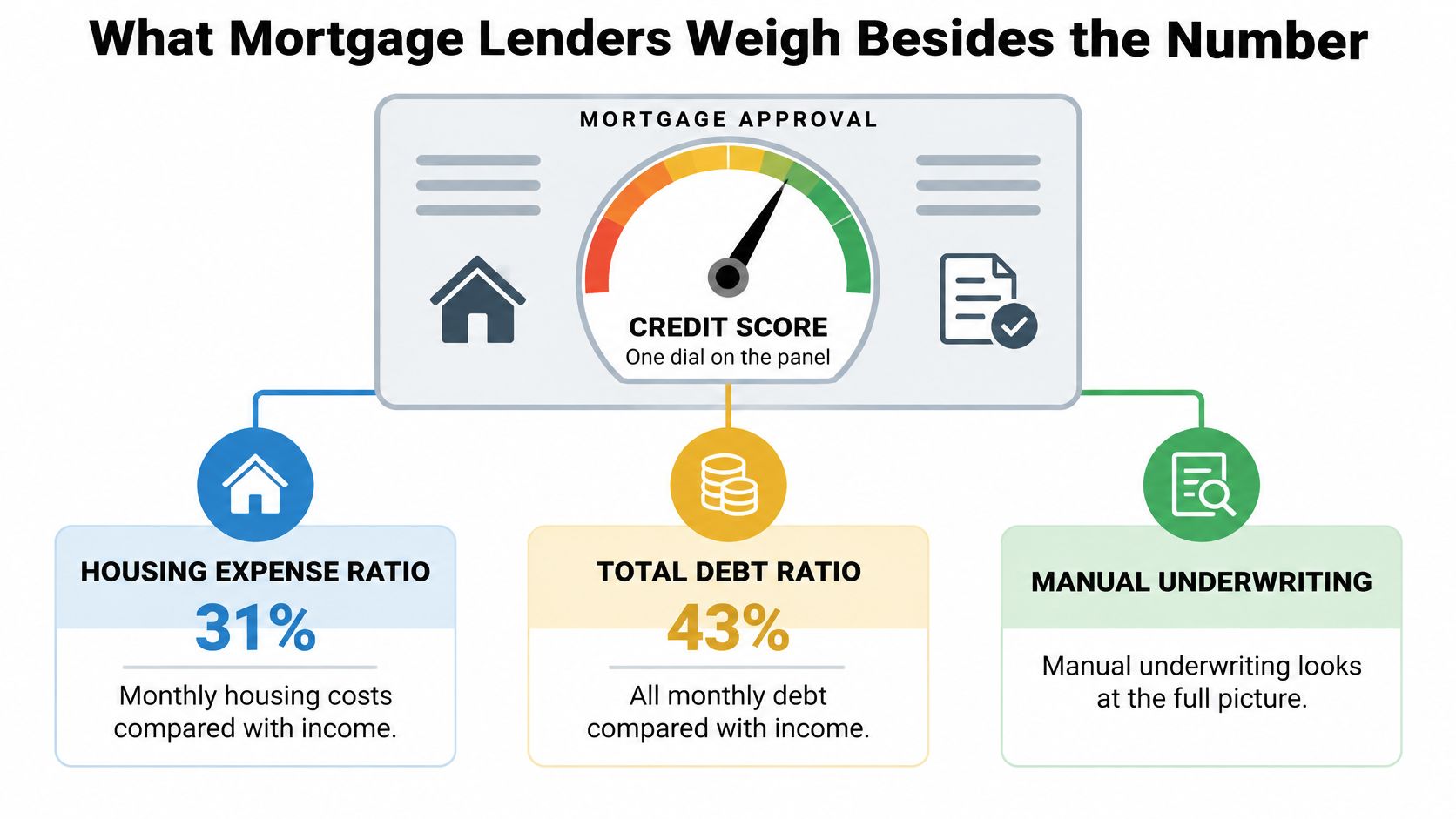
Your score is one dial on a larger panel. A lender can see a score that clears a program minimum and still pause the loan because your debts take too much of your income, your recent payments look unstable, or you have no cash left after closing. The reverse can also happen, a modest score may still move forward when income is steady, debts are low, and reserves are documented.
The 31 Percent and 43 Percent Ratios in Real Dollars
Lenders use debt-to-income ratio, or DTI, to compare your monthly debts with your gross monthly income. Under HUD manual-underwriting guidance, borrowers with scores from 500 to 579 or with no borrower-level credit score are listed at a 31% housing-expense ratio and a 43% total-debt ratio. For borrowers at 580 or higher, those same ratios are available without compensating factors, and higher ratios may be permitted with strengths such as verified cash reserves, residual income, a minimal increase in housing payment, or additional qualifying income.
Picture $6,000 in qualifying monthly gross income. A 31% housing ratio equals about $1,860 for principal, interest, taxes, insurance, and related housing costs. A 43% total-debt ratio equals about $2,580 for housing plus car payments, minimum card payments, student loans, and other recurring debts on the credit report.
That math explains a common disappointment. A buyer at 585 may still be declined if a $650 car payment and large card minimums push total debts over the limit. Paying down revolving balances can help both sides of the file, because it may lower reported utilization and reduce the monthly minimums counted in DTI, although the exact result depends on the account terms.
Compensating Factors Are Proof, Not Excuses
A compensating factor is a documented strength that helps balance a weaker part of the file. Cash reserves mean money left after closing that the lender can verify in bank statements. Residual income means income remaining after housing and recurring debts, which matters especially in VA underwriting and can support other manual reviews.
Stable, documentable income also matters. Lenders want pay stubs, tax records, or other proof that fits your job type, not just a verbal estimate. A small increase from rent to the new house payment can also help, because it suggests the payment shock is manageable.
None of these strengths erase a weak score by themselves. They work as a package, and an individual lender may still require stronger credit than the federal FHA baseline. That's why credit repair for homebuyers should pair score work with debt reduction and paperwork organization.
Why All Three Reports Need a Side by Side Read
The first step is comparing the Experian, Equifax, and TransUnion reports, because the same account may show different balances, statuses, dates, limits, payment months, or collection ownership across the bureaus. A card might show closed on one report and open on another, or a collection might list different owners. Those differences matter because the lender bases its decision on the bureau pattern it pulls, not on the cleanest version you found.
- Balances and limits: Check whether a paid down card still shows an old high balance.
- Dates and statuses: Look for a late payment month that doesn't match your statements.
- Collection ownership: Confirm the same debt isn't listed by two collectors at once.
- Personal information: Review names and addresses for signs of a mixed file.
If you're unsure which score version a lender will use, the Superior Credit Repair mortgage scoring guide explains the mortgage scoring process in plain English. Read all three reports before you rate shop, dispute anything, or assume your app score is the number underwriting will see. A passing score paired with high debts, thin reserves, or a mismatched bureau file can still stall, while a lower score with a clean, well documented file may have a clearer path.
How Credit Problems Change Mortgage Readiness
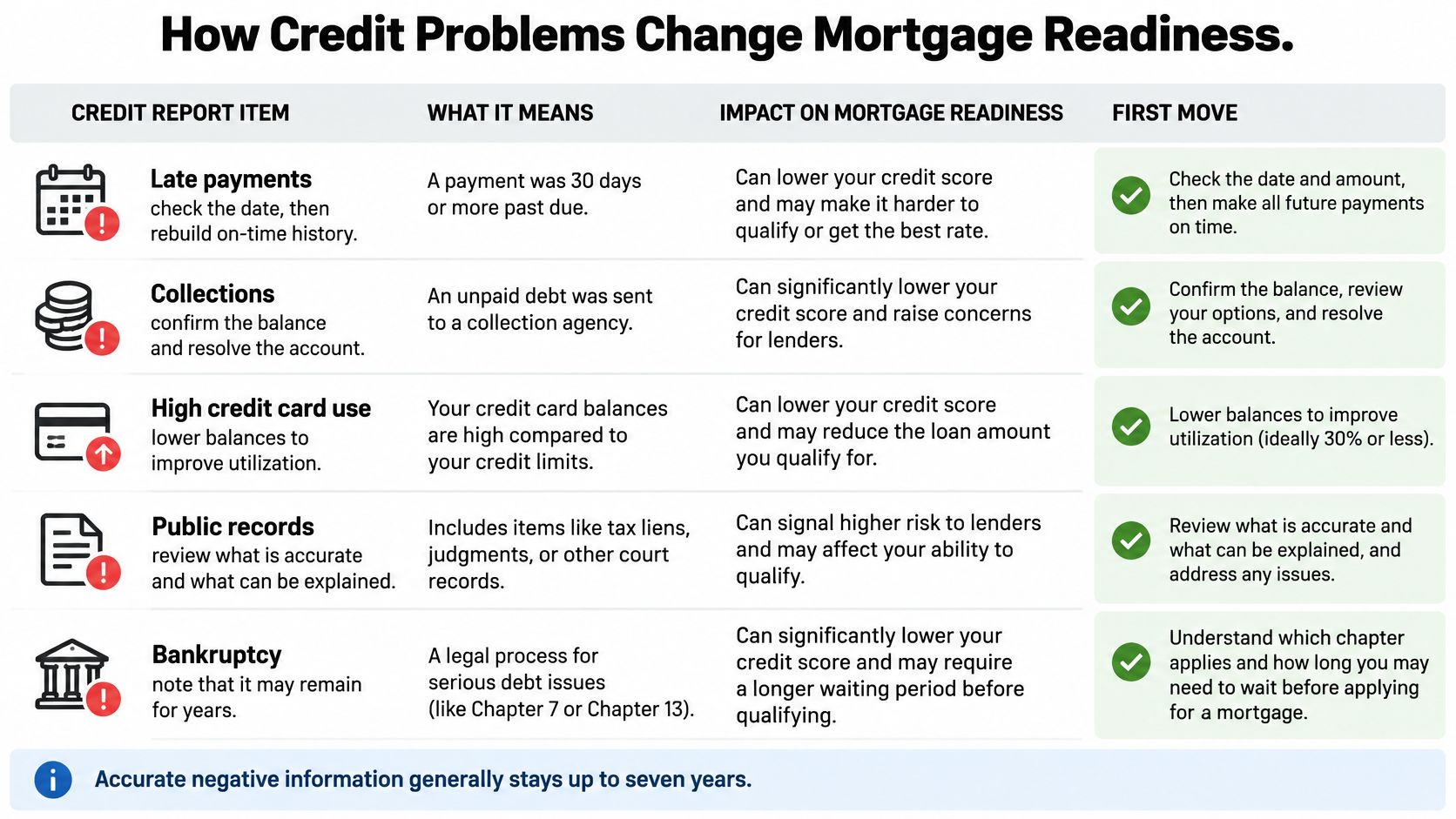
Not every negative item creates the same mortgage problem. A recent late payment, an unpaid collection, and a high card balance may all lower a score, but an underwriter asks different questions about each one. Your job is to sort accuracy problems from accurate history before you choose a next step.
The Federal Trade Commission guidance on disputing credit report errors states that most accurate negative information may be reported for seven years, while bankruptcy information may remain for up to 10 years. For many negative accounts, that seven-year period runs from the date of the event that caused the negative information, and an unpaid judgment may be reportable for seven years or until the applicable statute of limitations expires, whichever is longer.
Credit Issues and What They Mean Before a Mortgage
| Issue | Typical reporting window | How it can affect a mortgage file | First move |
|---|---|---|---|
| Late payment | Up to seven years for accurate negative information | A recent late weighs more than an older one | Keep every open account current; dispute only a wrong date or status |
| Collection | Up to seven years for accurate negative information | Underwriters ask who owns it and whether it is unpaid | Verify balance, owner, and dates across all three bureaus |
| Charge-off | Up to seven years for accurate negative information | Shows the original creditor wrote the debt off | Check for a second listing of the same debt as a collection |
| High utilization | Balance updates each statement cycle | Can suppress the score despite on-time payments | Lower revolving balances before statement dates when cash allows |
| Thin file | Not a negative item | May lack the tradelines a lender wants | Add a small positive history slowly; do not open a stack of new accounts |
| Bankruptcy | Up to 10 years | Seasoning rules differ by chapter and loan program | Confirm discharge dates with the loan officer before applying |
| Medical collection | Up to seven years for accurate negative information | May be weighed differently from other collections | Match the provider bill to the tradeline before a dispute |
Late Payments, Collections, and Charge-Offs Are Not Interchangeable
A late payment shows you missed a due date on an account that may still be open. A 30-day late from last month usually worries an underwriter more than an isolated late from several years ago, because recent behavior suggests current cash flow stress. Late payment dispute help only fits when the date, status, or account ownership is wrong.
A collection means a debt has been placed with a collector or sold to a debt buyer. The underwriter may ask whether it's paid, settled, disputed, or still owed, and whether the balance is large enough to affect the loan. If you want more detail on that piece, read how collections affect mortgage approval before you pay, settle, or dispute anything in a rush.
A charge-off means the original creditor wrote the account off as a loss, but that doesn't always mean the debt disappeared. Watch for duplicates, where the original charge-off and a new collection both report balances for the same debt. Charge-off dispute help starts with matching account numbers, dates, and balances, not with a generic letter.
Utilization, Medical Bills, and Bankruptcy Need Different First Moves
Utilization is how much of your revolving credit limit you're using. You can pay every card on time and still lose points if statements close with balances near the limits. Because issuers usually report around the statement closing date, paying before that date can change the balance the bureaus receive, although it doesn't guarantee a specific score.
Medical collections deserve a paper check first. Match the provider bill, insurance explanation of benefits, and collection notice to the tradeline, because medical collection credit repair often turns on whether the amount was billed correctly or already resolved. Bankruptcy is different again, you'll need the filing and discharge dates, the chapter, and the loan program's seasoning rule. Seasoning means the required waiting period after the event before you're eligible again.
Sorting rule: Mark each item as either factually wrong or accurate but painful. The first group may support a documented dispute, the second group needs time, payment stability, and a lender strategy.
Accurate information can't lawfully be removed because you're applying for a mortgage. A responsible review verifies dates and details, preserves records, and disputes only information with a specific factual or legal basis. That distinction protects you from wasted disputes and helps you rebuild credit profile strength in a way underwriting can see.
A Realistic Timeline to Become Lender Ready
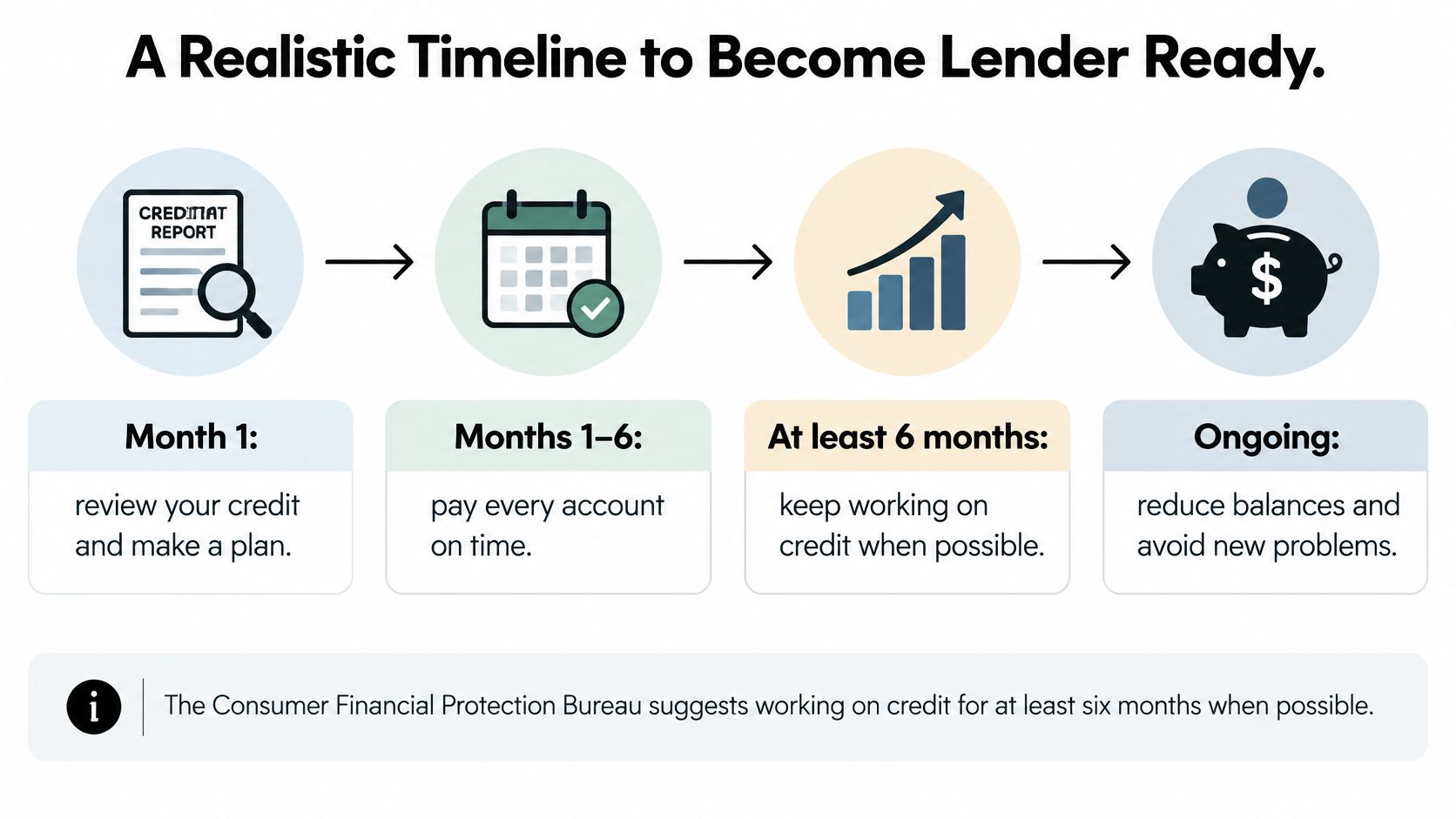
Becoming lender ready is a sequence, not a weekend project. Some changes can appear after one statement cycle, while disputes, on-time history, and bankruptcy seasoning take longer. A realistic plan protects the progress you're making while older issues are reviewed.
The Consumer Financial Protection Bureau homebuying preparation guide advises working on credit for at least six months when possible, paying every account on time, and paying down credit-card debt. It also describes a broad pricing pattern, the lowest rates generally go to borrowers in the mid-to-high 700s or above, borrowers at 680 to 740 typically pay more, borrowers at 620 to 680 face the highest rates and fewest choices, and scores below 620 often create qualification difficulty, although FHA, VA, and USDA programs can expand options.
Seven Moves in the Right Order
- Pull and compare all three reports: Do this before disputing anything, so you can see bureau differences and identify your likely middle score pattern.
- Name the approval goal: Write it in concrete terms, such as FHA review at 580 or higher with total debts kept under the ratio your lender targets.
- Stop new late payments: Put every due date on one calendar, set autopay for at least the minimum where it fits your budget, and call creditors before a due date if a payment problem is coming.
- Lower revolving balances before statement closing dates: Reducing balances before the issuer reports can lower reported utilization, which may help the score used in underwriting.
- Dispute only specific inaccuracies: Gather statements, collection letters, settlement records, and payment proof first, then dispute the exact wrong date, balance, status, or ownership.
- Pause new credit applications: In the months before preapproval, avoid opening cards, financing furniture, or adding buy now, pay later accounts that create inquiries or new minimum payments.
- Recheck after updates cycle through: Confirm that bureaus and furnishers changed the reporting before you ask a lender to pull credit again.
Our blog's guidance is that the first step in a credit file review should be a measured review rather than a rushed dispute. That order matters because a dispute sent without documents can be verified as reported, leaving you with lost time and the same tradeline. Mortgage credit repair works best when the review, the documents, and the rebuilding habits move together.
Realistic Timeline for Each Lender-Readiness Step
| Step | Typical timing | What affects it |
|---|---|---|
| Pull and compare all three reports | Before any dispute is filed | Differences between bureau files and the pattern the lender pulls |
| Reduce revolving balances | Can appear after the next statement closing date | Card issuer's reporting cycle |
| Dispute an inaccurate item | Furnisher generally must respond within 30 days | Completeness of documentation and bureau response cycles |
| Keep every payment on time | At least six months when possible, per CFPB guidance | Consistency of payments across all accounts |
| Pause new credit applications | In the months before preapproval | New inquiries and newly opened accounts |
| Bankruptcy seasoning | Months to years | Chapter type and the specific loan program |
| Recheck reports | After bureau and furnisher updates | Each bureau's and furnisher's own reporting schedule |
Timing depends on the account, documentation, bureau response cycles, furnisher updates, and current credit behavior. A lower card balance may show after the next statement, while credit recovery after negative marks that involve verified disputes or older derogatory accounts usually takes longer. Keep rebuilding documents together, statement dates for utilization planning, a payment calendar, recent inquiry notes, and any lender feedback about credit concerns.
No step guarantees a mortgage, a deletion, or a specific score outcome. What this timeline does give you is control over the parts you own, accurate reports, current accounts, lower reported balances, and a file that tells a stable story when underwriting reads it. That's how you improve credit score readiness without chasing a single number in isolation.
Thin Credit Files and Buyers With Little History
Rent paid on time, current utility bills, and careful debit-card use can all reflect responsible habits. Yet they may leave little traditional credit history for a mortgage lender to review. That is a thin file: too few reported accounts for the usual scoring and underwriting checks.
Thin files are common among renters, younger buyers, immigrants, military families, and people who rely on debit cards or newer financial products. First-time buyers make up a large share of FHA purchase borrowers, and many are moving from renting to owning with limited mortgage history. Responsible payment habits matter, but lenders can assess only the information available to them.

A Score Alone Does Not Create a Mortgage File
VantageScore's overview of its mortgage expansion says VantageScore 4.0 can score 33 million more consumers than FICO, including an estimated 13 million with scores of at least 620. A score can make a buyer visible to a scoring model, but it does not by itself establish mortgage readiness. Lenders also review tradelines, payment history, debt-to-income ratio, documentation, and the underwriting system used for the loan.
For a closer look at how lenders may assess limited traditional history, read Superior Credit Repair no-credit mortgage guidance.
Build Tradelines a Lender Will Actually Count
Before opening an account, ask the loan officer which tradelines the program accepts for a thin file and how long they need to report before preapproval. That answer should guide your next step. An account the lender will not count may add an inquiry without helping your application.
- Secured card used lightly: A small recurring charge, paid in full, can establish a revolving tradeline if the issuer reports it to the bureaus.
- Documented rent or utility history: Keep leases, cancelled checks, bank records, and utility statements. Ask whether the lender accepts these records for your loan program.
- Self-reporting tools: Treat these as optional. Confirm with the lender whether the information can support your application.
- Authorized user accounts: Ask how the underwriting system treats this history, since it may give less weight to accounts you did not manage yourself.
Opening several accounts just before applying can add inquiries, shorten the average age of your accounts, and create new minimum payments that affect your debt-to-income picture. A single account, managed carefully and given time to report on-time payments, may present a clearer record than several new accounts opened at once.
Keep balances low, pay by each due date, and save rent records. Give any new account time to appear on your reports before relying on it in a mortgage application. Its usefulness depends on whether it reports and whether the lender accepts it; the rest of your income and debt picture still matters.
When a Compliance-Based Credit Review Helps
Help becomes useful when you can't tell an error from accurate history, the same debt appears three different ways, or a denial letter names accounts you don't recognize. Credit repair, done properly, is a structured review process, a legal dispute and verification process, and a documentation-based rebuilding plan. It isn't a way to erase true history because a home purchase is close.
How a Documented Dispute Should Work
According to the Consumer Financial Protection Bureau explanation of furnisher dispute results, consumers generally should dispute an error with both the credit reporting company and the furnisher that supplied the information. Furnishers generally must investigate and respond within 30 days after receiving the dispute. If information is wrong or cannot be verified, the furnisher must update or remove it and notify the credit reporting companies, which must then update your reports.
A strong dispute is specific. It identifies the account, states the exact inaccuracy, and attaches proof such as a statement showing a different balance, a settlement letter, a payment confirmation, or a collection notice with a different owner. Vague claims that an account is not yours or should be removed, without documents, are easier for a furnisher to verify as reported.
Collections dispute assistance and credit report error corrections can align with a mortgage timeline. If your file is progressing toward FHA, VA, conventional, or USDA review, mortgage readiness through careful credit preparation means resolving factual issues before underwriting raises detailed questions. Mixed files, re-aged dates, duplicate collections, and tangled medical bills are practical situations to request a second set of eyes.
The Limits Every Buyer Should Hear Plainly
Superior Credit Repair does not control the bureaus, furnishers, or scoring models, so no fee buys a guaranteed deletion or score. Credit repair cannot guarantee approval for a mortgage, auto, or rental review. It can help correct inaccurate information, but it cannot legally erase accurate negative history or guarantee a score increase.
If the information is accurate, it ordinarily should stay, even when it harms a mortgage application. Your plan then shifts to time, on-time payments, lower balances, and choosing the loan program that fits the history you have.
You still own the habits that support the file. Keep accounts current, manage utilization, avoid unnecessary new debt, and save every dispute letter and response in one folder. Results vary based on your credit file, documentation, creditor responses, account history, and current credit behavior, and a compliance-based review should tell you that before any work begins.
Frequently Asked Questions Before You Apply
Can I Buy a Home With a 620 Score
Sometimes, yes. A 620 middle score may fit some FHA, VA, USDA, or conventional paths, but the lender still checks debt-to-income ratio, reserves, down payment funds, and recent payment history. A conventional file near 620 often has fewer choices and higher pricing than a stronger file, so compare the cost of applying now with the benefit of improving the file first.
Will Paying a Collection Remove It From My Report
Payment may resolve the debt and change the status, but an accurate collection generally remains until its reporting period ends unless the listing itself contains an error. Before paying, confirm the current owner, balance, and date, and keep written proof of any settlement or payment. If the balance, ownership, or dates are wrong, that factual problem may support a documented dispute.
How Fast Can My File Change
It depends on the item. A lower credit card balance can appear after the next statement closing date if the issuer reports it then. A documented dispute generally follows the furnisher response process, while bankruptcy seasoning and rebuilding on-time history can take months or years. Anyone promising a specific score jump by a specific date isn't describing a compliance-based process.
Should I Apply Now or Wait
If your middle score sits below the loan row you want, a recent late payment is unexplained, or your debts leave little room under the lender's ratio limits, stabilizing the file first is usually the calmer choice. If your score fits the program, your income is documented, and your reports are accurate, a lender conversation can show you real numbers. Superior Credit Repair offers mortgage and homebuyer credit help, including a First-Time Homebuyer Credit Repair Playbook, and offers a free credit review request if you want help sorting the file first.
For a first conversation, bring your three current credit reports, photo identification, current address information, recent statements for accounts to be reviewed, collection notices, payment confirmations, and any denial or adverse-action notice tied to the application that prompted your search. Superior Credit Repair can review your credit report, help identify inaccurate or questionable items, and explain a step-by-step plan for improving your credit profile. You can request a free credit analysis or consultation to better understand your options.
Superior Credit Repair Online provides educational credit guidance for individuals and families preparing for major financial goals like buying a home, applying for a mortgage, refinancing, or rebuilding after credit challenges. If this information helped you better understand your credit report or your next steps, we would appreciate your honest feedback. You are welcome to share your experience with Superior Credit Repair on our Google Business Profile. https://share.google/ePRpFvtCXwCjiJwOK
If you're preparing for an FHA, VA, USDA, or conventional mortgage and want a clear read on your three reports before a lender pulls them, we can help you identify inaccurate or questionable items, organize your documents, and map a realistic lender-readiness plan. Results vary by file, documentation, creditor responses, and current behavior, and we won't promise approval or a specific score. Visit Superior Credit Repair to request a free credit analysis and talk through your next step toward your first home.