


An inquiry is a record that a person or company asked to access your credit file for a legally permitted purpose, most often when you apply for credit. It logs that request. It is not a verdict that you mishandled a bill.
Say you opened your reports last night because a lender asked for them before a home loan. One line shows a company you do not remember, dated a few weeks ago. That pause is common, and it does not mean the file is ruined. What is an inquiry on a credit report becomes clearer once you treat the line as something to verify. You match the name and the date to a real application, or you set it aside for a closer look if the match fails. Outcomes still depend on your file, the papers you keep, and how each company responds.
Table of Contents
- What an Inquiry on a Credit Report Actually Records
- Hard and Soft Inquiries Compared by Trigger and Score Impact
- Where Inquiries Appear and How Long They Stay
- How to Check Whether an Inquiry Is Yours
- How to Dispute an Unauthorized Inquiry
- Inquiries in Mortgage Shopping, BNPL, and Credit Repair
- Decide What to Do Before Your Next Application
- Frequently Asked Questions About Credit Inquiries
What an Inquiry on a Credit Report Actually Records
Think of a hotel guest register. The book does not say a visitor caused a problem. It only shows who came in and when. A credit inquiry works the same way. It is a log entry, not an account, a late payment, a collection, or a judgment, so the line itself does not show that you did anything wrong.
The Consumer Financial Protection Bureau describes a credit inquiry as a request to see a person's credit report or score for a legally permitted purpose. Those purposes include evaluating an application for a mortgage, a credit card, an auto loan, insurance, housing, or employment. On the report, the entry typically names the requesting company, the date, and the type of inquiry.

Two families sit under that log. A hard inquiry generally follows an application for new credit, and scoring models may weigh how recently and how often you sought credit. A soft inquiry can happen when you check your own reports, when a current lender reviews an account, or when a company prescreens you for an offer. Soft inquiries do not affect credit scores, and businesses buying the report generally do not see them. The next section sets those differences side by side.
Not every inquiry changes a score. Checking your own file before you apply is not, by itself, damaging. What can add hard inquiries is submitting separate credit applications.
Practical rule: An entry you do not recognize can be an early sign of an application made in your name. Read the inquiry list on each of the three bureau reports before you apply for any loan, and confirm that every hard inquiry ties to an application or another purpose allowed under the Fair Credit Reporting Act.
Hard and Soft Inquiries Compared by Trigger and Score Impact
A hard inquiry is a formal review of an application, the way an underwriter reads a file before a loan decision. A soft inquiry is a look that no new-credit decision rests on, closer to opening your own mail.
What starts each kind of check
Hard inquiries show up when you apply for a credit card, an auto loan, or a mortgage, and sometimes when you ask for a higher credit limit. Scoring models look at how recently and how often you have applied, so several applications close together can look like higher risk to a lender. That is a signal about new credit seeking, not a finding that a payment was late. How payment history affects credit scores is a separate part of the score, and an inquiry does not rewrite that history.
Soft inquiries cover three everyday events. You pull your own report. An existing lender reviews an account it already has. A company prescreens you for an offer you did not request. None of those is the same as applying for a new loan.
Equifax draws the line this way. A hard inquiry is made when a lender evaluates an application for new credit and can influence scores. A soft inquiry, such as a personal file check, promotional prescreening, or an existing creditor's account review, does not. Checking your own report, or receiving a prescreened offer, is not the same as applying. A hard inquiry also leaves a dated trail of when credit was sought, so an entry you cannot explain can be a practical warning of an unauthorized application or identity theft.
| Feature | Hard inquiry | Soft inquiry |
|---|---|---|
| What triggers it | Applying for new credit, such as a mortgage, credit card, or auto loan | Checking your own report, an existing lender reviewing your account, or a prescreened offer |
| Affects credit score | Can affect scores, usually a small and temporary effect | Does not affect scores |
| Visible to businesses | Yes, lenders reviewing your file can see it | Generally no, not shown to businesses that receive your report |
| Visible to you | Yes, listed on your report | Yes, may appear on your personal disclosure |
| Typical trigger for a check | Formal application you submitted | Routine review, self-check, or prescreening you may not have requested |
Before you submit anything, ask the lender whether it will perform a hard pull. Prequalification methods differ from one lender to another, and some applications trigger a hard inquiry while others do not.
Where Inquiries Appear and How Long They Stay
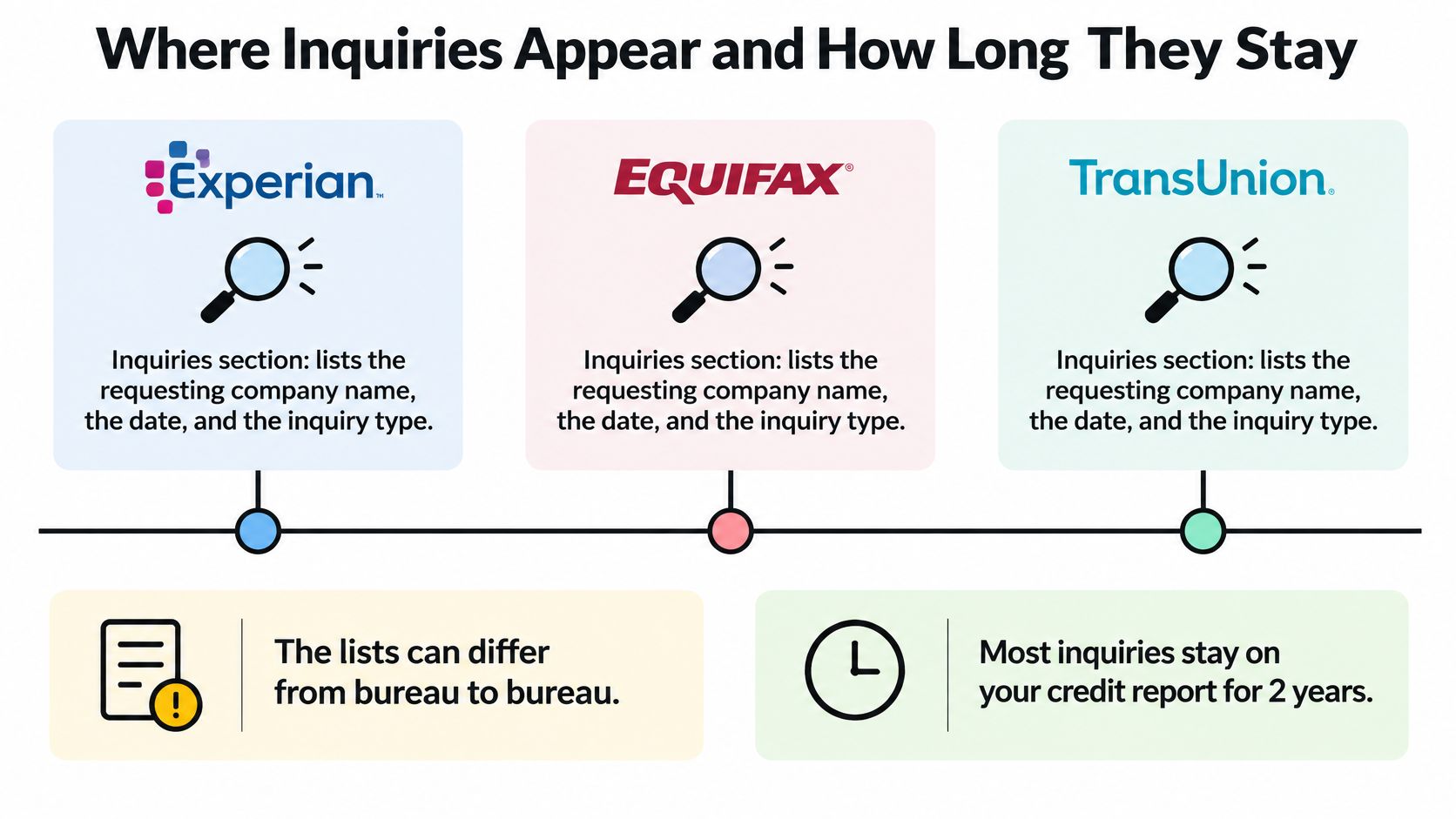
Inquiries live in the inquiries section of each national bureau report. Each line lists the requesting company, the date, and the inquiry type. The three lists often do not match, because a lender may report to one bureau and skip the others. Read Experian, Equifax, and TransUnion rather than stopping at a single file.
Two clocks, not one
A hard inquiry is recorded on the day of the application. FICO states that new credit represents 10% of a FICO Score, and that a single additional hard inquiry typically lowers the score by fewer than 5 points for many people, though the exact effect varies by credit profile. The same explanation sets two timelines. Hard inquiries can remain listed for as long as 24 months, while FICO Scores generally consider them for only 12 months. A lender may still see the line during the two-year reporting period after the direct scoring effect has ended. Soft inquiries are not scored at any age. Our Superior Credit Repair hard inquiry guide walks through that listing period in more detail for people preparing a file.
| Record or model | Typical duration | What it means for you |
|---|---|---|
| Credit report listing for a hard inquiry | Up to 24 months | Lenders may still see the inquiry during this period |
| FICO Score consideration for a hard inquiry | About 12 months | The direct scoring effect normally ends after one year |
| Soft inquiry | No scoring period | Not scored, so it does not affect the score at any age |
Mortgage, auto, and student-loan rate shopping can be grouped inside a shopping period in many models, so comparing lenders is not the same as opening several unrelated accounts. Ask whether a given prequalification uses a hard pull before you authorize it.
Try this with a calendar and keep it with your other mortgage-preparation records.
- Write down the date of each hard inquiry.
- Count 12 months forward to mark when the scoring effect normally ends.
- Count 24 months forward to mark when the listing drops off.
- Store that calendar with your loan notes so you are not guessing later.
How to Check Whether an Inquiry Is Yours
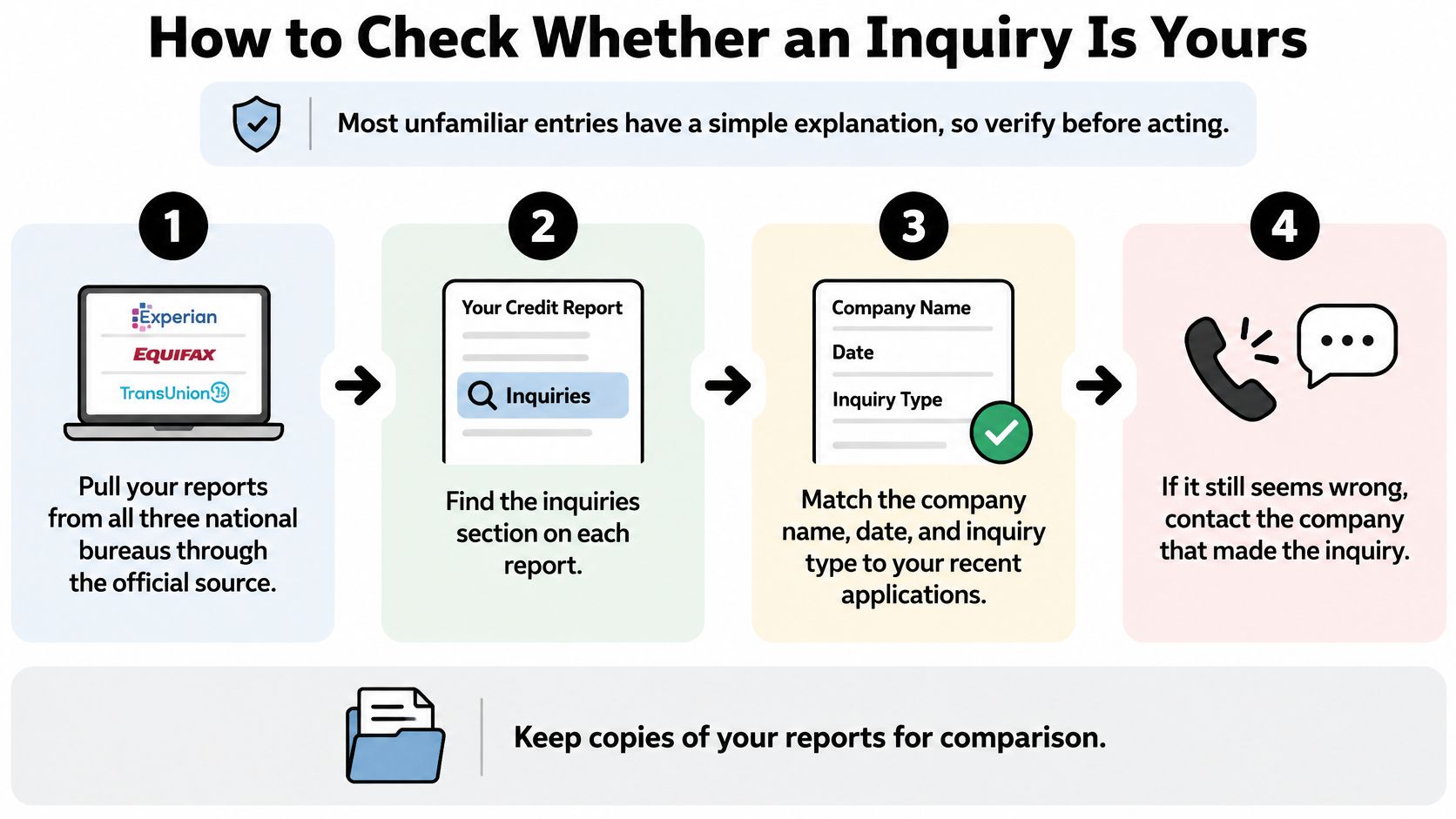
Most unfamiliar entries have a simple explanation, so verify before you act. A renamed lender, a dealership's finance desk, or an apartment screening can look like a stranger on the page.
Match the line before you challenge it
- Pull your reports from all three national bureaus through the official free-report channel, so you are not working from one lender's snapshot.
- Copy each inquiry into a list with the company name, the date, and the inquiry type. A written list is easier to compare than three screens.
- Match each hard inquiry to an application you remember, such as a car dealership, a credit card, an apartment, a phone carrier, or a utility deposit.
- Compare those dates with your own calendar, including recent rental, loan, and buy-now-pay-later applications. Some of those checks never become hard inquiries, which is why a missing match is not automatic proof of a problem.
- Mark any entry you cannot match. Ask whether the name is a brand you do not know, a renamed version of a known lender, or a debt buyer.
- Contact the company using a phone number or address from its own website or from your statements, not from the report alone. Ask which application the inquiry relates to and what permissible purpose it used.
- Save the list, the company's reply, and your notes with dates. That packet is what a later dispute needs.
Under the Fair Credit Reporting Act, every hard inquiry should connect to an application you made or to another permissible purpose. If the company cannot make that connection, you have grounds to dispute. If you did authorize it, leave it. A recognized inquiry is not a problem to remove, and challenging an accurate line wastes time you could spend on items that are wrong.
Keep the three reports side by side. A name that appears on only one bureau is often a lender that does not report everywhere, not a second application.
How to Dispute an Unauthorized Inquiry
Treat the dispute as a sequence, not a single letter. You escalate only after the company has had a chance to show its paperwork.
Gather, ask, then dispute
Start with the file. Collect the report page that shows the inquiry, your identification, any written reply from the company, and a short note of the dates that matter. Without those pages, a bureau has little to investigate.
Write the company first. Ask the business that requested the inquiry for documentation of the application and the permissible purpose. A clear reply either explains a legitimate check or shows that the company cannot tie the pull to you.
Dispute with each bureau that lists it. If the company cannot confirm the inquiry, use that bureau's online form, mail, or phone process. Identify the inquiry by company and date, state that you did not authorize it, and attach copies, not originals. If you want a starting structure, letter writing help for first-time homebuyers shows how to keep the facts plain.
Treat identity theft as its own track. If the inquiry looks tied to someone using your identity, file a report with the Federal Trade Commission, file a police report where you can, and ask about a fraud alert or a security freeze. Do that alongside the bureau dispute, not instead of it.
Track the clock. Note the date each dispute was sent. Many credit bureau investigations operate within standard 30-day periods, and responses may extend depending on bureau volume and creditor response times. When the bureau answers, read the updated report, confirm the inquiry was removed or corrected, and keep the result. If the response is unsatisfactory, a complaint with the CFPB or your state regulator is a reasonable next step.
No company can legally remove accurate, current, or verifiable information, and results vary by consumer file and by bureau or creditor responses. A dispute is a verification process. It is not a promise that a line will disappear.
Inquiries in Mortgage Shopping, BNPL, and Credit Repair
The same log entry means something different for a homebuyer, a buy-now-pay-later shopper, and someone cleaning up a file. Read it against the situation, not as a single rule.
Homebuyers and the shopping window
People often hear that several mortgage checks count as one inquiry. FICO's explanation of how long hard inquiries stay shows why that shortcut fails. Newer FICO models generally group mortgage, auto, and student-loan inquiries made within a 45-day window as one inquiry. Older FICO models use a 14-day window, and VantageScore commonly uses 14 days. Some mortgage lenders still use older FICO versions, so waiting several weeks between applications can create more inquiry risk than you expect. A mortgage and a credit card in the same month are not combined. Asking about rates should not require a credit pull, while mortgage preapproval generally involves a hard inquiry, and a lender may check again shortly before closing.
| Scoring model | Grouping window for mortgage inquiries | Notes |
|---|---|---|
| Newer FICO Score versions | 45 days | Groups mortgage, auto, and student-loan inquiries made within the window |
| Older FICO Score versions | 14 days | Some mortgage lenders may still use these versions |
| VantageScore | 14 days | Commonly used window for grouping |
| Credit card applications | Not grouped under rate-shopping treatment | Each card application is generally scored separately |
Compare lenders inside one short stretch. Confirm a hard pull before preapproval. Skip unrelated cards, store financing, and vehicle loans while an FHA, VA, USDA, or conventional file is in progress. Shopping can still be worthwhile, because a better loan offer often matters more than one extra inquiry. That is a judgment about your offers, not a guaranteed score result.
Buy now, pay later
BNPL underwriting generally involves a soft inquiry, so the first eligibility check typically does not lower a conventional score. The account can still matter through unpaid balances, later collection activity, bank cash-flow patterns, or a lender's look at monthly obligations. A Federal Reserve survey, discussed in the CFPB's BNPL report, found that 38% of respondents believed BNPL use would help build a credit history, while another 40% were unsure, even though those purchases and on-time payments generally were not affecting histories or scores at the three major bureaus at the time of the survey. Ask three questions, and read how BNPL reporting affects mortgage readiness before you assume the account is invisible. Was the check hard or soft? Is the account reported to a bureau? Could the payment show up in underwriting documents or bank statements?
Credit repair decisions
Review inquiries before you file any dispute. A legitimate inquiry is not a dispute target. An unauthorized one is. A measured review, rather than a rushed stack of letters, keeps the file steadier while you examine older collections, late payments, or charge-offs. If an unfamiliar application used your photo or name in a way that looks fabricated, reading about using someone's likeness can help you see when identity misuse goes beyond a simple misreported pull. Outcomes still depend on the individual file.
Decide What to Do Before Your Next Application
You already have a list. The next move is a set of decisions, not another round of copying names.
- Mark each inquiry as authorized, unknown, or questionable.
- Dispute only the unknown or questionable lines you cannot tie to a real application. Leave recognized inquiries alone.
- Pause new credit, including cards, store financing, and vehicle loans, while a home loan is being prepared.
- Plan any mortgage rate shopping inside one short window, and ask which score model each lender uses.
- Ask each lender whether it will perform a hard pull before preapproval.
Superior Credit Repair can review your credit report, help identify inaccurate or questionable items, and explain a step-by-step plan for improving your credit profile. You can request a free credit analysis or consultation to better understand your options. The free consultation includes a review of your credit reports, confirmation of negative accounts, inquiries, and questionable items, then an explanation of pricing and next steps. For that first conversation, bring the three current credit reports, photo identification, current address information, recent statements, collection notices, payment confirmations, and any denial or adverse-action notice, meaning the letter that explains a denial, tied to the application that prompted the search.
Results vary based on your credit file, documentation, creditor responses, account history, and current credit behavior. You remain responsible for decisions about applying for housing or financing.
Frequently Asked Questions About Credit Inquiries
Does checking my own credit report hurt my score?
No. A self-check is a soft inquiry, and soft inquiries are not scored. Pulling your reports before a mortgage application is a sensible habit, not a penalty.
How long does a hard inquiry affect my score?
FICO Scores generally consider a hard inquiry for about 12 months. The line can remain listed on the report for up to 24 months, so a lender may still see it after the score has stopped counting it. The size of any change depends on the rest of the file.
Is a buy-now-pay-later check a hard inquiry?
The initial eligibility check generally involves a soft inquiry. Unpaid balances, collection activity, or payments that show up in bank statements can still matter in a lender's broader review, including FHA, VA, USDA, and conventional underwriting.
Can I dispute an inquiry I authorized?
No. Disputes are for unauthorized or unverifiable entries. An inquiry you approved, even one you forgot, is not a removal target. Results of any dispute vary by credit file, documentation, and creditor responses.
If this information helped you better understand your credit report or your next steps, we would appreciate your honest feedback. You are welcome to share your experience with Superior Credit Repair on our Google Business Profile. https://share.google/ePRpFvtCXwCjiJwOK
If you are preparing for a home, auto, or personal loan and an inquiry on your report still does not make sense, Superior Credit Repair can walk through the file with you, separate authorized checks from questionable ones, and outline a documentation-based plan. You can request a free credit analysis or consultation and bring your three current reports so the conversation starts from what is reporting. You decide when to apply, and results vary with your file and with how creditors respond.