

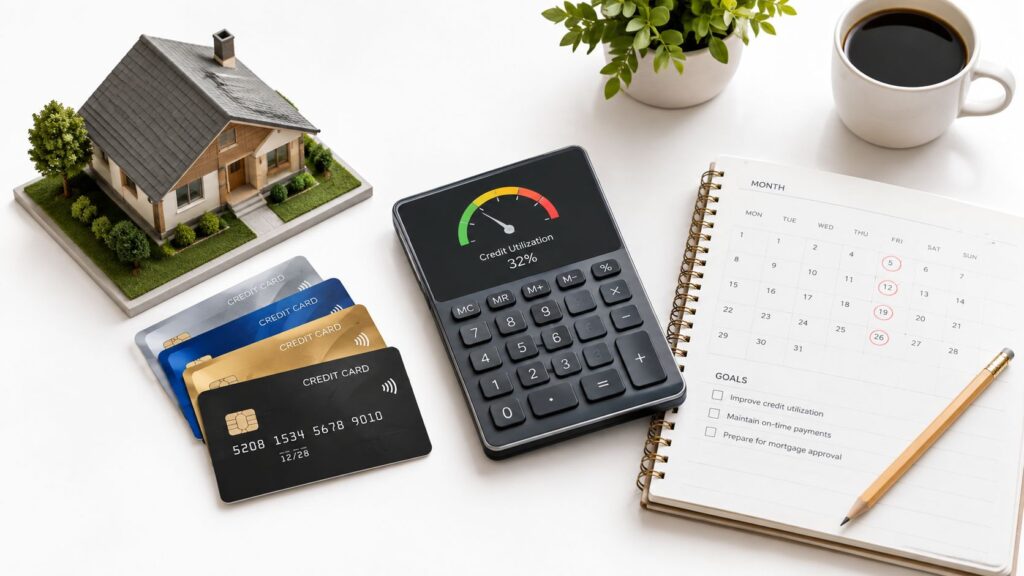
Credit utilization for mortgage approval is reviewed both per card and in aggregate, and mortgage lenders weigh it alongside payment history, reserves, and debt-to-income rather than against any single cutoff. A 30% utilization level can be a useful planning benchmark, but it isn't a universal approval rule.
You may be preparing for a first mortgage while watching every account closely. Perhaps your balances are paid on time, yet one card is carrying a large balance after an unexpected expense. Or your overall card usage looks manageable, but a single account is close to its limit. These situations can affect how your credit profile appears when a lender reviews it.
The practical question isn't, “Am I under 30%?” A sound mortgage preparation plan considers reported balances, individual card utilization, total revolving debt, payment history, debt-to-income ratio, reserves, account age, recent applications, and other obligations. The aim is a stable, accurate, lender-ready credit profile, not a temporary number created just before an application.
Table of Contents
- Why Credit Utilization Matters Before You Apply for a Mortgage
- How Credit Utilization Is Calculated Per Card and in Aggregate
- How Mortgage Underwriters Review Utilization on FHA VA and Conventional Loans
- Beyond the 30 Percent Rule What Lenders Actually Look At
- Statement Timing Reporting Cycles and the Lender Credit Pull
- BNPL Fintech Loans and the Utilization You Cannot Always See
- A 90 Day Plan to Improve Credit Utilization Before Applying
- Lender Readiness Checklist and When to Ask for Credit Help
Why Credit Utilization Matters Before You Apply for a Mortgage
A borrower preparing for preapproval often focuses first on income and down payment. Those items matter, but revolving balances deserve attention early because utilization connects your credit score with the lender's broader risk review.
Credit utilization measures revolving-account balances against available credit limits. A $2,700 balance on a $9,000 card represents 30% utilization. The amount owed category, which includes utilization, represents approximately 30% of a traditional FICO Score, while payment history represents 35%, according to Experian's consumer credit review. That doesn't make utilization more important than every other part of your file. It does mean that balance management is a foundational part of mortgage preparation.
Why an early plan is better than a last-minute payment
Paying down a balance can help the percentage that appears on a credit report, but timing and documentation matter. A card issuer may report an earlier statement balance rather than the amount remaining after the payment due date. A borrower who waits until the final days before a lender's credit pull may discover that the lower balance hasn't appeared yet.
Mortgage underwriting also considers income, debt-to-income ratio, reserves, payment history, account history, recent credit activity, and the overall credit file. The credit score guide for mortgage applicants can help first-time buyers understand how scores fit into the larger borrowing picture, while the Superior Credit Repair mortgage guide provides additional context about lender review.
Practical rule: Treat utilization as a planning item months before preapproval, not as a payment to make after the lender has already pulled your credit.
Keeping low reported balances consistently is more useful than creating a short-lived improvement. Avoiding new debt also matters because a new balance can affect utilization, monthly obligations, and the lender's assessment of your financial stability. Results vary with each person's credit file, creditor reporting, documentation, and current credit behavior.
How Credit Utilization Is Calculated Per Card and in Aggregate
The calculation is simple, but mortgage preparation becomes clearer when you perform it at two levels.
For each card, divide the reported balance by the card's credit limit, then multiply by 100. A $2,700 balance divided by a $9,000 limit equals 30%. A $1,500 balance divided by a $3,000 limit equals 50%.
Then calculate the aggregate ratio by adding the balances on all revolving accounts and dividing that total by the combined credit limits. This overall figure shows how much of your available revolving credit is being used across the portfolio.
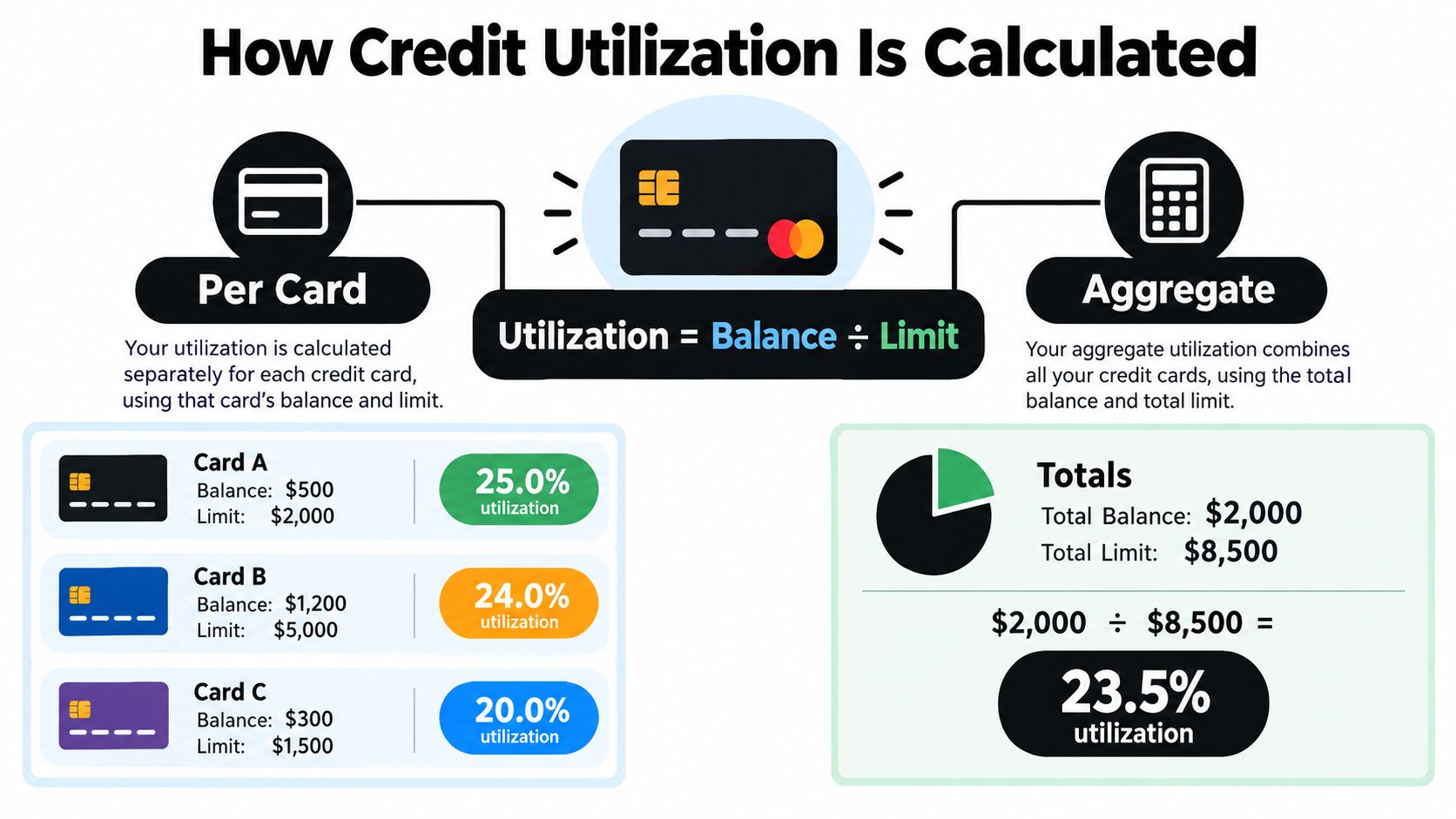
Per-card and overall examples
| Card | Balance | Credit Limit | Per-Card Utilization | Overall Utilization |
|---|---|---|---|---|
| Card A | $500 | $2,000 | 25% | 23.5% |
| Card B | $1,200 | $5,000 | 24% | 23.5% |
| Card C | $300 | $1,500 | 20% | 23.5% |
| Total | $2,000 | $8,500 | Varies by card | 23.5% |
The table demonstrates why a low aggregate percentage doesn't tell the entire story. One card can be heavily used even when the combined ratio looks reasonable. A lender may notice that concentration, particularly when the account is recently opened or repeatedly approaches its limit.
The commonly used 30% benchmark is a practical planning guideline, not a universal mortgage cutoff. Lower reported ratios are generally more favorable, but a specific percentage can't guarantee a score, interest rate, or approval. Bookkeeping and Accounting of Florida Inc.'s credit card statement reconciliation resource offers useful background on comparing statement balances and records.
For a buyer deciding how low should credit utilization be, the better question is whether each card and the overall portfolio are being managed consistently. Prioritize accounts that are closest to their limits, confirm that the limits reported by each bureau are accurate, and don't charge balances back up before the reporting date.
How Mortgage Underwriters Review Utilization on FHA VA and Conventional Loans
Mortgage programs differ in eligibility and underwriting systems, but none should be treated as a reason to ignore revolving-credit behavior. Utilization is part of the evidence lenders use to understand how an applicant manages available credit.
For conventional loans, Fannie Mae identifies low balance-to-limit ratios as generally lower risk and high ratios as generally higher risk. Recently opened accounts that are near their limits can raise additional concern because they may indicate overextension or dependence on revolving debt. The lender also considers whether the borrower has a history of late payments or other signs of weak credit management. Fannie Mae's credit utilization guidance explains why account-level patterns matter.
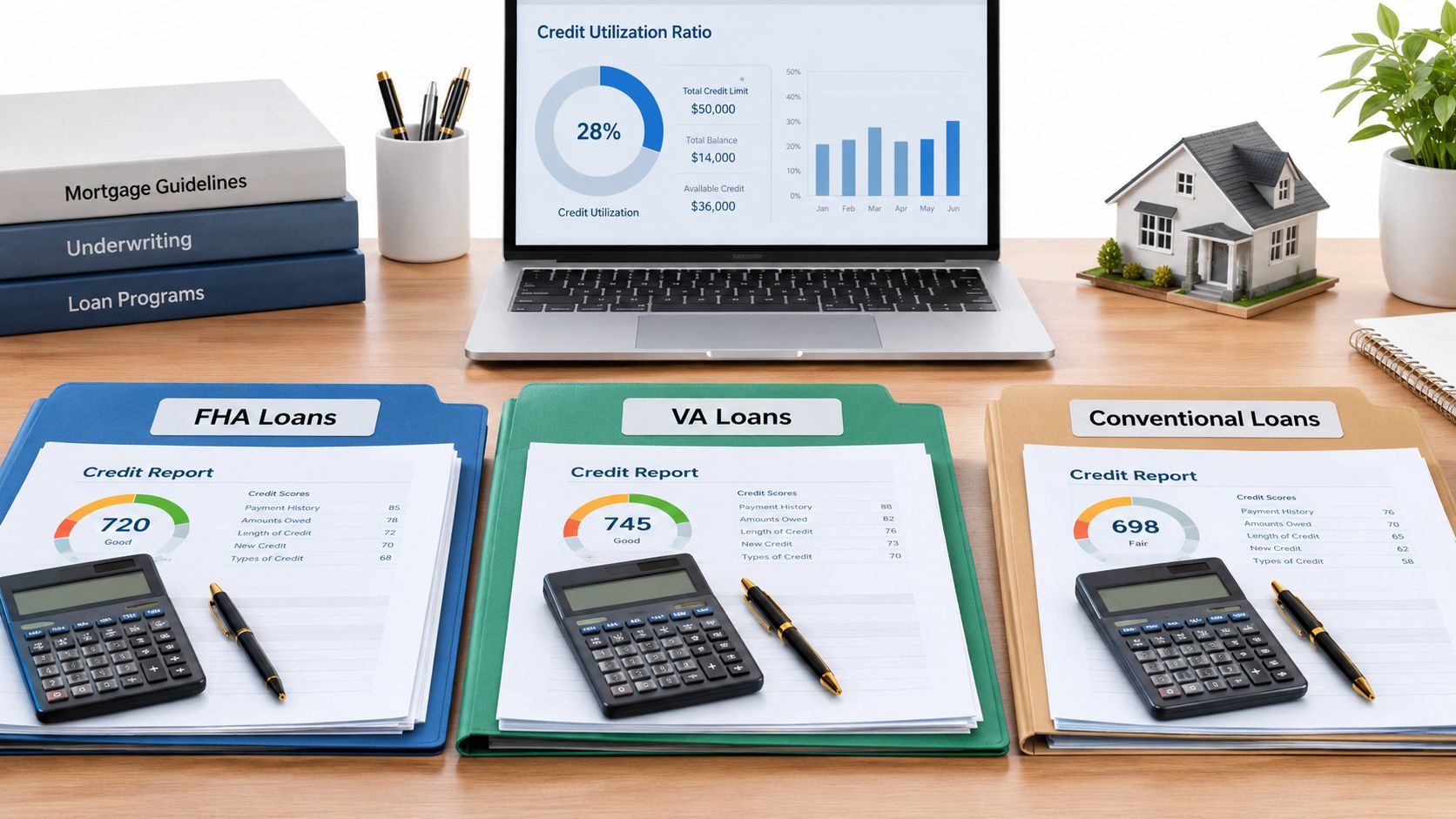
What this means for different loan programs
Conventional mortgage preparation usually requires attention to the full credit profile, including utilization, payment history, recent accounts, and debt obligations. A low overall ratio may not offset a nearly maxed-out card or a pattern of borrowing close to limits.
FHA loan preparation also involves reviewing credit history and repayment capacity. Utilization can influence the score used in the file and may signal how the applicant manages revolving debt, but FHA approval isn't determined by one utilization percentage.
VA loan preparation likewise requires a complete view of credit behavior, income, obligations, and repayment ability. Veterans should avoid assuming that a program's flexibility makes balance management irrelevant.
The same reasoning applies to USDA financing. A lender evaluates the interaction among utilization, account age, payment history, recent credit activity, and total debt rather than reading one number in isolation.
A card at a high balance can tell a different story from three cards carrying modest, stable balances, even when the combined percentage looks similar.
A mortgage lender may also apply requirements that are more conservative than general agency guidance. Before moving balances, closing accounts, or applying for new credit, discuss the proposed change with the loan professional handling your file.
Beyond the 30 Percent Rule What Lenders Actually Look At
The 30% guideline is useful because it gives borrowers a concrete target. It becomes misleading when treated as a guarantee. A person at 29% utilization can still have excessive monthly obligations, insufficient reserves, inaccurate reporting, or serious payment-history problems.
Debt-to-income ratio illustrates the difference between score optimization and underwriting capacity. Fannie Mae guidance allows up to 50% DTI for loans underwritten through Desktop Underwriter. Manually underwritten loans generally have a 36% maximum, with the possibility of reaching 45% when credit-score and reserve requirements are met, as described in Fannie Mae's debt-to-income guidance.
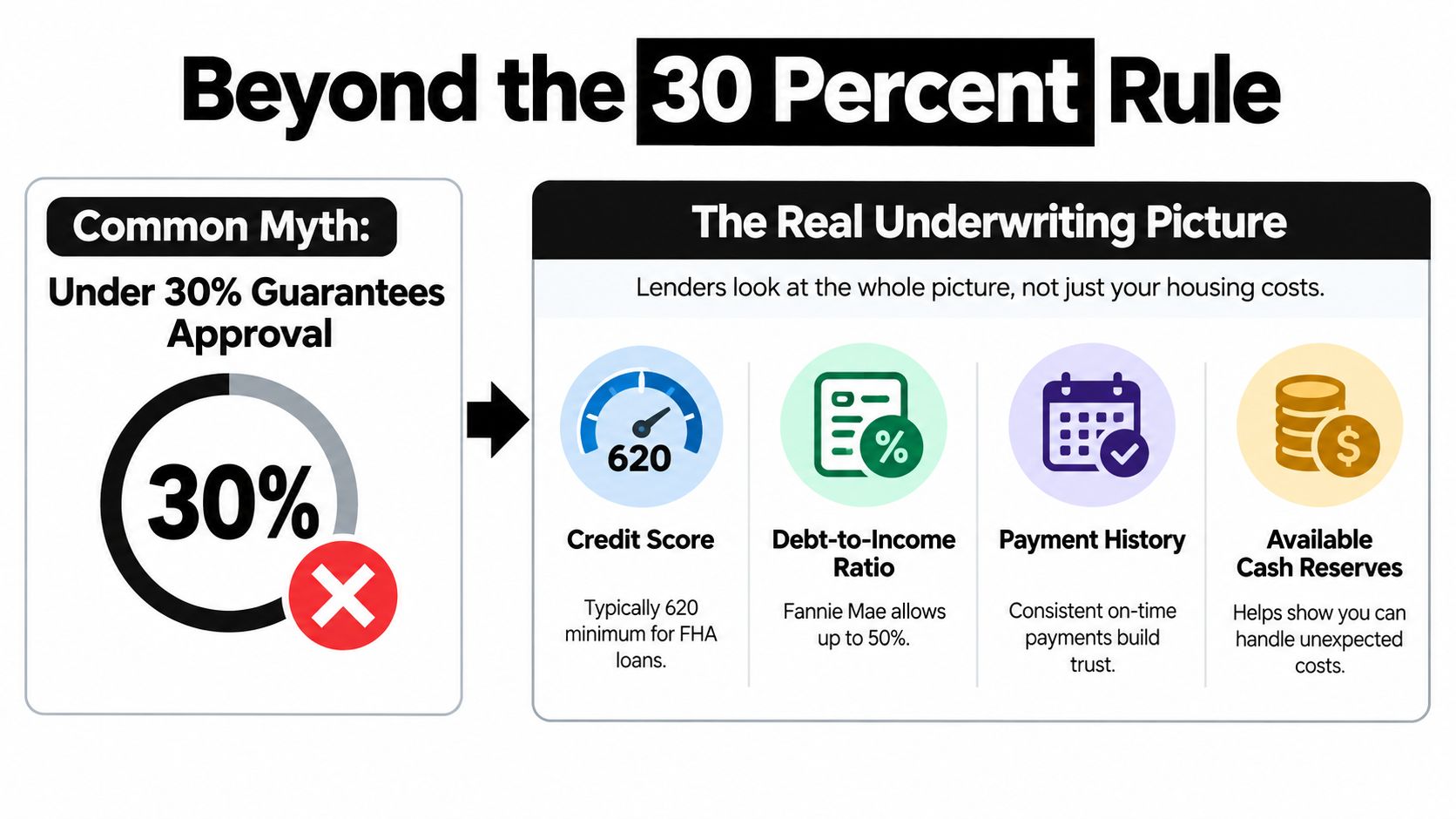
A lower ratio doesn't solve every problem
Suppose a borrower reduces a card from 60% utilization to 29%. The lower reported balance may support a better score profile, but the card's minimum payment may still contribute to a DTI that is too high for the lender's assessment. The borrower may also have collections, late payments, limited reserves, or income documentation issues.
The opposite can also be true. A borrower slightly above 30% may still qualify if payment history, income, reserves, debt obligations, and the rest of the credit file are strong. That outcome isn't a reason to ignore utilization. It shows why the number should be treated as one part of a complete application.
What lenders combine
Mortgage underwriting commonly brings together:
- Payment history: Recent or repeated late payments can weaken the file even when balances are low.
- Reserves: Available savings can help demonstrate the ability to handle ownership costs and unexpected expenses.
- Debt-to-income: Card payments and other debts affect the monthly obligation calculation.
- Account behavior: A card repeatedly near its limit may raise concern beyond the aggregate ratio.
- Credit accuracy: Incorrect limits or balances can distort both utilization and the lender's review.
Use the 30% benchmark as a planning reference, then ask what the lender needs to see in the full file. No utilization percentage guarantees mortgage approval.
Statement Timing Reporting Cycles and the Lender Credit Pull
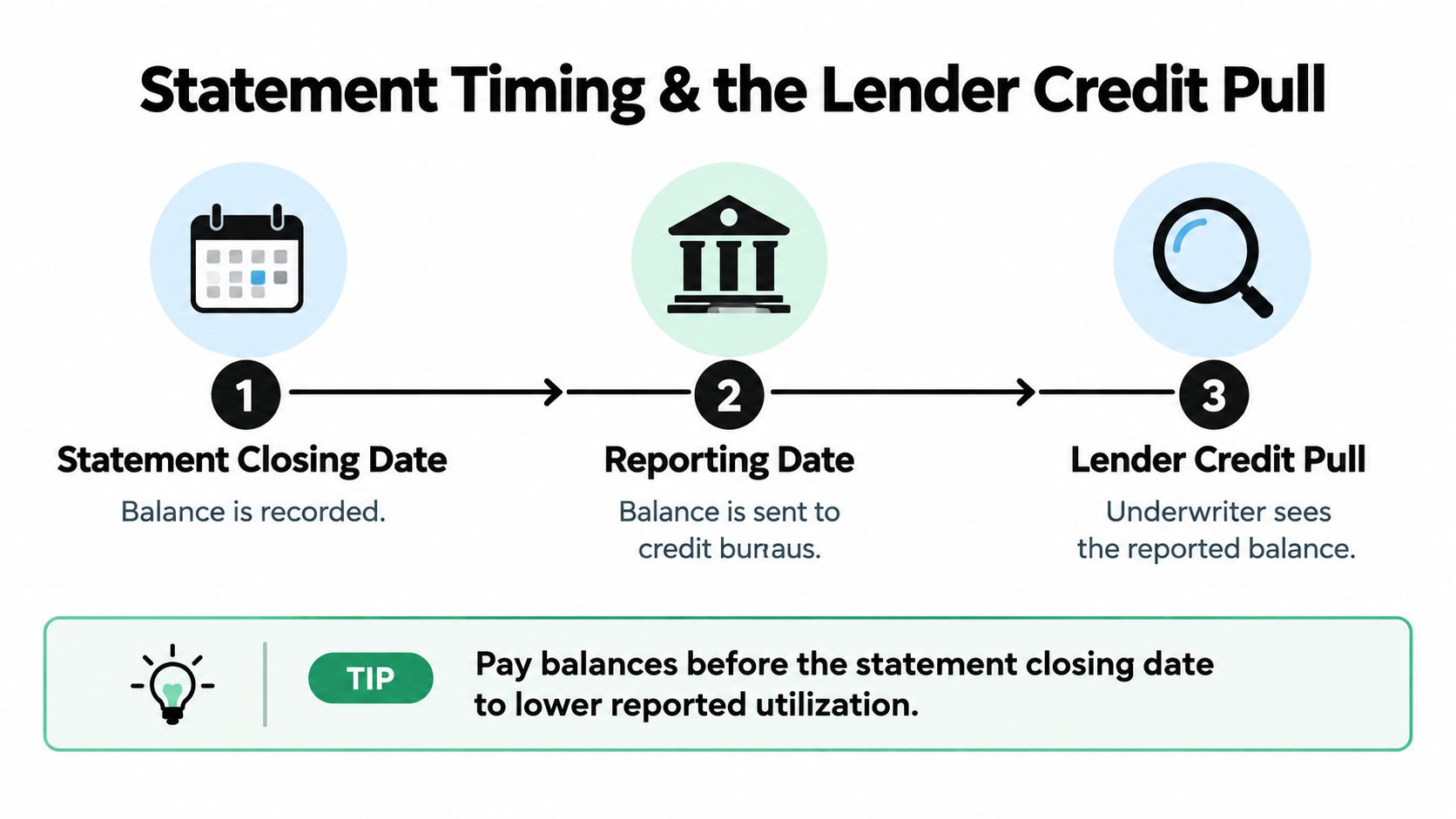
The balance you pay and the balance a bureau receives may be different. Many issuers report the balance from a statement cycle, so paying by the due date doesn't always lower the utilization shown on the mortgage credit report.
Start by finding the statement-closing date for every revolving account. This date is different from the payment due date. If your goal is to reduce the reported percentage, pay down the balance before the statement closes, then allow time for the issuer to report the updated information.
A practical timing sequence
- Review each statement: Locate the closing date, reported balance, credit limit, and minimum payment.
- Plan before closing: Make the intended paydown early enough for the issuer to process it.
- Confirm reporting: Check whether the lower balance appears on your credit reports.
- Coordinate with the lender: Tell the loan professional about planned payments and ask how the credit-pull timeline affects documentation.
- Avoid rebuilding the balance: New charges before the next statement can replace the improvement you intended to report.
The timeline matters because a lender may use a tri-bureau report, and the three major bureaus can receive information at different times. The Consumer Financial Protection Bureau explains that mortgage lenders commonly review scores from Equifax, Experian, and TransUnion and often use the middle score. Its homebuying credit guidance also emphasizes that higher scores often support better rates, while scores below 620 generally create more qualification difficulty. These are educational benchmarks, not approval guarantees.
Don't close an older revolving account solely to remove its balance. Eliminating that credit limit can reduce total available credit and raise the aggregate utilization ratio. Before changing an account, learn how credit checks affect mortgage approval and ask the lender whether the change could trigger additional review.
BNPL Fintech Loans and the Utilization You Cannot Always See
Buy-now-pay-later obligations create a separate mortgage-preparation concern because they may not appear in the same place as traditional revolving accounts. CFPB research found that major providers, including Affirm, Afterpay, Klarna, PayPal, Sezzle, and Zip, have typically not reported these loans to nationwide credit bureaus.
That can create a misleadingly clean credit report. A borrower may show low card utilization while recurring BNPL payments appear in bank statements or other documents reviewed by the lender. The result can be a DTI or documentation question even though the obligation isn't visible in ordinary revolving utilization.
Keep the mortgage file consistent
Treat every BNPL account as relevant. Keep records showing the provider, remaining balance, payment schedule, and any payoff. Tell the mortgage professional about the obligation before preapproval rather than assuming that “not on the credit report” means “not part of underwriting.”
The Mortgage Bankers Association reported that lenders may discover BNPL payments through bank-statement review, while many of these obligations are absent from automated underwriting systems. That makes voluntary disclosure and clear documentation practical safeguards. New BNPL purchases before preapproval or closing can also create additional questions about payment capacity and recent financial behavior.
Read the BNPL credit bureau reporting guide for a plain-language explanation of why fintech debt can be difficult to track. The treatment of short-term obligations may vary by loan program, duration, payment size, and lender interpretation, so ask the lender before opening another account or assuming a payoff will be handled automatically.
A 90 Day Plan to Improve Credit Utilization Before Applying
A structured timeline helps you replace guesswork with records. It can't guarantee a score change or approval because outcomes depend on your credit file, creditor responses, documentation, and current behavior.
Days 1 to 30 establish the baseline
Pull and review all three credit reports. Confirm every revolving account's balance, credit limit, account status, and payment history. Note each statement-closing date and compare the information across bureaus.
Flag information that is inaccurate, outdated, unverifiable, or misleading. A wrong limit can inflate utilization, while an incorrect balance can make a lender see a risk that doesn't reflect your actual account. Gather statements, payment confirmations, creditor letters, and dispute records.
Days 31 to 60 target the accounts that need attention
Prioritize cards closest to their limits, especially if one account carries a much higher ratio than the others. Plan payments around statement-closing dates rather than relying only on due dates.
Don't open new cards to create more available credit without discussing the move with the lender. A new account can change the average age of the file, create an inquiry, add a payment, or prompt additional underwriting questions. If you need preparing your credit file for a loan, include a written balance and reporting-date schedule.
Days 61 to 90 stabilize the file
Hold reported balances low and avoid charging them back up. Document BNPL, installment, and other recurring obligations. Organize income records, asset information, debt statements, and evidence of reserves for the lender.
Continue checking for updates, but don't make major credit changes without guidance. A legitimate credit restoration process can address factual reporting problems, but it can't remove accurate negative information because it makes an application harder. Sustainable payment habits remain important after the mortgage closes, when homeownership can bring moving costs, repairs, furnishings, taxes, insurance, and other demands on cash.
Lender Readiness Checklist and When to Ask for Credit Help
Before preapproval, confirm limits and balances across all three bureaus, keep individual card utilization low, align paydowns with statement dates, document BNPL and installment debt, avoid new revolving accounts through closing, and preserve cash reserves. Ask for help when inaccurate, outdated, unverifiable, or misleading information may be distorting your utilization or account history.
Superior Credit Repair Online provides educational credit guidance for people preparing for homeownership, refinancing, or other financing goals. Results vary by credit file, documentation, creditor responses, and current credit behavior.
If this information helped you better understand your credit report or your next steps, we would appreciate your honest feedback. You are welcome to share your experience with Superior Credit Repair on our Google Business Profile. Share your feedback on Google
Superior Credit Repair can review your credit report, help identify inaccurate or questionable items, and explain a step-by-step plan for improving your credit profile. Visit Superior Credit Repair to request a free credit analysis or consultation and better understand your mortgage-readiness options.