


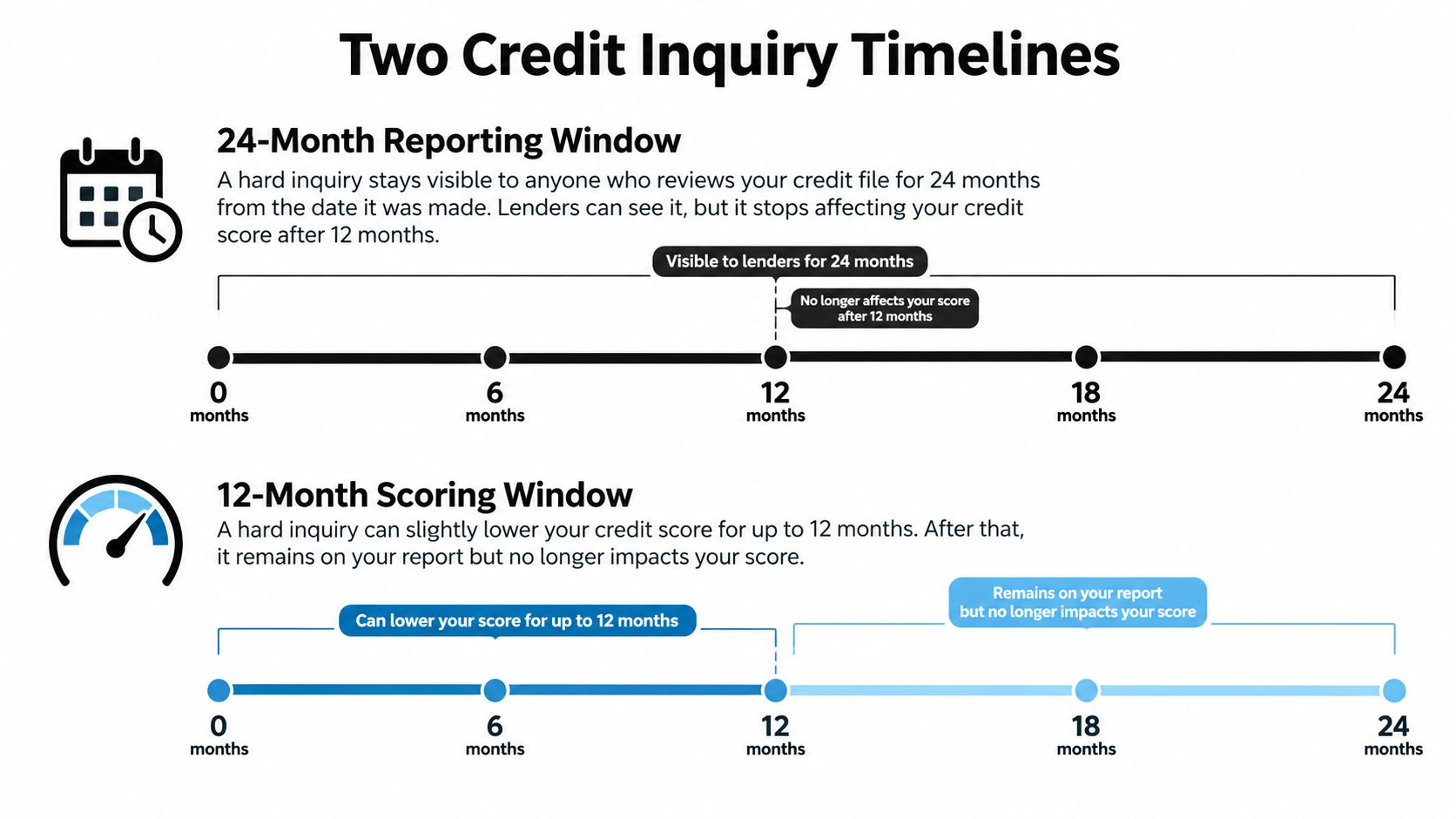
A hard inquiry generally stays visible on a U.S. credit report for up to two years, but it typically affects a FICO Score for only about 12 months. The report's visibility period and the scoring period are separate, so an older inquiry can still appear without continuing to lower the score.
You may notice this distinction at an uncomfortable time. Perhaps you're a first-time homebuyer reviewing your credit before speaking with a mortgage lender, and the report shows inquiries from a credit card application, an auto loan conversation, or a personal loan you barely remember. Seeing several entries can make it feel as though your mortgage plans are already in trouble.
That conclusion is often premature. A legitimate inquiry can remain on the file after its direct FICO scoring effect has ended. The more useful questions are whether each inquiry was authorized, whether any recent inquiry still affects scoring, and whether larger issues, such as high utilization, late payments, collections, charge-offs, or inaccurate balances, need attention first.
Mortgage preparation also requires knowing which scoring model a lender uses. FICO and VantageScore can treat inquiry history differently, and rate-shopping rules may group certain mortgage, auto, and student-loan inquiries together. A calm review helps you protect your file without disputing accurate information just because it looks concerning.
Table of Contents
- Why This Question Matters When You Apply for a Mortgage
- Hard Inquiries and Soft Inquiries in Plain English
- The Two Timelines Every Borrower Should Know
- The Rate-Shopping Rule for Mortgages, Auto, and Student Loans
- How to Check Your Report and Dispute Unauthorized Inquiries
- A Lender-Ready Plan and When to Ask for Help
Why This Question Matters When You Apply for a Mortgage
A first-time buyer named Jordan pulls all three credit reports before applying for an FHA mortgage. Jordan expects to see account balances and payment history, but the inquiry section contains several lender names. One inquiry is from an auto dealership, another is from a credit card issuer, and a third is connected to a mortgage prequalification conversation.
Jordan's first reaction is understandable: “Are these entries lowering my score, and can a lender deny my application because they're still there?”
That concern often comes from treating the inquiry section as one continuous penalty. It isn't. The date an inquiry remains visible and the period during which it influences a FICO Score are different timelines. A lender may still see an older inquiry during underwriting even though that inquiry no longer has a direct effect on the FICO score.
Why old inquiries can look worse than they are
Credit reports are historical records. They show activity that may no longer affect today's score, just as an old address or closed account may remain part of a consumer's credit history. A legitimate hard inquiry doesn't become inaccurate merely because it remains visible.
Mortgage applicants sometimes spend too much energy trying to remove an authorized inquiry while overlooking matters that can have broader consequences, including:
- Revolving utilization: High card balances can make a credit profile appear more strained.
- Payment history: Late payments can matter more than an aging inquiry.
- Collections and charge-offs: Inaccurate or unresolved negative accounts may require documentation and focused review.
- Account balances: A balance reported incorrectly can affect both scoring and underwriting discussions.
- Debt-to-income concerns: A lender may evaluate monthly obligations alongside the credit report.
These factors don't make inquiries irrelevant. They put them in proportion.
Practical rule: First confirm whether an inquiry is authorized. Then determine whether it is still within the scoring period. Only after that should you decide whether action is needed.
The same reasoning applies whether you're preparing for an FHA, VA, USDA, or conventional mortgage. Veterans, military families, renters moving toward homeownership, and consumers recovering from divorce or financial hardship can all benefit from reviewing the entire file rather than focusing on one intimidating section.
If you want a broader explanation of mortgage scoring and lender review, you can trust Superior Credit Repair for mortgage readiness. The goal isn't to erase accurate history. It's to separate normal credit activity from information that may be inaccurate, unauthorized, outdated, unverifiable, or misleading.
Hard Inquiries and Soft Inquiries in Plain English
Start with the type of credit check. A hard inquiry usually appears when you authorize a lender to review your credit after submitting an application for new credit. This may happen with a mortgage, auto loan, student loan, personal loan, or credit card.
A soft inquiry has a different purpose. It can happen when you check your own report, an existing creditor reviews an account, a company prescreens you for an offer, or a lender checks information during certain prequalification processes. Soft inquiries don't affect credit scores, even though they may appear on some consumer-facing reports.
Think of the difference as a job search. A hard inquiry resembles submitting a formal job application. You've asked the employer to evaluate you for a specific position, so the review becomes part of the application record. A soft inquiry is closer to a recruiter viewing a public profile. Someone has looked at information, but you haven't submitted a formal application for new borrowing.
What to look for on the report
When you open an inquiry section, check four details:
- The creditor name. The name may differ from the brand you remember, especially when a dealership or broker sends an application to multiple lenders.
- The inquiry date. This tells you where the entry falls on the reporting and scoring timelines.
- The product involved. Identify whether it relates to a mortgage, auto loan, student loan, credit card, or another application.
- Your memory of the event. An unfamiliar name doesn't automatically prove fraud, but it deserves verification.
Soft inquiries aren't treated as applications for new borrowing. They also aren't visible to lenders in the same way as hard inquiries. That distinction can prevent unnecessary alarm when you see several entries connected with account reviews or personal credit monitoring.
A lender may still ask about recent credit activity during mortgage underwriting. Answer and keep records of applications you authorized. The inquiry itself is only one piece of the file.
For a more detailed explanation of the two types of credit checks, use this guide for first-time homebuyers on credit checks. Knowing whether a check was hard or soft is the foundation for understanding how long credit inquiries stay on report and whether they require any response.
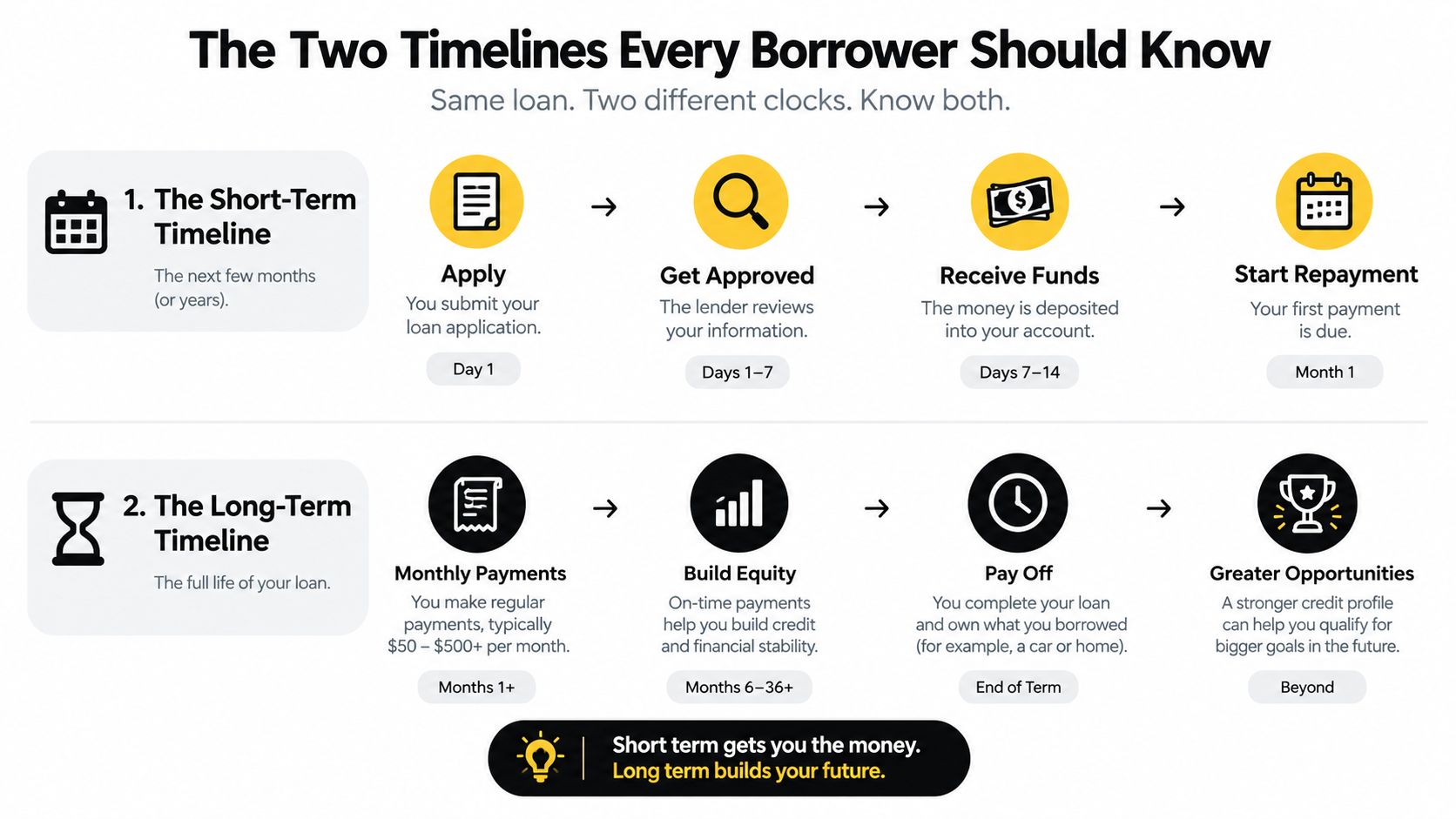
The Two Timelines Every Borrower Should Know
A borrower applying for a mortgage in January can still see that inquiry on a credit report long after its scoring effect has ended. Two clocks begin on the inquiry date:
- A hard inquiry generally remains visible on a U.S. credit report for up to two years.
- FICO Scores generally consider hard inquiries for about 12 months.
The visibility clock describes what an authorized reviewer may find in the inquiry section. The scoring clock describes how long the inquiry can directly affect a FICO Score. These timelines overlap at first, then separate.
A timeline example
Suppose a borrower authorizes a mortgage-related hard inquiry in January.
- At the inquiry date: The entry is added to the report.
- During the first 12 months: The inquiry may affect the FICO Score, and lenders can see it.
- After 12 months: The inquiry may remain visible, but it generally no longer has a direct FICO scoring effect.
- After two years: The accurate inquiry generally ages off automatically.
Experian reports that a single hard inquiry typically reduces a FICO Score by fewer than five points, as explained in Experian's explanation of hard inquiries. The actual effect can vary with the borrower's wider credit profile and existing inquiry activity. An older inquiry usually deserves less attention than inaccurate late payments, high utilization, or improperly reported collections.
What this means during underwriting
Mortgage underwriters can review inquiry activity even after an inquiry stops affecting the FICO Score. They may ask whether you applied for new debt, opened an account, or accepted an obligation that has not yet appeared elsewhere in the report.
If your inquiry is 15 months old, record it as visible but outside the usual scoring period. Before a pre-approval meeting, direct your effort toward payment history, utilization, and documentation of authorized applications. A visible entry is not automatically a problem, and a legitimate inquiry should not be disputed because it remains listed.
A personalized Superior Credit Repair timeline can help organize expectations. No company can promise a particular deletion, score outcome, or mortgage approval.
The Rate-Shopping Rule for Mortgages, Auto, and Student Loans
Comparing mortgage offers can create multiple hard inquiries. That doesn't necessarily mean each lender pull creates a separate scoring penalty.
FICO scoring models generally group qualifying inquiries for the same type of installment loan when the applications occur within a focused shopping window. The exact window depends on the model. Newer FICO models generally use a 45-day period for mortgage, auto, and student-loan inquiries, while older FICO versions may use a 14-day period, as described by myFICO's explanation of checking credit and scoring.
Equifax describes the rate-shopping window as typically ranging from 14 to 45 days, depending on the scoring model. That model-specific difference matters because you may not know which version a lender will use.
Compare the approaches
| Situation | What usually happens |
|---|---|
| Multiple mortgage inquiries during a focused shopping period | Qualifying inquiries may be grouped for scoring purposes |
| Mortgage applications spread across many months | They may not receive the same shopping treatment |
| Soft prequalification check | It generally doesn't affect the score |
| Credit card applications | They aren't treated the same as mortgage rate shopping |
| Personal loan applications | The grouping rules may differ from mortgage shopping |
VantageScore may evaluate hard inquiries across the full 24 months they remain on the file, according to Experian's discussion of inquiry limits. That doesn't mean every inquiry will produce a large score change. It means borrowers should ask which scoring model the prospective lender uses before submitting applications.
A practical shopping method
Choose a concentrated period for comparing mortgage offers. Contact lenders, document the dates, and ask whether the initial review will be a soft inquiry or a hard inquiry. If a formal application is required, complete the applications close together instead of spacing them across many months.
The same general discipline can help when comparing auto or student-loan options. For FHA, VA, USDA, and conventional mortgage shopping, keep a list of the lenders contacted and the products discussed. Multiple entries may still appear separately on the report, and that can be normal even when a scoring model groups them for scoring.
How to Check Your Report and Dispute Unauthorized Inquiries
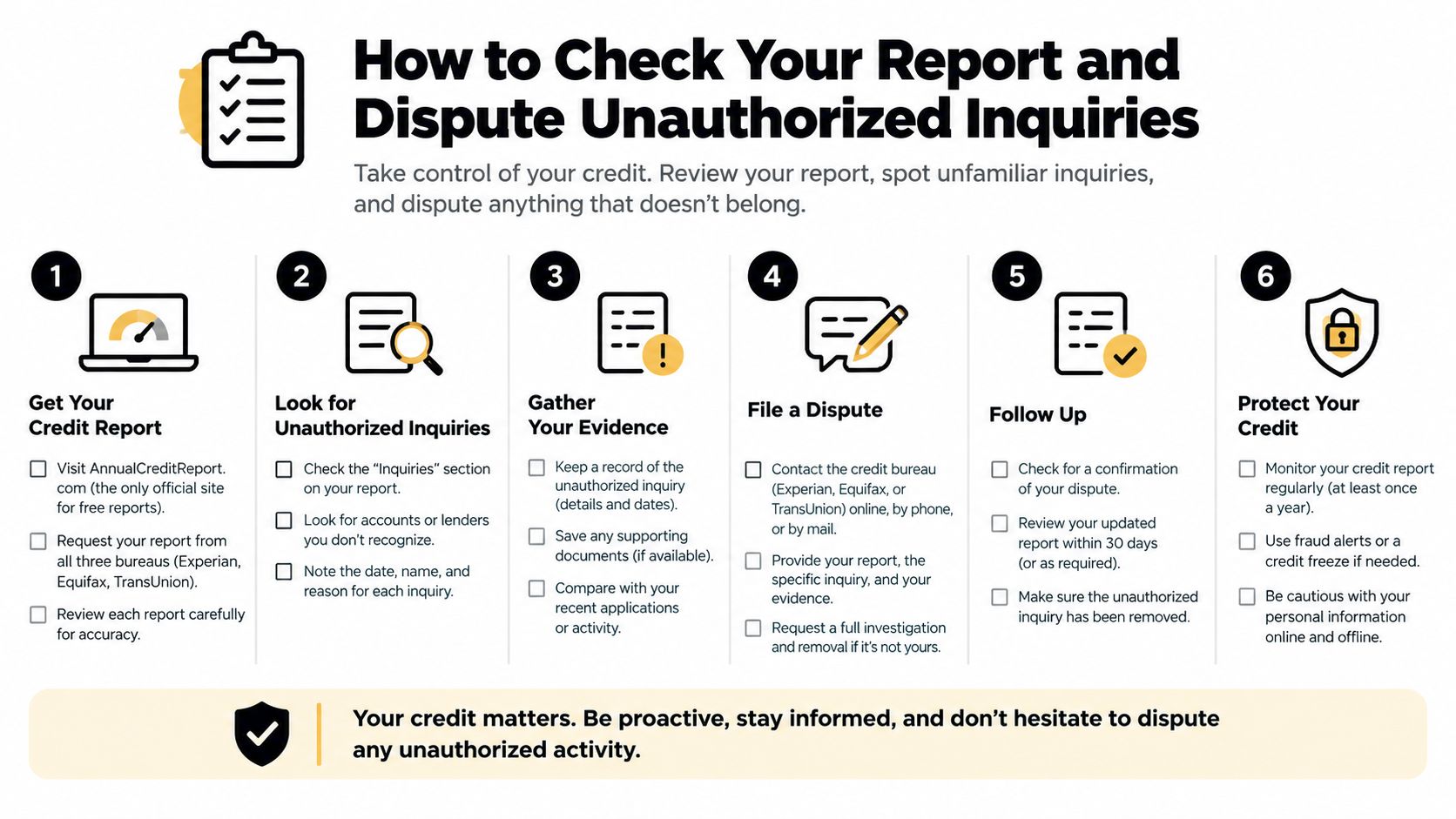
A careful review starts with all three major credit reports. Don't assume that one report contains every inquiry or that the creditor name will look exactly like the business you remember.
Review each report methodically
Use this sequence:
- Collect the reports: Obtain the reports from Equifax, Experian, and TransUnion.
- Mark each inquiry: Record the date, company name, and type of credit involved.
- Match the entry: Compare it with applications, dealership visits, mortgage conversations, or loan-broker activity.
- Contact unfamiliar businesses: Ask the company to explain the inquiry before concluding that it resulted from fraud.
- Separate errors from accurate history: A legitimate inquiry should generally be left to age off.
- Document questionable entries: Save statements, application records, identity-theft information, and correspondence.
An unfamiliar creditor name isn't automatically unauthorized. An auto dealership, broker, or intermediary may have submitted an application to several lenders. A lender may also report under a corporate name that differs from the brand you saw.
If you believe an inquiry was unauthorized, duplicated, or connected to identity theft, dispute it with the bureau that reports it. If the same inaccurate inquiry appears on more than one report, each bureau may require its own dispute. Include a clear explanation and supporting documents, and retain copies of everything submitted.
Consumers concerned about identity theft can also review educational resources such as this guide for MSPs on the Experian breach, which provides context for understanding how exposed information can create security concerns. The existence of a breach reference alone doesn't prove that a particular inquiry resulted from identity theft. Verification still matters.
Focus disputes on accuracy
A dispute is appropriate when the information may be wrong, unauthorized, duplicated, or unverifiable. It isn't a method for removing accurate information just because it makes a report look less attractive.
If the inquiry came from a credit card, auto loan, personal loan, or mortgage application you authorized, it generally cannot be removed for convenience. It normally ages off automatically after the two-year reporting period. A professional review, including these credit repair tips from Superior Credit Repair, should focus on documentation and proper verification rather than promises of guaranteed deletion.
Mortgage readiness often improves more through correcting an inaccurate collection, addressing a late payment, reducing revolving balances, or confirming account statuses than through challenging an accurate old inquiry.
A Lender-Ready Plan and When to Ask for Help
A mortgage-ready credit plan works best when it starts before you submit an application. Early preparation gives you time to correct errors, document disputes, stabilize payment behavior, and avoid new activity that could raise questions during underwriting.
Start with a full-file review
Pull all three credit reports during the earlier preparation period. Review more than the inquiry section, and create a working list of:
- Current and past-due accounts
- Collections and charge-offs
- Reported balances
- Late-payment history
- Hard and soft inquiries
- Accounts you do not recognize
- Debts that may affect debt-to-income calculations
An accurate inquiry may need time to age off. An inaccurate balance, misleading account status, or unauthorized collection may require documented follow-up. Separating those issues keeps your effort focused on information that can affect the lender's view of your file.
Build stability before the mortgage application
Lowering revolving balances can support a stronger credit profile, although the appropriate target depends on your file and lender. Bring past-due accounts current where possible, make every payment on schedule, and avoid closing accounts or opening new ones without understanding the possible effect.
Use this 90 day credit improvement strategy to sequence report review, utilization planning, and payment stabilization during the final 60 to 90 days before underwriting. Experian notes that multiple applications in a short period can have a cumulative negative effect, so limit unnecessary applications before seeking mortgage, vehicle, or personal financing.
A practical timeline separates the longer preparation period from the final lender review:
- Six to 12 months before applying: Pull the reports, identify errors, address collections or late payments, and begin gathering records for any dispute or account-status question.
- During lender preparation: Compare mortgage options within a concentrated rate-shopping period. Ask each lender which scoring model it uses and how that model treats mortgage inquiries.
- During the final 60 to 90 days: Freeze new applications that are unrelated to the mortgage, pay card balances before statement dates when possible, and keep payment activity consistent.
- Before underwriting: Save lender correspondence, application confirmations, and explanations for any recent inquiry or new account. Be ready to show which applications you authorized.
This timing matters because an inquiry can remain visible for two years while its direct FICO scoring effect generally lasts about 12 months. Visibility is like an entry remaining in a logbook. Scoring impact is the shorter period in which that entry may influence the calculation. A lender can see the inquiry after its scoring effect has faded, so prepare an explanation without assuming an old inquiry is still lowering your score.
The same record-keeping can support FHA loan preparation, VA loan preparation, USDA financing, conventional mortgage preparation, apartment approval, and rental screening. A lender-ready profile reflects payment history, balances, account stability, income, and obligations, not inquiries alone.

When professional support makes sense
Structured help may be useful when you cannot determine whether an inquiry was authorized, when reports contain conflicting information, or when your file includes collections, late payments, charge-offs, medical collections, repossessions, or high utilization. A responsible provider should explain what can be disputed, what should remain, which documents are needed, and why results vary.
Superior Credit Repair can review your credit report, help identify inaccurate or questionable items, and explain a step-by-step approach to improving your credit profile. You can request a free credit analysis or consultation to understand your options. Results depend on your credit file, documentation, creditor responses, account history, and current credit behavior. No specific score increase, deletion, or loan approval can be promised.
Frequently asked questions
Do hard inquiries stay on a credit report for two years?
Generally, yes. In the United States, an accurate hard inquiry can remain visible for up to two years from the inquiry date. Its direct FICO scoring effect generally lasts only about 12 months.
Can I remove a legitimate hard inquiry?
Usually, no. If you authorized the application and the inquiry is accurately reported, it normally ages off automatically. A dispute is appropriate when the inquiry was unauthorized, duplicated, or reported inaccurately.
Do soft inquiries lower credit scores?
No. Soft inquiries, including checking your own report or certain account reviews, do not affect credit scores. They are not treated like applications for new borrowing.
Should I avoid comparing mortgage lenders?
No. Rate shopping can be sensible. Compare lenders during a concentrated period, ask about the scoring model, and keep application records. Qualifying mortgage inquiries may be grouped for scoring purposes, although treatment depends on the model and timing.
What should I fix before worrying about old inquiries?
Start with inaccurate information, late payments, collections, charge-offs, high revolving utilization, incorrect balances, and debt-to-income concerns. An old authorized inquiry may remain visible without continuing to affect the FICO Score.
If this information helped you understand your credit report or next steps, you are welcome to share your experience with Superior Credit Repair on its Google Business Profile: https://share.google/ePRpFvtCXwCjiJwOK
Superior Credit Repair offers documentation-based credit report reviews, dispute support for potentially inaccurate or unauthorized information, and practical guidance for mortgage readiness. Visit Superior Credit Repair to request a free credit analysis or consultation.