


Most BNPL providers haven't consistently reported Pay-in-4 loans to major credit bureaus, so timely payments may not help your score while missed payments can still create complications. In 2022, 21.2% of consumers with a credit record used BNPL, and about 20% of BNPL borrowers were heavy users, averaging more than one loan per month. The Consumer Financial Protection Bureau documented those figures.
You may be months away from buying your first home. Your credit score has improved, your credit cards are under control, and you're preparing for an FHA, VA, USDA, or conventional mortgage application. Then you remember the furniture purchase split into payments, the medical bill paid through installments, or the several smaller purchases you made through different BNPL apps.
The question is simple but important: Will the mortgage lender see those accounts, and can they affect approval even if your FICO score doesn't change?
The answer depends on the provider, bureau, account classification, reporting cycle, scoring model, and the lender's underwriting process. A missing tradeline on a traditional credit report doesn't erase the underlying obligation. It may still appear elsewhere, affect your bank account, or raise questions about recurring debt and cash flow.
For consumers researching the broader role of installment products in modern financial services, Vaira's View offers useful context in its guide to embedded finance. For mortgage preparation, however, the practical priority is more personal: review every account before a lender reviews your file. Start with checking BNPL purchases before buying a home and organize the balances, due dates, and payment records you'll need.
Table of Contents
- Understanding How BNPL Reporting to Credit Bureaus Affects Your Mortgage Plans
- The Reality of Inconsistent BNPL Reporting Across Credit Bureaus
- How Account Classification Changes Your Credit Score Impact
- Why Score-Neutral Does Not Mean Mortgage-Neutral
- Practical Steps to Audit and Manage Your BNPL Accounts
- Building a Long-Term Strategy for Credit Readiness and Homeownership
Understanding How BNPL Reporting to Credit Bureaus Affects Your Mortgage Plans
Consider a first-time buyer named Jordan. Jordan has paid every reported credit card account on time and recently paid down revolving balances. The credit score looks encouraging, so Jordan begins gathering documents for a mortgage preapproval.
While reviewing recent bank statements, Jordan notices automatic withdrawals from several BNPL providers. One account financed household items, another covered travel expenses, and a third paid for a medical purchase in installments. None appears clearly on the traditional credit report Jordan checked.
That situation can create false confidence. Jordan's score may not reflect all current obligations, but a mortgage application asks for more than a score. A lender may review credit reports, bank statements, debt disclosures, payment obligations, and the borrower's ability to manage the proposed housing payment.
Why widespread use matters
The CFPB found that 21.2% of consumers with a credit record financed at least one purchase through BNPL in 2022, up from 17.6% in 2021. About 20% of BNPL borrowers were heavy users, originating more than one loan per month on average, compared with 18% in 2021. The CFPB's consumer-use report also found that the average number of BNPL originations per borrower rose from 8.5 to 9.5.
Those figures don't mean every BNPL user has a mortgage problem. They show why a credit score alone may not provide a complete picture of short-term installment activity. The same report found that approximately 63% of borrowers took out multiple simultaneous BNPL loans, while 33% borrowed from multiple BNPL companies.
A buyer may therefore have several small scheduled payments that feel manageable separately but become meaningful when a lender evaluates the entire monthly budget. A mortgage underwriter may also want an explanation if bank withdrawals show recurring obligations that weren't listed on the application.
Practical rule: Treat every BNPL plan as a real debt obligation, whether or not it appears on a credit report.
The mortgage question is broader than “Will my score drop?”
FHA, VA, USDA, and conventional lenders use credit scores, but they also evaluate repayment patterns and debt capacity. A score can remain unchanged while an underwriter still asks about payment commitments, account activity, or unexplained withdrawals.
This distinction matters for renters preparing to buy, military families planning for VA financing, and consumers recovering from hardship. The right objective isn't to make BNPL activity disappear. It's to identify the accounts, confirm the information, correct inaccuracies, and present a complete financial picture.
The Reality of Inconsistent BNPL Reporting Across Credit Bureaus
BNPL reporting isn't standardized across providers or bureaus. A Congressional Research Service summary states that most BNPL providers, except Affirm, haven't consistently furnished origination or repayment data for Pay-in-4 products to the major credit bureaus. TransUnion's research summary also cites CFPB data showing that 53.6 million consumers used at least one Pay-in-4 loan in 2023.
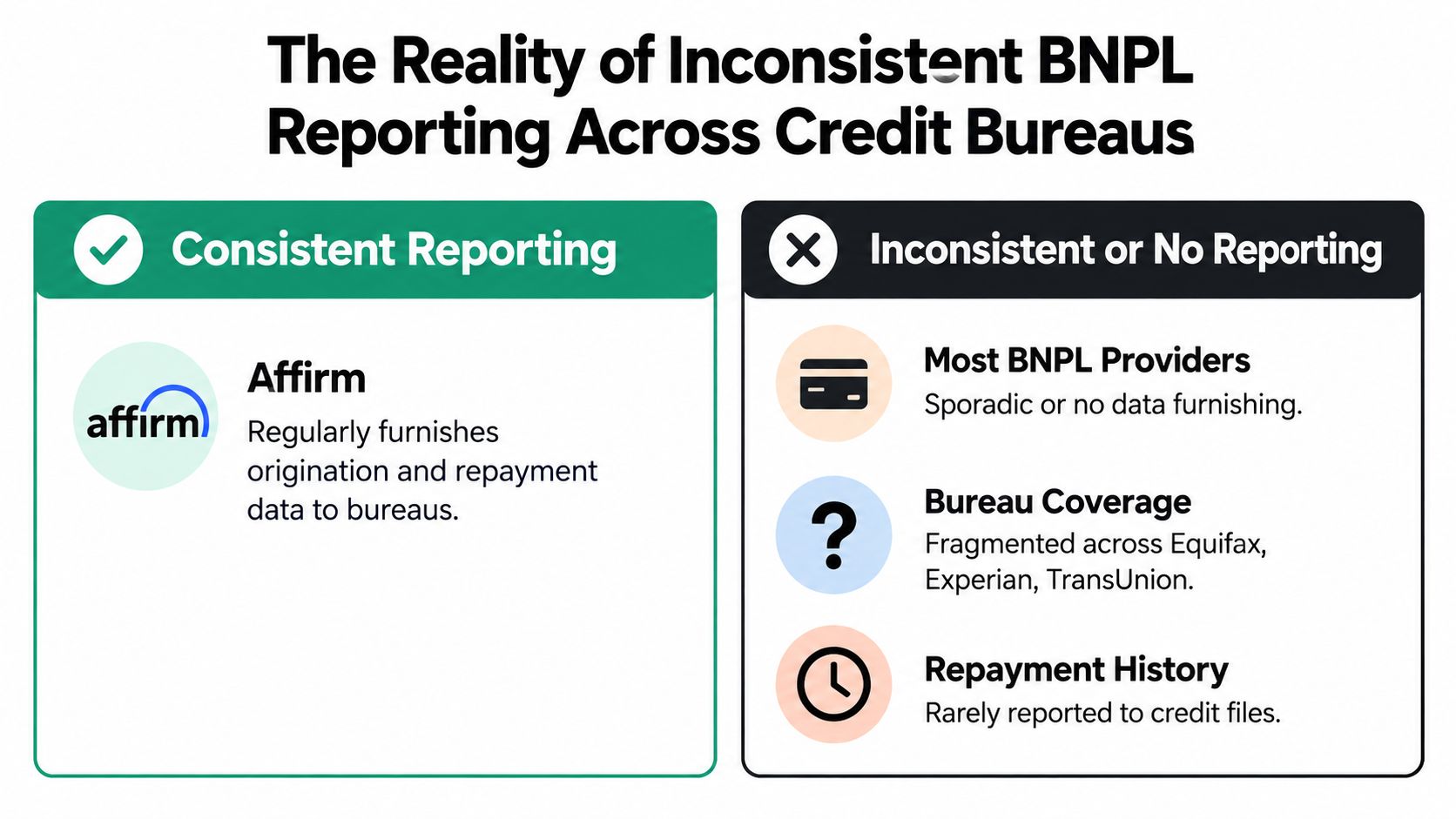
That inconsistency creates two different problems. First, timely payments may not establish positive history if the provider doesn't furnish the account. Second, a missed payment may not immediately appear on a traditional report, but it can still cause account restrictions, failed automatic withdrawals, overdraft problems, or collection activity.
Visibility can differ by product and provider
Pay-in-4 products often operate differently from longer-term installment loans. One provider may furnish information while another doesn't. A provider may report to one bureau but not another, or may change its furnishing policy over time.
The result is that consumers can't safely assume any of the following:
- “It isn't on one report, so it isn't anywhere.” Another bureau or document may show it.
- “My on-time payments will build credit.” That only happens if the provider furnishes data and the relevant scoring system uses it.
- “A late payment won't matter because it isn't reported.” Collections and banking problems can still create underwriting concerns.
- “All BNPL accounts are scored alike.” Account coding and model rules can differ.
Market scale makes the reporting gap material. CFPB data cited by TransUnion show 335.8 million Pay-in-4 transactions totaling $45.2 billion in 2023, with transaction volume up 23% and total volume up 26% from 2022 after inflation adjustment. The CFPB measured a 1.83% charge-off rate in 2023, down from 2.63% in 2022. Those numbers describe the market, not an individual borrower's risk, but they help explain why lenders and regulators pay attention to BNPL visibility.
What this means before a mortgage application
Pulling one credit report isn't enough for a careful audit. Review all three nationwide reports, provider portals, bank statements, and email records for payment confirmations. If a collection, balance, or late payment is inaccurate, document the error before disputing it.
Consumers who need fixing collection errors before mortgage approval should compare the reported account with original creditor records and current statements. A dispute should address a specific, supportable inaccuracy, not just request removal because the information is inconvenient.
How Account Classification Changes Your Credit Score Impact
Two BNPL accounts can produce different score effects because the provider may report them under different account classifications. The key comparison is revolving credit versus installment credit.
Revolving credit normally involves a credit limit and a balance that can rise or fall. Utilization measures how much of that available limit is being used. If a BNPL account is reported as revolving credit, a high balance may create utilization pressure similar to a heavily used credit card.
An installment account works differently. It typically has a fixed balance and scheduled payments. The scoring model may evaluate payment history, account age, and installment-loan characteristics rather than applying a revolving utilization calculation.
Revolving classification
A revolving classification can matter because utilization is a significant scoring input. A short-term BNPL balance reported against a limit may look different from the same obligation reported as a fixed installment account.
For example, a consumer could make every payment on time but still see pressure from a high reported revolving balance. Paying the balance down may help later, but the timing depends on when the provider updates the bureau and when the lender obtains the report.
Installment classification
FICO's analysis found that BNPL accounts reported as installment loans generally produced a modest change, approximately plus or minus 10 FICO points, with a slight tendency toward lower scores in the cited analysis. FICO's explanation of BNPL score effects emphasizes that the account type influences the scoring response.
That range isn't a promise or prediction for your file. The result can vary based on the scoring model, existing accounts, payment history, reported balance, and the lender's reporting data.
| Reporting treatment | Main issue | Mortgage preparation response |
|---|---|---|
| Revolving credit | Balance-to-limit utilization may create pressure | Review the reported balance and update timing |
| Installment loan | Payment history and installment characteristics may matter | Confirm the remaining balance and scheduled payment |
| Not reported | Traditional score may not reflect the account | Track it through provider records and bank statements |
Why an early payoff may not change the score immediately
Paying a BNPL balance shortly before underwriting doesn't guarantee an immediate score improvement. The provider must first update its records, the bureau must receive the information, and the lender must pull a report after the update. The scoring model must also use the account data in the way you expect.
Consumers looking for a plain-language review can read Superior Credit Repair on BNPL risk. The safer approach is consistent on-time payment behavior, fewer simultaneous obligations, and accurate disclosure when a lender requests documentation.
Why Score-Neutral Does Not Mean Mortgage-Neutral
A credit score is one measurement. Mortgage underwriting is a broader review.
Experian says reported BNPL accounts can be visible to lenders even when traditional Experian-based scores don't include that information. TransUnion states that BNPL data it receives may be visible to consumers but currently unavailable to lenders, insurers, and scoring providers. TransUnion's BNPL explanation illustrates why bureau-by-bureau treatment matters.

A lender may pull a report that displays a BNPL account, while another system may not receive or use the same data. Even when the account is visible, the lender's underwriting rules determine whether it counts toward debt-to-income analysis or prompts a request for additional documentation.
Underwriting looks at capacity and consistency
Debt-to-income analysis compares recurring debt payments with qualifying income. A BNPL payment may be small, but several scheduled payments can affect the household budget. The lender may also examine whether automatic withdrawals create unstable cash flow or leave too little money for reserves and housing expenses.
This doesn't mean every BNPL account will cause denial. It means the borrower should know what exists and explain it accurately. An underwriter is usually more comfortable with organized records than with unexplained activity discovered late in the process.
The practical questions are:
- Can the lender see the account on a report or application documentation?
- Will the payment count as a recurring liability?
- Does the account suggest overlapping short-term borrowing?
- Can the borrower document that payments are current?
Why the same borrower may receive different treatment
Reporting can vary by bureau, product, and provider. One consumer may see a BNPL account on an Experian report but not on TransUnion. Another may see provider data as a consumer but not have it included in the score a lender uses.
That's why a score-only strategy can miss the issue. Before applying for FHA, VA, USDA, or conventional financing, review Superior Credit Repair's mortgage score guide and ask the lender how it handles reported BNPL obligations.
A score-neutral account can still be mortgage-neutral only after you confirm that the lender won't count it, question it, or require documentation about it.
Practical Steps to Audit and Manage Your BNPL Accounts
A BNPL audit should produce a clear record, not more anxiety. Start early enough to correct inaccurate information and answer lender questions without rushing.
Step one is to build the account list
Search each provider's website and mobile app. Review email confirmations, text alerts, bank transactions, and saved payment methods. Include closed plans if they generated a late payment, collection referral, disputed balance, or unusual withdrawal.
Record the following for each account:
- Provider and product: Identify Affirm, Afterpay, Klarna, PayPal Pay in 4, Sezzle, Zip, or another provider.
- Original purchase: Note what the plan financed and when it opened.
- Remaining balance: Use the provider's current statement rather than an old checkout receipt.
- Scheduled payment: Record the amount, due date, and payment method.
- Status: Mark the account current, paid, disputed, delinquent, or referred to collections.
- Documentation: Save statements, payment confirmations, correspondence, and bank records.
Step two is to compare every bureau
The CFPB reported that most BNPL lenders generally didn't report loans to nationwide consumer reporting companies, limiting visibility into total BNPL debt. Experian says participating providers can report BNPL information that appears on an Experian report clearly labeled as a BNPL loan. The CFPB's research on heavy BNPL use supports reviewing more than one source.
Look for duplicate accounts, incorrect balances, accounts listed as open after payment, wrong dates, and accounts that don't belong to you. Compare each item with provider statements and bank records. A report can be incomplete without being inaccurate, so distinguish between “not listed” and “listed incorrectly.”
Step three is to verify before disputing
A lawful credit dispute should identify the specific information that is inaccurate, incomplete, outdated, or unverifiable. Attach records that support your position, keep copies of everything submitted, and track response dates.
Superior Credit Repair can review BNPL tradelines alongside account statements, identify potential reporting errors, and help consumers pursue documentation-based disputes through applicable processes. Results vary based on the credit file, evidence, furnisher response, account history, and current credit behavior.
Step four is to prepare a lender-ready explanation
If an underwriter asks about BNPL activity, provide a straightforward account list and current payment records. Don't hide an obligation because it isn't visible on a particular report. Don't claim an account is inaccurate unless your records support that conclusion.
Paying accounts on time, avoiding new overlapping plans, and preserving enough cash for ordinary expenses can make the financial picture easier to understand. These habits also support broader mortgage credit repair work involving collections, late payments, charge-offs, high utilization, and debt-to-income concerns.
Building a Long-Term Strategy for Credit Readiness and Homeownership
Using BNPL intentionally to build credit may sound appealing, especially for someone with a thin file. It isn't a dependable mortgage strategy unless you first confirm which provider reports, which bureau receives the information, how the account is classified, and whether the lender uses a compatible scoring model.
The transition is still uneven. Affirm began reporting BNPL activity to Experian in April 2025, but that data was initially excluded from traditional scores. TransUnion states that BNPL information it receives is visible to consumers but not usable by lenders or scoring providers. The reporting and scoring discussion summarized by Fortune shows why “on time” doesn't automatically mean “credit building.”
A safer preparation framework
Protect cash flow first. A mortgage application shouldn't be built around a score while recurring payments strain the bank account. Review automatic withdrawals and make sure the household budget can support existing obligations.
Avoid opening new BNPL accounts before applying. New obligations can complicate documentation and make debt capacity harder to explain. If a purchase is necessary, understand the payment schedule and retain the records.
Correct reporting errors separately from rebuilding habits. Disputing an inaccurate late payment is different from improving utilization or establishing a consistent payment history. Both may matter, but they require different evidence and actions.
Ask the lender specific questions. Find out how the lender treats BNPL accounts in debt-to-income calculations, what documentation it wants, and which credit reports or scoring models it uses. Policies can vary across FHA, VA, USDA, and conventional mortgage programs and among individual lenders.
For a broader timeline that connects report review, utilization planning, payment habits, and mortgage preparation, use Superior Credit Repair's mortgage readiness guide.
Credit repair is a structured review and verification process, not a promise of deletion or approval. Results vary with the consumer's credit history, documentation, creditor responses, and current behavior. The strongest plan combines accurate reporting, manageable obligations, stable payment habits, and realistic communication with the lender.
Superior Credit Repair can review your credit report, help identify inaccurate or questionable BNPL information, and explain a step-by-step plan for improving your credit profile. Request a free credit analysis or consultation to understand your options before submitting a mortgage application.
Frequently asked questions
Does BNPL affect mortgage approval if it doesn't change my credit score?
It can. A score may exclude BNPL data while a lender sees the account on a credit report, application documentation, or bank statements. The lender may also consider the recurring payment when evaluating debt capacity. Ask the lender how it treats BNPL obligations and disclose accounts accurately.
Do all BNPL providers report to credit bureaus?
No. Reporting varies by provider, product, bureau, and time period. Most providers haven't consistently furnished Pay-in-4 origination or repayment data, while some providers have reported certain activity to selected bureaus. Review all three reports and provider statements instead of assuming universal reporting or universal invisibility.
Can on-time BNPL payments improve my credit score?
They may not. A provider must furnish the account, the bureau must receive the information, and the scoring model must use it. Some reported accounts may be visible to lenders but excluded from traditional scores, so timely payment alone doesn't guarantee credit-building value.
Should I pay off BNPL before applying for a mortgage?
Reducing obligations may simplify your financial picture, but an early payoff doesn't guarantee an immediate score change. Updates depend on the provider's reporting cycle, bureau coverage, account classification, and scoring model. Keep proof of payment and ask your lender how it wants closed or paid accounts documented.
Can inaccurate BNPL information be disputed?
Potentially, if the reported information is inaccurate, incomplete, outdated, misleading, or unverifiable. Gather provider statements, payment records, and identification of the specific error. A compliant dispute process is documentation-based, and results vary based on the evidence and furnisher response.
If this information helped you better understand your credit report or your next steps, we would appreciate your honest feedback. You are welcome to share your experience with Superior Credit Repair on our Google Business Profile. https://share.google/ePRpFvtCXwCjiJwOK