

The Department of Veterans Affairs does not set a minimum credit score for VA home loans. Lenders set their own standards, commonly around 620, while some may accept scores from 550 to 580 when the full borrower profile supports approval.
That answer sounds simple, but it changes how you should prepare. A score below 620 isn't an automatic VA program disqualification, just as a score at or above 620 doesn't guarantee that a lender will approve your application. The private lender reviews the entire file, including payment history, debts, income, occupancy, and the stability of your credit behavior.
For veterans, active-duty service members, and eligible surviving spouses, the most useful question isn't only “What's the VA min credit score?” It's “What does my lender need to see before considering my file ready?” The sections below explain the difference between VA rules and lender overlays, how different score ranges may be viewed, why BNPL obligations and thin files matter, and how accurate credit repair and steady rebuilding habits can support mortgage preparation.
Table of Contents
- The Surprising Truth About the VA Minimum Credit Score
- How VA Loan Credit Standards Actually Work
- What Different Credit Score Ranges Mean for VA Applicants
- What VA Lenders Look at Beyond Your Credit Score
- Modern Credit File Issues That Affect VA Approval
- Building a Lender-Ready Credit Profile Before You Apply
- Your Realistic Next Steps Toward a VA Loan
The Surprising Truth About the VA Minimum Credit Score
The most important fact is also the one many borrowers don't expect: the VA itself sets no minimum credit score for its home loan program. The Department of Veterans Affairs instead uses a broader standard centered on satisfactory credit and the borrower's overall ability to repay. The VA's eligibility guidance explains that lenders apply their own credit standards, and that many commonly look for a score around 620.
That makes the VA program different from a mortgage program with one universal government score threshold. A veteran with a score below 620 isn't automatically rejected by the VA. The lender still has to decide whether the borrower's payment history, existing obligations, income, occupancy, and overall financial profile meet that lender's requirements.
Why 620 appears so often
The 620 figure is a common lender benchmark, not a VA rule. Private lenders provide the mortgage and decide how much risk they're willing to accept. Some lenders may consider scores below that benchmark, including scores in the 550 to 580 range, when the rest of the file is strong. The VA Buyers Guide describes this lender-specific structure and makes clear that practical approval standards can vary.
A lower score may lead a lender to ask for more documentation or examine recent credit activity more closely. Another lender may have a different policy. Neither outcome changes the underlying VA rule.
Practical rule: Treat 620 as a market reference point, not as a pass-or-fail line established by the VA.
What this means for your preparation
If your score is below a lender's preferred range, the next step isn't to chase a fast score increase or assume homeownership is out of reach. Start by reviewing the accuracy of your credit reports, identifying recent risks, and understanding how your debts affect affordability.
This article will show you how lender overlays work, what score ranges may mean in practice, how collections, charge-offs, late payments, utilization, BNPL accounts, and thin files can affect review, and how to build a lender-ready profile without relying on promises. Results vary based on your credit file, documentation, creditor responses, account history, and current credit behavior.
How VA Loan Credit Standards Actually Work
VA approval operates through two layers. The first layer is the VA program's baseline eligibility framework. The second layer is the private lender's underwriting policy. The VA backs eligible loans, but the lender evaluates the application and decides whether its own standards are satisfied.
A useful analogy is a rental property. The city may establish a safety code that every property must meet. The property manager can still require additional documentation, income verification, or other conditions before approving a tenant. The manager's extra requirements don't become city law. They're the property manager's risk rules.
The VA layer
For credit, the VA emphasizes satisfactory credit rather than one fixed minimum score. Underwriters may consider payment patterns, debts, income, and occupancy together. This broader review recognizes that a credit score is a summary produced by a scoring model, not a complete explanation of a borrower's financial behavior.
The VA also recognizes that some applicants have limited traditional credit. Guidance says lack of credit isn't automatically viewed as a negative, and lenders may use nontraditional tradelines or scoring models when evaluating a borrower with a thin file. The VA credit underwriting presentation provides that framework for lenders.
The lender layer
A lender may establish a minimum score, requirements for recent payment history, or additional documentation standards. These requirements are often called overlays. An overlay is a lender's added rule above the baseline program guidelines.
That's why two lenders can review the same borrower and reach different conclusions. One may have a policy that commonly targets 620. Another may consider a lower score if the file demonstrates stable income, manageable debt, and responsible recent credit behavior. A denial from one lender doesn't necessarily mean the VA program itself has denied you.
The lender also reviews whether you intend to occupy the property as your home and whether your income and debts support the proposed payment. A score can open a conversation, but the underwriting decision depends on the complete application.
Borrowers dealing with collections or charge-offs may benefit from understanding the difference between a program rule and a lender's overlay. This guide to VA loan credit approval after collections can help explain why the same account may receive different treatment depending on its accuracy, age, payment status, and the lender reviewing the file.
What Different Credit Score Ranges Mean for VA Applicants
Score ranges can help you set expectations, but they shouldn't be treated as approval categories. A lender considers the score model it uses, the information on the report, recent activity, debts, income, and the stability of the entire file.
Lower score ranges
A score in the 550 to 580 range may be considered by some lenders, but the available options can be narrower. The lender may look carefully at recent late payments, collections, charge-offs, utilization, and debt obligations. A lower score can also affect the lender's willingness to approve, the documentation it requests, or the terms it offers. Approval is never guaranteed.
A score in the 580 to 619 range may receive more consideration from lenders that accept scores below the common 620 benchmark. The file still needs to show responsible behavior and sufficient repayment capacity. Paying down revolving balances may help the profile, but borrowers shouldn't open accounts, close accounts, or move debts without understanding the potential mortgage consequences.
Scores around and above the common benchmark
A score in the 620 to 679 range may fit the published benchmark used by many lenders. That can make lender conversations easier, but it doesn't erase concerns such as recent collections, disputed information, high utilization, or excessive monthly obligations.
A score of 680 or higher may make a file more attractive to some lenders, but it still isn't a guarantee of approval or the best available terms. A high score can coexist with a recent late payment, an unaffordable debt load, or inaccurate reporting that needs attention.
The difference between VA and other programs is structural. The following comparison uses the official or commonly cited thresholds described by Equifax's homebuyer credit education.
| Loan Program | Official Minimum Score | Common Lender Practice |
|---|---|---|
| VA | No VA-set minimum | Many lenders commonly look around 620, while some may consider 550 to 580 depending on the full profile |
| FHA | 580 for a 3.5% down payment, or 500 with 10% down | Lenders may apply their own overlays |
| Conventional | About 620 in common practice | Lenders may apply their own standards and overlays |
The comparison doesn't mean one program is automatically better. FHA, VA, conventional, and USDA loan preparation each involve different eligibility and underwriting considerations. The right choice depends on your service eligibility, income, debt, property, credit history, and the lender's current requirements.
What VA Lenders Look at Beyond Your Credit Score
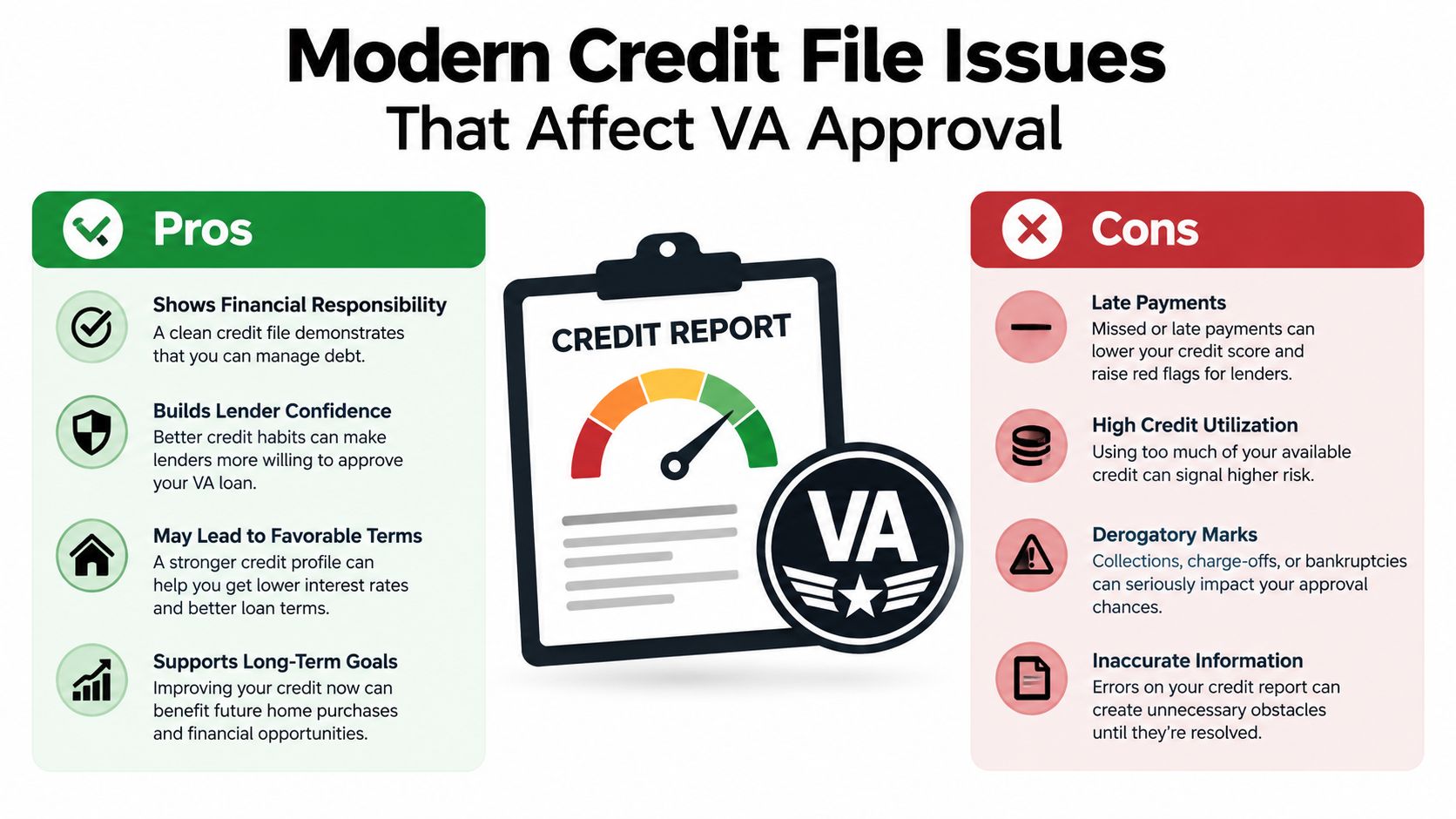
A credit score is a starting signal. Underwriters need to understand the behavior and obligations behind it. They may review payment history, collections, charge-offs, credit card utilization, debt-to-income concerns, and whether the file shows consistent financial management.
Payment history often deserves close attention because recent missed payments can suggest current difficulty, while older problems may be viewed in the context of stronger recent behavior. Collections and charge-offs also require explanation. A collection is an account sent to a collection company after the original creditor says it wasn't paid as agreed. A charge-off is an accounting status showing that a creditor treated the debt as a loss. Neither term automatically determines the outcome, but inaccurate, outdated, unverifiable, or misleading reporting should be investigated.
Two files with different stories
Consider a borrower with a score that appears acceptable but several recent collections and high revolving balances. The score may not fully show the lender's concern. Recent derogatory activity and limited available credit can raise questions about whether the borrower can comfortably manage a new mortgage payment.
Now consider a borrower with a lower score but a clean, stable pattern of recent payments, manageable debts, and consistent income. That borrower may still face lender restrictions, but the file could provide more context than the score alone suggests.
These are representative examples, not predictions. A lender's decision depends on the actual documentation and underwriting rules that apply to the application.
Accuracy comes before tactics
Credit restoration should begin with a report review, not a promise of deletion. If an account contains an incorrect balance, wrong payment status, inaccurate dates, mixed-file information, or another reporting error, the consumer can gather supporting documents and use the applicable dispute and verification process. The creditor or credit reporting company may investigate and respond. No ethical provider can guarantee a deletion or a particular score change.
Superior Credit Repair's information for credit repair for homebuyers discusses the lender-facing issues borrowers commonly need to understand before applying.

The goal is a more accurate and stable profile. Credit repair isn't a shortcut around underwriting, and mortgage credit repair should never involve disputing information that is accurate only because it's inconvenient.
Modern Credit File Issues That Affect VA Approval
Many discussions of VA credit requirements stop with the 620 benchmark. That leaves out an important question: what obligations may affect the file even when the score looks acceptable?
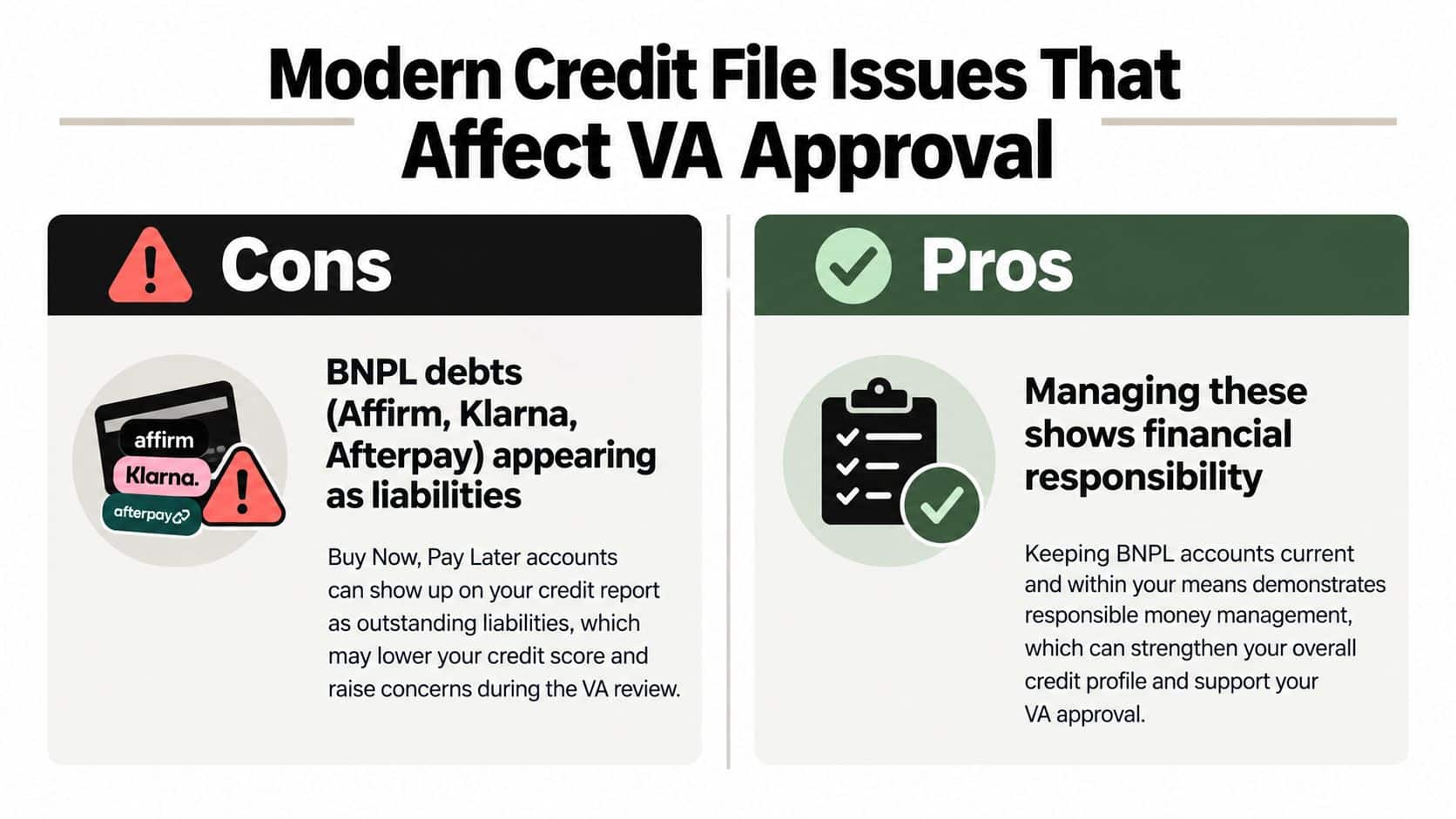
Buy now, pay later services such as Affirm, Klarna, Afterpay, Sezzle, and PayPal can create installment obligations that affect affordability. Some may be reported lightly or inconsistently, but a lender may still identify them through bank statements, application disclosures, credit data, or other documentation. The debt can matter because underwriting evaluates the borrower's obligations, not only the score displayed by a scoring model.
BNPL and affordability
A borrower may view several small payments as separate purchases. An underwriter may view them as recurring obligations that reduce available monthly cash flow. Those payments can influence the lender's assessment of debt-to-income and file stability, especially when new accounts appear shortly before an application.
That doesn't make BNPL use automatically disqualifying. Consistent repayment can show organization and responsibility. The concern arises when the obligations are difficult to identify, accumulate quickly, or compete with rent, car payments, credit cards, and the proposed mortgage.
Borrowers should keep records of current balances, payment schedules, and account status. Don't hide obligations from a lender. Complete and accurate disclosure gives the underwriter a better basis for evaluating affordability.
Thin files and no traditional history
A thin credit file contains limited information for a lender to review. Someone may have paid rent, utilities, insurance, or other regular bills without using conventional credit accounts that report to the bureaus. A no-credit-history borrower may therefore have a weaker score profile without having a history of missed payments.
VA guidance says lack of credit isn't viewed as a negative by itself. Lenders may consider nontraditional tradelines, meaning documented payment accounts such as rent or utilities that help demonstrate financial responsibility. Some lenders may also use alternative scoring models or additional documentation.
This is one reason a simple VA min credit score search can mislead borrowers. The benchmark doesn't capture every way a lender may evaluate a file. Short-term score gains also matter less than a sustained pattern of accurate reporting, affordable obligations, and on-time payments.
For borrowers concerned about differences between bureau reports, reviewing credit bureau mismatches can help identify why an account appears differently across reports and what documentation may be relevant.
Building a Lender-Ready Credit Profile Before You Apply
Preparation works best as a controlled process. The objective isn't to manufacture a score. It's to make sure your reports are accurate, your obligations are understood, and your recent behavior supports a responsible mortgage application.
Begin with a complete review
Obtain your available reports from the major credit reporting companies and compare names, account numbers, balances, payment statuses, dates, and ownership. Look for accounts that aren't yours, duplicate collections, obsolete information, incorrect late payments, inaccurate charge-off details, and debts that should have been updated after payment or transfer.
Keep a document file with statements, account correspondence, payment confirmations, identity records, and other evidence. A clear record makes it easier to explain an issue and distinguish a legitimate dispute from a request to remove accurate information.
Use the dispute and verification process
A dispute should identify the specific information you believe is inaccurate, outdated, unverifiable, or misleading and explain why. Supporting documents can help the reporting company or furnisher investigate. The result depends on the accuracy of the claim, the evidence submitted, creditor responses, and the information available to the reporting system.
No legitimate credit restoration company should promise guaranteed deletions, an overnight repair, or a specific score increase. Results vary by file and by current credit behavior. Accurate negative information generally requires a different strategy from information that cannot be verified or is being reported incorrectly.
Build positive habits while issues are reviewed
Bring revolving balances down where practical, avoid taking on unnecessary new obligations, and keep every active account current. Consumers with thin files may discuss secured or starter card options with a qualified professional, but opening an account solely to chase a score can create a new payment obligation.
Account stability matters. Don't close an older account or shift balances without considering how the change could affect your overall profile and mortgage timeline. Keep statements and confirmation records for debts you pay or settle.
Address mortgage-specific concerns
Before applying, review collections, late payments, charge-offs, utilization, and debt-to-income together. A lender may need explanations for recent derogatory activity, documentation for unusual deposits or payments, or a clearer picture of recurring BNPL obligations.
Superior Credit Repair on credit ratios offers educational information about utilization planning. Whether you work with a credit repair company, a housing counselor, or directly with a lender, choose a process based on accuracy, documentation, and realistic timelines.
Your Realistic Next Steps Toward a VA Loan
You now have a more useful answer than a single score threshold. The VA sets no minimum credit score, lenders commonly use their own standards around 620, and some may consider scores from 550 to 580 when the full profile supports the application. The score matters, but payment history, collections, charge-offs, utilization, debt obligations, income, occupancy, and file stability give the lender the context needed for a decision.
Start by checking your credit reports and making a written list of issues. Separate information that appears inaccurate from information that is accurate but needs time and responsible management. Then speak with a VA lender about its current overlays before making major changes to your accounts.
If your file needs work, a structured plan can be more useful than a rushed application. You can review how Superior Credit Repair designs a recovery and compare that approach with guidance from a lender or housing counselor. Results vary based on documentation, creditor responses, account history, and current behavior.
Superior Credit Repair can review your credit report, help identify inaccurate or questionable items, and explain a step-by-step plan for improving your credit profile. You can request a free credit analysis or consultation to better understand your options.
Frequently asked questions
Does a 620 score guarantee VA loan approval
No. 620 is a common lender benchmark, not a guarantee and not a VA-set minimum. The lender still evaluates the full credit file, income, debts, occupancy, and documentation.
Can you get a VA loan with no credit history
Possibly. VA guidance says lack of credit isn't viewed as a negative by itself. A lender may review nontraditional tradelines or use another method to evaluate payment responsibility, but each lender sets its own underwriting requirements.
How can BNPL debt affect VA approval
BNPL obligations can affect affordability and debt-to-income even when they aren't fully reflected in a credit score. Disclose current obligations, maintain payment records, and avoid taking on new debt without understanding how a lender may evaluate it.
Is credit repair legal
Yes, credit repair can involve lawful report review, documentation, disputes, verification, and credit education. The process must be accurate and honest. No company can legally promise guaranteed deletions, a specific score increase, or guaranteed mortgage approval.
If this information helped you better understand your credit report or your next steps, we would appreciate your honest feedback. You are welcome to share your experience with Superior Credit Repair on our Google Business Profile.
Superior Credit Repair offers documentation-based credit report reviews, dispute support, and mortgage-readiness education for veterans and families preparing for VA financing. Visit Superior Credit Repair to request a free credit analysis or consultation and discuss a realistic plan for your credit profile.