

Most mortgage denials come down to two hurdles: high debt-to-income ratio and credit report problems. In 2024, lenders denied more than 526,000 home purchase applications, roughly one in six, with DTI involved in about 35% of denials and credit history involved in about 29%.
You may be sitting at a kitchen table with a lender's application open, a target home saved on your phone, and one uncomfortable question: what will stop approval? A low score may be part of the answer, but it rarely tells the whole story. Lenders also examine monthly obligations, income stability, available assets, account history, and whether the information in your credit file can be verified.
The right objective isn't just to chase a higher number. It's to become underwriting clean, meaning your credit report, debts, income records, bank activity, and application details tell a consistent story. Results vary with each credit file, documentation, creditor response, account history, and current financial behavior, so no ethical company can promise a deletion, score increase, or loan approval.
Table of Contents
- Why Loans Get Denied in 2026
- Step-by-Step Credit File Cleanup
- Loan-Specific Approval Requirements
- Hidden Approval Risks and Common Mistakes
- The Lender-Ready Action Plan
- Frequently Asked Questions
Why Loans Get Denied in 2026
A lender doesn't approve a loan because one score crosses an imaginary finish line. Underwriting evaluates whether you can manage the proposed payment alongside your existing obligations and whether your financial history supports the application. That's why someone with an acceptable score can still be declined for excessive debt, unstable income documentation, unresolved disputes, or inaccurate negative reporting.
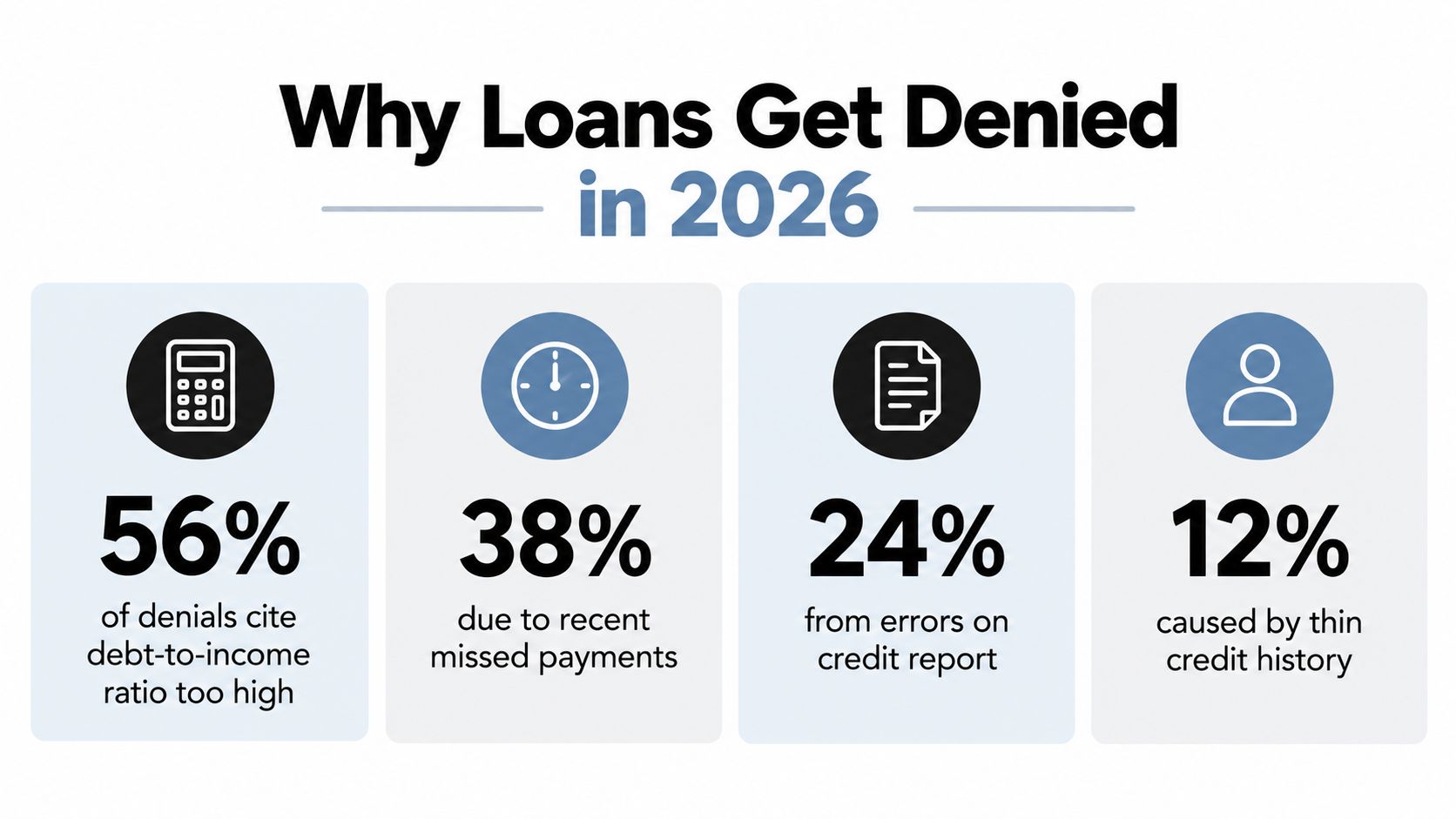
The Federal Reserve research cited above found that DTI was the most common denial hurdle, followed by credit history. During the 2022–2023 tightening cycle, aggregate denial rates increased from 12.2% to 15.7% through the DTI channel, and denial rates rose sharply for applicants above 50% DTI, eventually exceeding 80% above 60% DTI. See the Federal Reserve analysis of mortgage denial determinants for the underlying discussion.
The two screens that matter most
DTI compares your recurring monthly debt obligations with your gross monthly income. Credit card payments, auto loans, student debt, personal loans, and the new housing payment all compete for the same income. Reducing a revolving balance can help, but opening another account or financing a purchase can move your file in the wrong direction even if you never miss a payment.
Credit history tells the lender how reliably you've handled obligations. Late payments, collections, charge-offs, repossessions, and active disputes can create concern. An error can be just as disruptive as a legitimate negative account if it makes your file look riskier than it really is.
A practical overview of score factors and credit-building fundamentals is available in the Wealth Collective credit score guide. For the lender's broader evaluation, review these mortgage approval criteria explained, especially the relationship between credit history, liabilities, income, and documentation.
Practical rule: Don't apply because your score looks acceptable. Apply when your entire financial file is consistent, documented, and free of correctable surprises.
A lender-ready profile therefore has several parts. It has accurate account information, manageable monthly obligations, stable income records, explainable deposits, and no last-minute borrowing. That standard is more useful than obsessing over whether a single score is just above or below a target.
Step-by-Step Credit File Cleanup
Start before you request mortgage pre-approval. A credit report audit gives you time to find mistakes, gather records, and allow the reporting process to update your file. Submitting an application first and hoping to explain problems later gives the lender control of the timeline.
Pull every report and build an evidence file
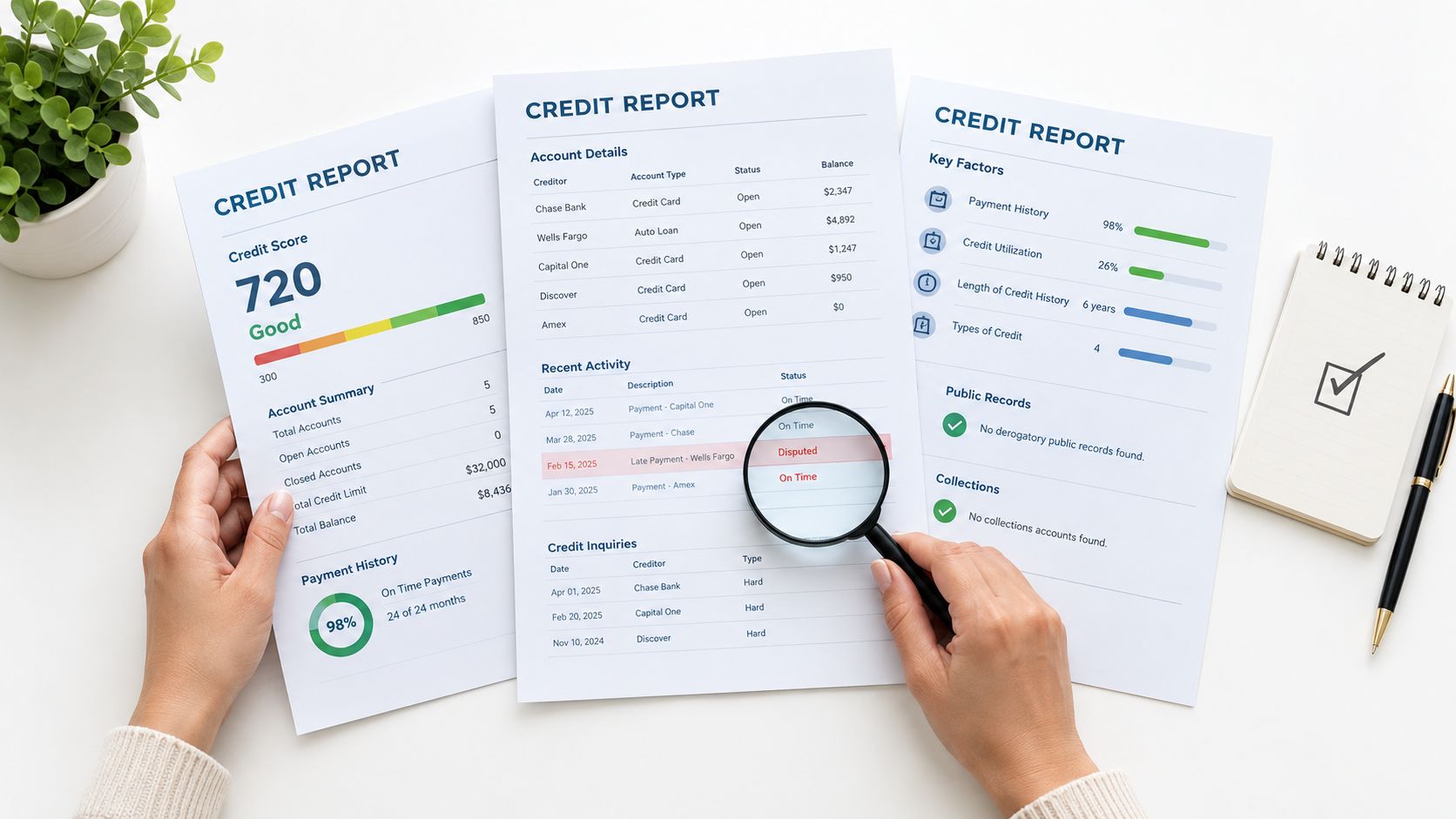
Obtain reports from all three nationwide credit reporting bureaus. The reports may contain different information, so checking only one can leave a collection, duplicate account, outdated balance, or incorrect payment status undiscovered.
Consumer-report surveys found serious problems in a meaningful share of reports. 25% contained serious errors that could cause a credit denial, 22% showed duplicated loans, 8% were missing major positive accounts, and 30% still listed closed accounts as open, according to consumer-report error findings from U.S. PIRG.
Create a simple record for every questionable item:
- Account identity: Write down the creditor name, account number as displayed, bureau reporting it, and account type.
- Problem description: State whether the balance, dates, ownership, payment status, account status, or personal information is inaccurate.
- Supporting documents: Gather statements, settlement letters, payment confirmations, identity-theft records, court documents, or correspondence.
- Desired correction: Ask for the specific correction supported by your records. Don't demand removal of accurate information just because it's negative.
Dispute with precision
A dispute should explain what's wrong and why the documentation supports a correction. Send the dispute to the appropriate credit reporting agency and, when appropriate, the furnisher that supplied the information. Keep copies of everything, including delivery confirmation and responses.
Under the Fair Credit Reporting Act process described by the Federal Trade Commission, a credit reporting agency normally has 30 days to investigate. If you add relevant information during that period, the investigation can extend by 15 additional days, for a possible total of 45 days.
Don't dispute accurate information with a generic form letter. A documentation-based process protects credibility and gives the recipient a clear issue to investigate. For practical guidance on preparing disputes involving correct collections and charge-offs, organize the facts before sending anything.
Wait for the file to reflect verified corrections
After a response, compare the updated report with your original evidence. Check whether the balance, payment history, ownership, dates, and account status changed as requested. If the response doesn't address the issue, preserve the result and consider the next lawful dispute or documentation step.
Accurate negative information generally can't be erased just because it hurts your application. Credit restoration means identifying inaccurate, outdated, unverifiable, or misleading reporting and using the applicable dispute and verification process. It also means rebuilding positive payment habits while the review is underway.
Loan-Specific Approval Requirements
The best loan program depends on your credit profile, cash position, service history where applicable, income, property, and overall debt burden. Don't assume a conventional mortgage is the only route, and don't assume a lower down payment automatically makes a program affordable.
For conventional mortgages, commonly cited approval profiles include an average FICO score around 755, approximately 19% down, and 35% DTI. FHA profiles are looser by comparison, with an average FICO around 676, approximately 5% down, and 43% DTI, according to mortgage approval profile comparisons. Those are profile descriptions, not promises or universal lender rules.
FHA and conventional options
FHA loans can allow a 580 score with 3.5% down, or a 500 score with 10% down, subject to program and lender requirements. Conforming conventional loans are commonly described as requiring about a 620 score, with some fixed-rate loans allowing 3% down and adjustable-rate loans commonly allowing 5% down, as outlined by Bankrate's FHA versus conventional comparison.
That difference matters for first-time buyers and people rebuilding after hardship. FHA may offer a more accessible entry point, while conventional financing may suit a borrower with stronger credit, more cash, and lower perceived risk. Compare the complete payment, mortgage insurance, cash reserves, and underwriting conditions instead of choosing based only on the minimum score.
If you're evaluating a lender conversation, this discussion of pre-approval from EndureGo Tax can help clarify why pre-approval is more useful when your documents and liabilities are already organized. You can also review the conventional loan 620 requirement in the context of the full application rather than treating it as a guarantee.
VA, USDA, and other financing
VA loans can be valuable for eligible military borrowers, but eligibility doesn't eliminate the need for stable income, accurate credit reporting, manageable obligations, and lender-specific underwriting. USDA financing may help eligible buyers in qualifying areas, yet property, income, documentation, and program rules still matter.
Personal loans use a different risk assessment from mortgages. Lenders may focus on credit history, income, existing obligations, and the requested payment. If you're trying to qualify for auto, business, or personal financing, the same lender-ready principles apply: correct the file, avoid unnecessary new debt, document income, and borrow only at a payment your budget can support.
Hidden Approval Risks and Common Mistakes
Many applicants believe a debt doesn't matter if it doesn't appear on a traditional credit report. That assumption is particularly risky with buy-now-pay-later plans. Affirm, Klarna, Afterpay, Sezzle, and similar services may create recurring obligations visible in bank statements even when the account isn't reported in the same way as a credit card or installment loan.
Recent reporting on BNPL and mortgage approval risk explains the two pathways. Underwriters can identify recurring payments through cash-flow and bank-statement review, which can increase the borrower's effective DTI. New FICO score versions announced in June 2025 also began incorporating BNPL data as availability expanded, making these obligations relevant to both underwriting review and future scoring models.
What can quietly weaken an application
Opening new credit: A new card, auto loan, personal loan, or furniture account can create a hard inquiry, a new payment, and a lower average account age. Even responsible borrowing can make your application look different from the file the lender initially reviewed.
Changing jobs without documentation: A job change may be reasonable, but lenders need a clear record of income stability and may request additional documents. Avoid creating uncertainty close to application unless the move is necessary and you can document it.
Leaving disputes active: A dispute can affect how an account balance or payment history is interpreted. Ask the prospective lender how active disputes will be handled before submitting a final application, and resolve documentation issues early.
Ignoring bank activity: Large unexplained deposits, frequent overdrafts, recurring transfers, or undisclosed obligations can prompt questions. Keep records for deposits and maintain ordinary, traceable account activity.
The same caution applies to collections, late payments, charge-offs, medical collections, and repossessions. Don't pay or close an account blindly if you don't understand how the action affects reporting, settlement documentation, or underwriting. Use this guide from Superior Credit Repair to review avoidable actions before a major approval review.
A lender evaluates the financial story behind the score. Make every part of that story easy to verify.
The Lender-Ready Action Plan
Approval readiness improves when you manage the process in the right order. First establish what the reports say. Then correct errors, reduce obligations, stabilize behavior, organize records, and only afterward submit applications. This sequence prevents a preventable credit-report problem from becoming a formal denial.
Start with an honest baseline
Pull all three reports and list every open account, balance, monthly payment, collection, late payment, charge-off, dispute, and recent inquiry. Compare the list with your bank statements and budget. Include BNPL plans and obligations that may not appear on the reports.
Next, calculate your current monthly debt burden using documented income. Don't rely on a rough estimate. Include the likely housing payment when you assess affordability, because a lender will evaluate the proposed loan alongside existing obligations.
Correct the file before you present it
Dispute inaccurate information with facts and supporting records. Track dates, responses, and requested corrections in one folder. If an account is accurate, focus on responsible repayment, written settlement terms where relevant, and a clean pattern of future payments rather than pursuing an unsupported deletion.
Credit utilization deserves active management. Keep revolving balances controlled, avoid charging close to limits, and pay attention to the balance that reports, not only the amount you pay by the due date. Don't close long-standing accounts or open new ones without considering the effect on your overall profile.
Stabilize the application window
Protect your financial snapshot before applying. Keep making every payment on time, avoid new financing, don't move money without records, and maintain consistent employment documentation. Ask the lender what records it wants so you can provide complete statements, pay information, tax documents, identification, and asset evidence without scrambling.
A mortgage readiness service can help you review reports, identify lender-readiness issues, organize documents, and choose a lawful dispute strategy. Superior Credit Repair offers this type of credit restoration and planning support, but results vary and no provider can guarantee a score outcome, deletion, or approval.
Use the plan to rebuild credit for mortgage approval as a planning reference. The timing matters less than the condition of your file when the lender pulls it. Apply smartly by comparing programs, asking about prequalification, and submitting a complete application only after you understand the lender's documentation and credit requirements.
Frequently Asked Questions
Can anyone guarantee that I'll get approved?
No. A credit repair company, lender, or advisor can't ethically guarantee mortgage approval. Underwriting depends on your credit file, income, assets, debt obligations, property, documentation, lender standards, and current market conditions. Credit restoration can correct inaccurate reporting and support better habits, but it can't change accurate history or control a creditor's decision.
Should I pay every collection before applying?
Not automatically. First determine whether the account is accurate, who owns it, how it's being reported, and whether the lender has a specific requirement. Paying an account without a plan may not produce the result you expect. Review documentation and ask the lender how collections will be treated before taking action.
How long does credit repair take?
There isn't one universal answer. A file with a clear reporting error may move differently from a file with accurate late payments, several creditors, active disputes, or incomplete documents. The credit repair timeline depends on bureau processes, creditor responses, evidence quality, and your ongoing payment behavior.
Is a higher score enough for a mortgage?
No. A score is one part of the review. Lenders also assess DTI, income stability, assets, account status, payment history, and whether your application matches your credit report and bank records. Becoming underwriting clean is a stronger target than chasing a score alone.
What should I do after a mortgage denial?
Request the lender's adverse-action explanation, identify the specific issue, and compare it with your reports and documentation. If the reason involves an error, address that error through a documented dispute process. If the problem is DTI or affordability, reduce obligations and strengthen income documentation before reapplying.
Superior Credit Repair can review your credit report, help identify inaccurate or questionable items, and explain a step-by-step plan for improving your credit profile before you apply. Visit Superior Credit Repair to request a free credit analysis or consultation and better understand your mortgage-readiness options.
Superior Credit Repair Online provides educational credit guidance for individuals and families preparing for major financial goals like buying a home, applying for a mortgage, refinancing, or rebuilding after credit challenges.
If this information helped you better understand your credit report or your next steps, we would appreciate your honest feedback. You are welcome to share your experience with Superior Credit Repair on our Google Business Profile.