


A single credit bureau dispute usually takes 30 to 45 days to investigate, but rebuilding a damaged credit profile for mortgage approval typically requires several months of consistent positive payment history. If accurate negative information is involved, the broader recovery can take much longer.
That answer challenges the most popular advice about credit repair. There isn't a legitimate overnight fix, guaranteed deletion, or reliable promise of an immediate score increase. A corrected account and a lender-ready credit profile are different outcomes, governed by different timelines.
For a first-time homebuyer, that distinction matters. You might correct a reporting error, yet still need time to lower revolving balances, establish stable payments, address collections, and demonstrate responsible credit behavior. Results vary according to your credit file, documentation, creditor responses, account history, and current financial habits.
Table of Contents
- The Two Clocks of Credit Repair
- Federal Timelines for Credit Report Disputes
- Factors That Speed Up or Slow Down Progress
- Sample Timelines for Common Credit Issues
- Building a Mortgage-Ready Credit Profile
- Realistic Milestones and What to Expect Month by Month
- Frequently Asked Questions About Credit Repair Timelines
The Two Clocks of Credit Repair
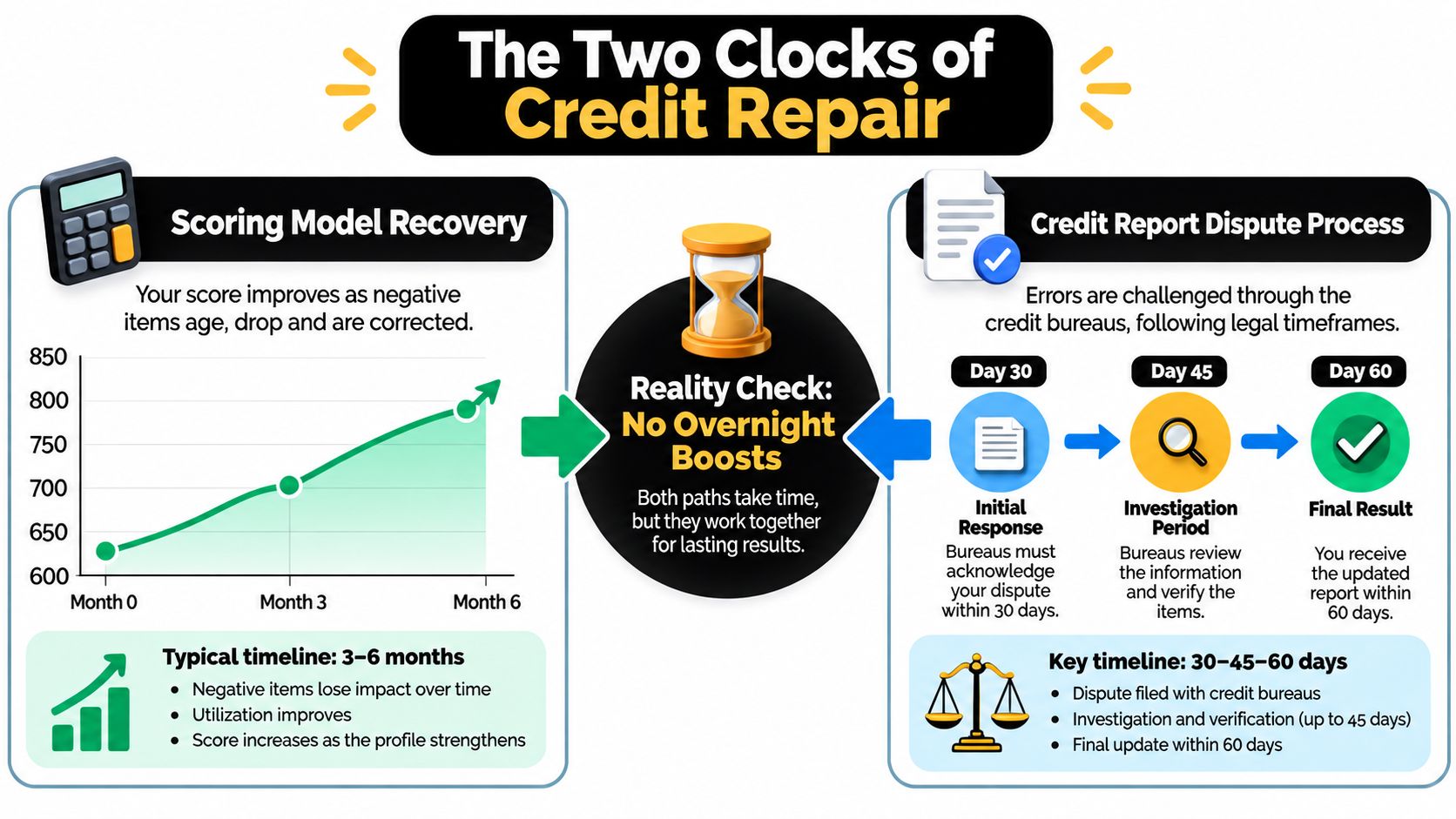
People searching for how long credit repair takes often expect one deadline. Credit improvement follows two separate clocks, and confusing them can lead to poor mortgage timing decisions.
The first is the dispute clock. It covers the administrative review of inaccurate, outdated, unverifiable, or misleading information. A credit bureau generally investigates within 30 days, with certain situations extending the process to 45 days under the Fair Credit Reporting Act's dispute provisions.
The second is the rebuilding clock. It measures the time required for the wider credit profile to become stronger. Consistent payments, lower balances, appropriate resolution of legitimate obligations, and new positive reporting all matter. Guidance from Experian explains that score improvement can take months to years, depending on the accounts involved, the accuracy of negative information, and whether positive data continues to appear on the report (Experian's credit repair timeline guidance).
Why a corrected item may not solve everything
A late payment reported on the wrong person's file may be removed after a successful dispute. That correction restores accuracy, but it does not automatically lower credit card balances or create a longer record of on-time payments.
Mortgage lenders assess the full file. They may review payment history, utilization, collections, charge-offs, debt-to-income concerns, and account stability. A dispute can correct one reporting problem, while rebuilding requires sustained responsible behavior across the remaining accounts.
A useful distinction is simple: the dispute clock asks whether information was reported accurately. The rebuilding clock asks whether the borrower now shows a stable pattern of repayment. One resolved item may therefore improve the report without making the borrower mortgage-ready immediately.
Consumers can monitor credit report changes calmly rather than reacting to every score fluctuation. Superior Credit Repair Online treats credit restoration as a documented review and longer-term rebuilding process, not an instant-results promise.
Federal Timelines for Credit Report Disputes
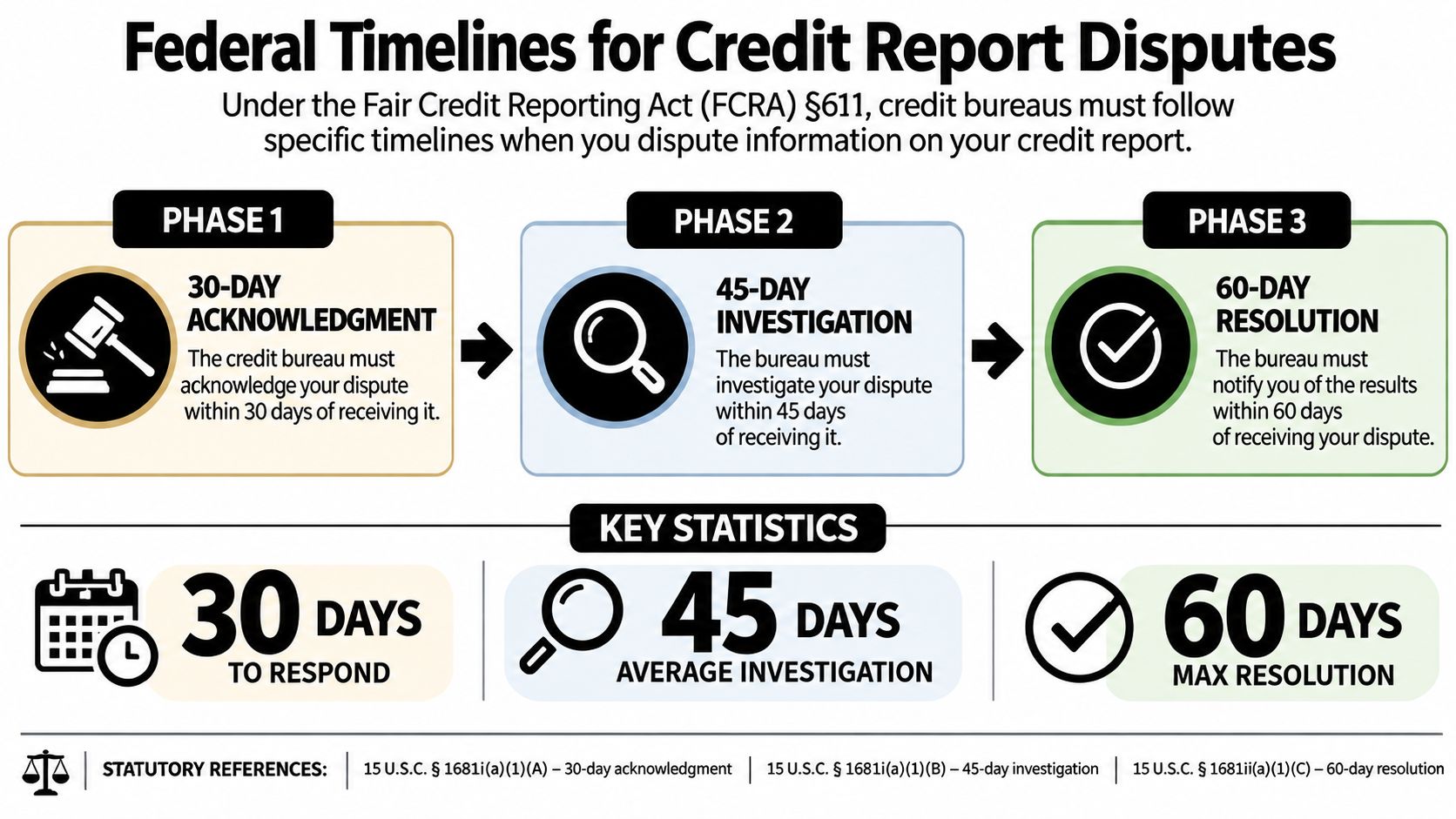
Federal rules set a procedural clock for correcting possible reporting errors. A credit reporting company generally must investigate a dispute within 30 days. The period can extend to 45 days if the consumer files after receiving a free annual credit report or submits new information during the investigation, according to CFPB guidance on credit report errors.
The process usually follows four steps:
- Review the report. Locate the account and identify the specific problem, such as an incorrect balance, payment status, date, ownership detail, or personal information.
- Prepare documentation. Gather records that support the claim, including statements, correspondence, identity documents, or payment evidence.
- Submit the dispute. Send the explanation and supporting records to the bureau reporting the information. If appropriate, provide the same facts to the creditor or other furnisher.
- Track the response. The bureau investigates and communicates its result. After the investigation ends, it must notify the consumer within five business days, as required under the FCRA dispute process.
Why the deadline isn't a guarantee of deletion
The deadline controls how quickly the bureau must respond, not what conclusion it must reach. The bureau may verify the information, correct it, delete it, or decide that the dispute lacks enough support. A dispute challenges accuracy. It does not require removal merely because an item lowers a score.
The Federal Trade Commission explains that accurate negative information does not have a quick-removal option. It may remain for seven years, while bankruptcy may remain for 10 years, as described in the FTC consumer guide to fixing credit.
The dispute clock and rebuilding clock measure different outcomes. A resolved error may improve the report, while mortgage readiness can still require months or years of consistent payments, manageable balances, and stable accounts. To dispute credit report for home loan, provide facts specific enough for the recipient to evaluate.
Factors That Speed Up or Slow Down Progress
Two consumers can dispute similar-looking accounts and experience different results. The timing depends on the quality of the claim, the supporting records, the number of accounts involved, and the responses from creditors or other furnishers.
Documentation quality
A clear dispute identifies the account and explains the exact error. “This account is wrong” gives the reviewer little to evaluate. A stronger submission connects the claim to a specific record, such as an incorrect payment status, balance, ownership detail, or date.
Documentation doesn't guarantee a favorable result, but it makes the issue easier to understand. It also helps preserve a reliable record of what you challenged and why.
Furnisher response and file complexity
Credit reporting companies often need information from the business that supplied the data. If the furnisher confirms the information, the bureau may leave it unchanged. If the account has several conflicting records, ownership questions, or a long payment history, the review can require more careful analysis.
A simple clerical mistake may be easier to evaluate than a disputed medical collection, repossession, or charge-off involving multiple documents. A complex file may also require follow-up work after the initial response.
Dispute relevance
The FTC states that a bureau can stop investigating a dispute it considers frivolous or irrelevant, but it must notify the consumer and explain the reason (Experian's explanation of dispute investigations). That makes accuracy and documentation central to responsible credit restoration.
Documentation matters more than volume. Sending repeated generic challenges can create confusion. A focused, well-supported dispute gives each issue a clearer path to review.
Your own actions can also slow progress. New late payments, rising card balances, unnecessary applications, ignored correspondence, or incomplete records can undermine a rebuilding plan while disputes are pending. Reviewing practical Superior Credit Repair advice before a major approval review can help you avoid preventable setbacks.
Sample Timelines for Common Credit Issues
Credit issues do not follow one universal schedule. An inaccurate late payment may be corrected after one investigation cycle when the records clearly support the change. A legitimate charge-off may remain reportable, so the practical work shifts from disputing the item to rebuilding payment history and account stability.
The table separates the dispute clock from the rebuilding clock. The first concerns administrative review. The second concerns the sustained behavior lenders may want to see across the full credit file. These are planning categories, not guarantees.
| Credit Issue Type | Initial Dispute Window | Rebuilding Phase |
|---|---|---|
| Inaccurate late payment | Usually one bureau investigation cycle, generally 30 days, with some cases extending to 45 days | Continued on-time payments and stable account management may still be needed |
| Collection with disputed details | Generally 30 days, with some cases extending to 45 days | May require follow-up documentation, account review, and ongoing positive credit behavior |
| Medical collection with inaccurate or unverifiable information | Generally 30 days, with some cases extending to 45 days | Depends on the report result, remaining accounts, utilization, and payment history |
| Charge-off with disputed ownership, balance, or dates | Generally 30 days, with some cases extending to 45 days | Often requires a longer strategy when the information is accurate and remains reportable |
| Thin credit file | Not primarily a dispute issue unless the file contains errors | Requires time to establish responsible account history and lender confidence |
| Multiple negative accounts | Each issue may require its own review and supporting records | Several rounds of work and sustained positive behavior may be necessary |
A bureau investigation can resolve a reporting problem within one cycle, but that result does not automatically create mortgage readiness. The rebuilding phase depends on current payment behavior, balances, account age, and the condition of the remaining file.
Why mortgage preparation takes longer
Mortgage preparation often exceeds one dispute cycle. Multiple disputes, document requests, and follow-up with a bureau or furnisher can extend the process. Each unresolved item may use the full investigation window before the next decision is available, as explained in Experian's dispute process explanation.
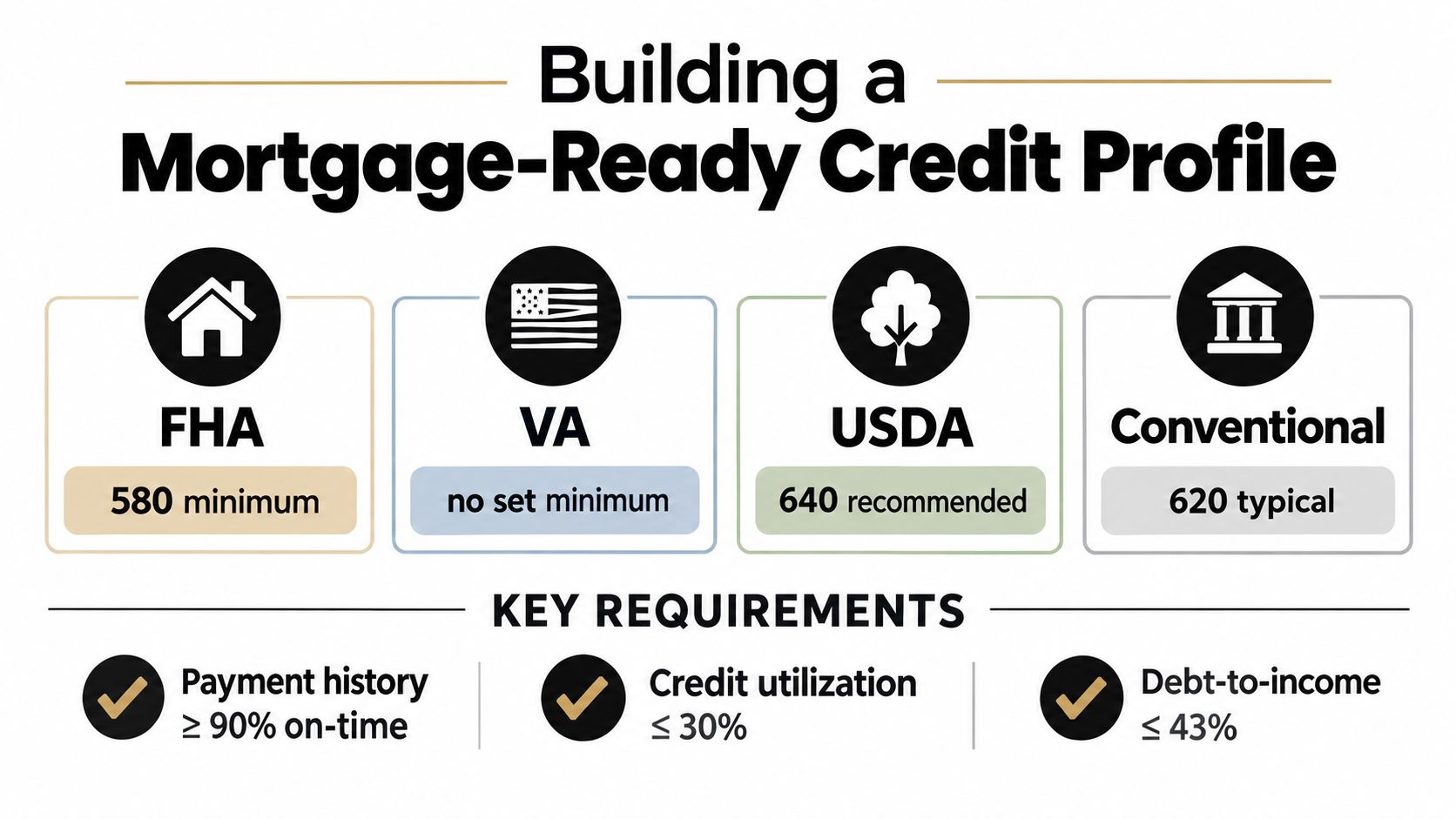
A consumer preparing for FHA, VA, USDA, or conventional mortgage approval should begin before choosing a lender. This credit repair timeline guide can help organize report review, documentation, utilization planning, and follow-up without treating a calendar date as a promised outcome.
Building a Mortgage-Ready Credit Profile
Mortgage readiness isn't defined only by whether a negative item disappears. Underwriters generally evaluate the complete financial picture, including payment history, credit utilization, collections, charge-offs, debt-to-income concerns, and the stability of the accounts on the file.
That applies across FHA loan preparation, VA loan preparation, USDA loan preparation, and conventional mortgage preparation. Each program and lender can apply its own underwriting standards, so a credit restoration plan should support lender review rather than attempt to manipulate a single score.
The profile lenders see
A borrower may correct an inaccurate collection and still need to reduce high revolving balances. Another borrower may have no major errors but lack enough established account history for a lender to assess stability confidently. Someone recovering from divorce, job loss, bankruptcy, or a medical hardship may need a plan that addresses both reporting accuracy and current affordability.
Debt-to-income is especially important because it compares monthly debt obligations with income. Credit repair can't replace the need for a sustainable budget, accurate income documentation, and manageable debts.
First-time buyers can also benefit from learning the broader homebuying process. For readers considering an international comparison or local housing-market perspective, this resource on buying a home in Vancouver offers context from Jacky Levi, a Vancouver Realtor. It doesn't replace advice from a United States mortgage professional, but it can illustrate why homebuyers should understand both financing preparation and the purchase process.
Positive credit needs time to accumulate
Lowering utilization can help the reported profile reflect less revolving debt, but the result depends on when creditors report and how the rest of the file looks. Consistent payments matter because lenders want evidence that current obligations are being handled responsibly.
Consumers with limited history may need education about starter products, secured cards, or appropriate reporting options. A thin file requires caution. Opening accounts solely to chase a score can create unnecessary inquiries or debt. Guidance about rent and utility credit for mortgages should be evaluated alongside the lender's requirements and the consumer's broader financial plan.
Superior Credit Repair can help consumers review report accuracy, organize documentation, and understand credit-building options. It can't guarantee deletions, score changes, or approval, and no responsible company can promise those outcomes.
Realistic Milestones and What to Expect Month by Month
Consider a first-time buyer named Jordan. Jordan finds a collection with an incorrect balance, two late-payment entries that need documentation, and credit card balances that are making the profile look heavily used. Jordan also has a target to become mortgage-ready, but not a promised approval date.
The initial review
During the first stage, Jordan obtains reports, checks personal information, lists each questionable account, and gathers statements and correspondence. The objective isn't to dispute everything. It's to separate potential errors from accurate negative information and identify current habits that need attention.
Jordan also creates a payment calendar, avoids new unnecessary applications, and reviews the monthly budget. Those actions don't change the report instantly, but they protect the rebuilding process from new damage.
The first investigation cycle
Jordan submits focused disputes with relevant documentation and records the dates. AnnualCreditReport.com advises consumers to allow up to 30 to 45 days for an investigation and says that if a dispute changes a report, the consumer can order a second free report within 12 months to review the changes (AnnualCreditReport.com's dispute instructions).
The first response may resolve one issue, leave another verified, and request a different strategy for a third. Jordan should read each result carefully rather than assume that one correction settles the entire file.
Continued rebuilding
After the initial response, Jordan compares the updated report with the prior version, continues on-time payments, works to lower revolving balances, and addresses accurate obligations responsibly. If a furnisher verifies disputed information, Jordan reviews the explanation and supporting records before deciding whether additional action is appropriate.
The rebuilding clock continues while administrative work proceeds. That is why mortgage credit repair should begin before the application stage, especially for buyers with collections, late payments, charge-offs, high utilization, or a thin credit file.
Frequently Asked Questions About Credit Repair Timelines
Do credit scores update immediately after a dispute?
No. A bureau may investigate within 30 to 45 days, but the score can update later, often when the next reporting cycle reflects the result (consumer credit score timing guidance). The dispute clock and rebuilding clock are different. Correcting one entry does not instantly create months of positive payment history.
How long can accurate negative information remain?
Accurate negative information may remain for seven years, and bankruptcy may remain for 10 years (FTC credit repair guidance). Time and responsible management are the appropriate response to accurate reporting.
What should I do if a creditor verifies the account?
Compare the result with your records, identify the specific error, and keep every document. Submit another focused dispute only when you have relevant evidence.
Can credit repair guarantee mortgage approval?
No. Approval, rates, scores, and deletions cannot be guaranteed. Lenders also review income, assets, debt-to-income, documentation, and program requirements.
Superior Credit Repair can review reports and explain options. Visit Superior Credit Repair for a free analysis or consultation.
Share your experience on the Google Business Profile.