

You've found a home in a rural community, your budget seems manageable, and a USDA loan appears to offer a practical path to ownership. Then you search for USDA loan credit requirements and find conflicting answers. One article says you need a 640 credit score. Another says USDA has no minimum score. A lender may give you a different answer based on its own underwriting policy.
The confusion comes from mixing up USDA program rules with common lender practices. The USDA Single Family Housing Guaranteed Loan Program doesn't impose one universal minimum credit score. Instead, it asks whether you've shown a willingness and ability to manage debt. At the same time, many lenders use 640 as an important automated-underwriting threshold, which can affect whether your file receives expedited processing or moves into manual review. USDA Rural Development explains the program's credit approach, while its underwriting guidance provides more detail about how lenders evaluate the complete file.
Superior Credit Repair Online provides educational credit guidance for people preparing for home, auto, business, and personal financing. This guide focuses on the practical question beneath the score myth: How strong does your entire credit file look to an underwriter?
Table of Contents
- Introduction to USDA Loan Credit Requirements
- How USDA Views Credit Without a Single Minimum Score
- Understanding the 640 Threshold and GUS Automated Underwriting
- How Derogatory Credit and Waiting Periods Affect Eligibility
- DTI Credit Report Rules and Compensating Factors Lenders Review
- Step by Step Plan to Prepare and Strengthen Your Credit Profile
- Next Steps Toward USDA Readiness With Trusted Guidance
Introduction to USDA Loan Credit Requirements
A renter has made on-time payments for 18 months, but the credit score is 620. Another buyer has a 680 score, yet recent 60-day late payments appear on the report. Their files call for different questions, because a credit score is only the cover of a financial report. The lender still reviews the pages inside, including payment history, collections, charge-offs, account stability, debt obligations, and explanations for serious past problems.
USDA credit review centers on the borrower's willingness and ability to manage debt. A score below a lender's preferred threshold may still lead to manual underwriting, while a higher score does not remove concerns about major delinquencies or unresolved federal issues. The strength of the entire file matters more than one number.
Practical rule: Treat 640 as a processing milestone, not a universal USDA approval guarantee.
Lender overlays can make the process stricter than USDA baseline guidance. An overlay is an added lender requirement, such as a preferred score cutoff, documentation standard, or specific treatment of derogatory accounts. As a result, two participating USDA lenders may assess the same borrower differently.
Credit is only one part of homebuying readiness. Property eligibility, income documentation, debt obligations, and the home's fit with your long-term plans also require review. Buyers and professionals assisting relocating families can use relocation resources for agents when comparing communities and housing options.
Comparing government-backed mortgage paths can also clarify differences in underwriting. The FHA loan credit score requirements provide another reference point for how a program approaches credit. FHA, VA, conventional, and USDA loans each have program rules and lender overlays.
Superior Credit Repair Online offers educational credit guidance for people preparing for home, auto, business, and personal financing. Preparation starts with reviewing each credit report carefully. Confirm that reported information is accurate and complete, then assess whether recent financial behavior supports the explanation you will provide to a lender.
How USDA Views Credit Without a Single Minimum Score
A borrower with a modest score may still present a file that deserves careful review, while a higher score may not explain recent payment problems. USDA underwriting weighs the full pattern of payment history and account stability, not just the summarized score. The USDA says applicants must show a willingness and ability to manage debt, and its USDA's official program guidance states that the program has no formal minimum credit score requirement.
The score reflects reported information such as payment history, balances, and account age. It does not fully explain why a late payment occurred, whether a collection was resolved, or how an applicant handled the problem. Lenders therefore review the credit report alongside the application, supporting documents, and automated underwriting findings.
Why identical scores can produce different reviews
Two applicants may have the same score but present different levels of documented risk. One might have established accounts, consistent recent payments, moderate balances, and no unresolved federal judgment. Another might have a thin file, recent missed payments, disputed information, and an undocumented collection. The number is similar, but the evidence supporting each application is not.
USDA training materials explain that the Guaranteed Underwriting System, or GUS, uses credit data from a recognized repository. GUS may produce an automated finding, while a thin file or a finding other than an automated accept can lead to manual review. USDA training materials describe GUS and alternative credit evidence.
Alternative or nontraditional credit evidence can help when traditional scoring is unavailable. The lender must document payment behavior and financial obligations, such as recurring housing or service payments, before considering that evidence.
What willingness and ability mean in practice
Willingness concerns whether you paid obligations as agreed and responded responsibly when difficulties arose. Ability concerns whether your income and existing debts support the proposed mortgage payment. A lender evaluates these ideas through documented behavior and affordability, not through one score alone.
For a clearer explanation of how scoring fits into mortgage preparation, review these Superior Credit Repair credit tips. The practical goal is to correct inaccurate reporting, maintain reliable payment behavior, and provide a file the lender can verify.
Understanding the 640 Threshold and GUS Automated Underwriting
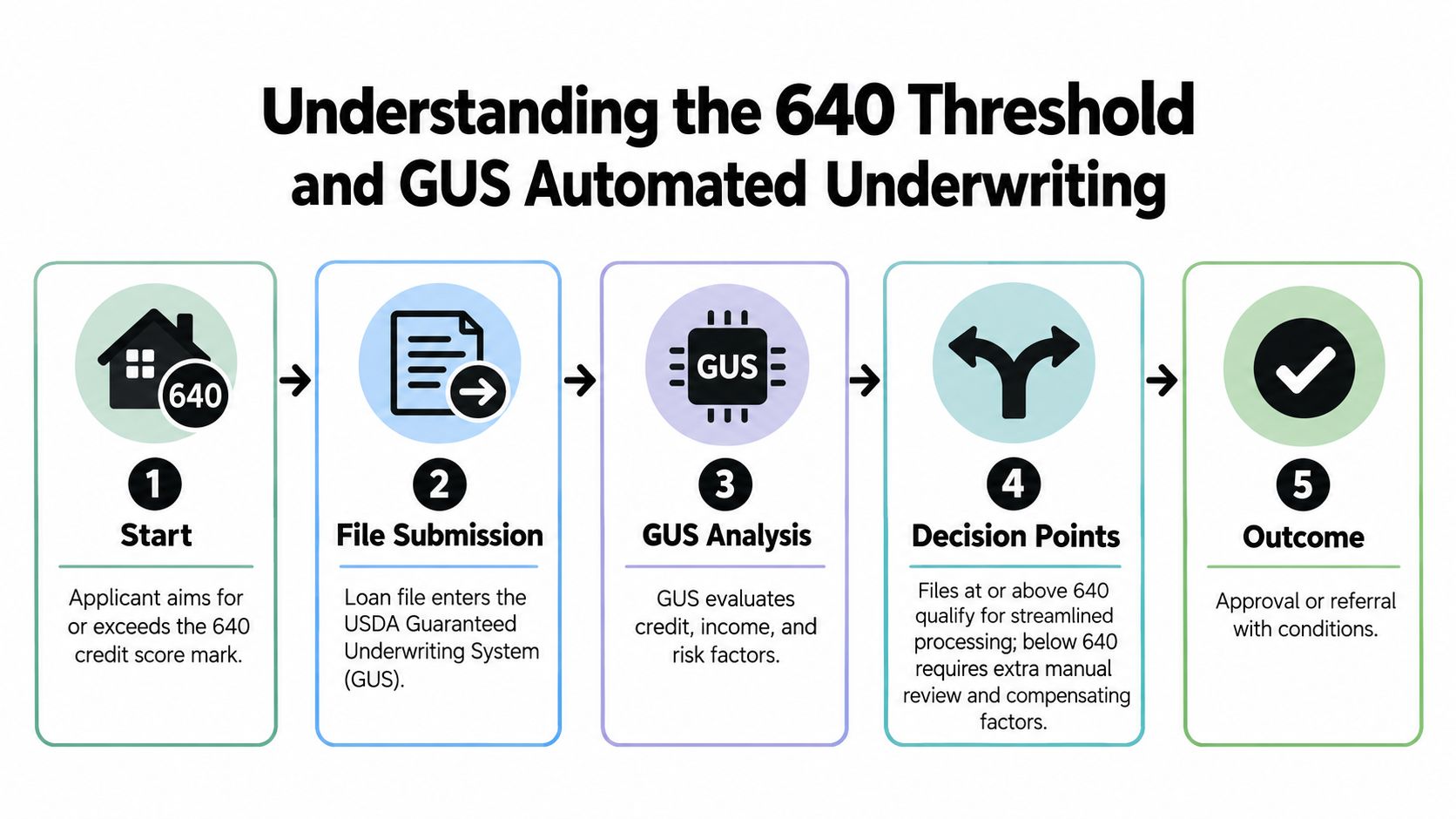
A borrower can reach a 640 threshold and still need careful file preparation. In USDA lending, that score is commonly used as a dividing point for the review path. A score at or above 640 may support automated processing through GUS, while a lower score often leads to manual underwriting. The threshold guides how the file is reviewed, rather than serving as the USDA's single formal approval rule.
Guaranteed Underwriting System, or GUS, examines the information entered in the loan file, including credit data, income, debts, and other risk factors. Its finding can organize the lender's review, but it does not replace verification. The lender remains responsible for checking the application, resolving concerns, and confirming that the information is accurate.
An automated file and a manual-review file
A borrower at or above 640 may receive an automated finding that supports a more predictable documentation process. The lender still reviews the complete application, and an automated result does not prevent questions about payment history, debts, or other concerns.
A borrower below 640 generally receives more individualized attention. The lender may examine the applicant's willingness to manage obligations, ability to afford the proposed payment, financial behavior, and available compensating factors. Manual underwriting is not an automatic denial. It means the lender must evaluate the file more closely instead of relying as heavily on an automated result.
A score opens a review path. It doesn't write the entire approval decision.
A score at or above 640 also does not erase significant credit concerns. Recent payment problems, unresolved accounts, or inaccurate reporting can affect the lender's assessment of stability. Reaching the threshold is therefore one checkpoint, not the end of preparation.
Lender overlays create practical differences
USDA guidance sets the program framework, while participating lenders may apply additional internal standards. One lender may review a lower-score file manually, while another may prefer a higher internal cutoff. Documentation requirements can also differ for disputed accounts, collections, or recent payment problems.
Before applying, ask the lender:
- Score policy: Is 640 an internal minimum or an automated-processing benchmark?
- Manual review: Are files below 640 considered when compensating factors are documented?
- Disputed accounts: How are active disputes handled during underwriting?
- Documentation: Which explanations, statements, or payment records are required?
- Recent problems: How are recent late payments or unresolved derogatory accounts evaluated?
A practical guide to mortgage approval can help you prepare these questions before requesting prequalification. The answer should match the lender's current policy and your actual credit profile.
How Derogatory Credit and Waiting Periods Affect Eligibility
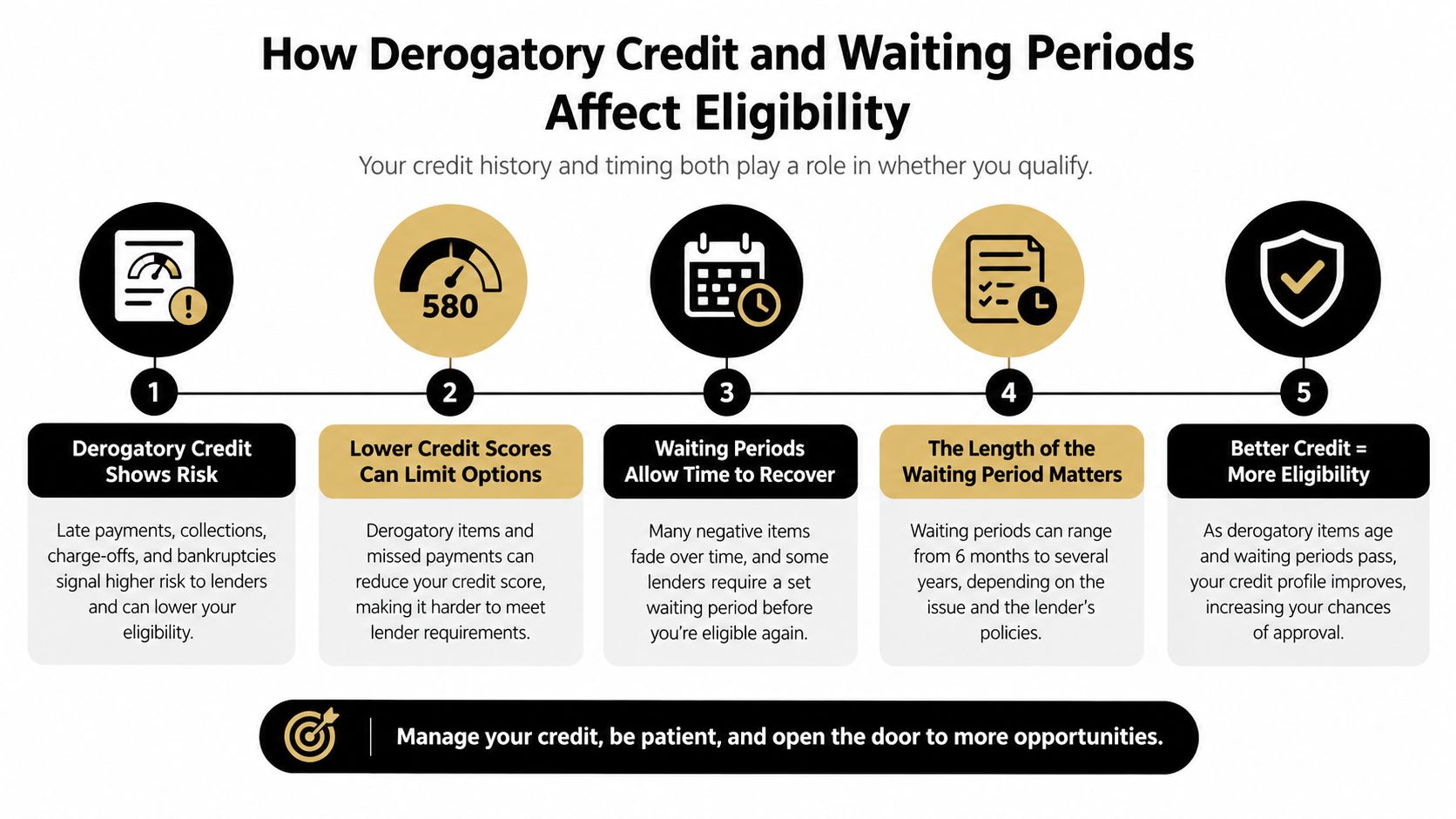
Underwriters don't view every negative item the same way. A recent late payment tells a different story from an older, isolated charge-off. A medical collection may require different documentation from a civil judgment. The important questions are whether the account information is accurate, whether the obligation has been resolved, how recent the event is, and what your payment behavior has looked like since then.
Late payments and account patterns
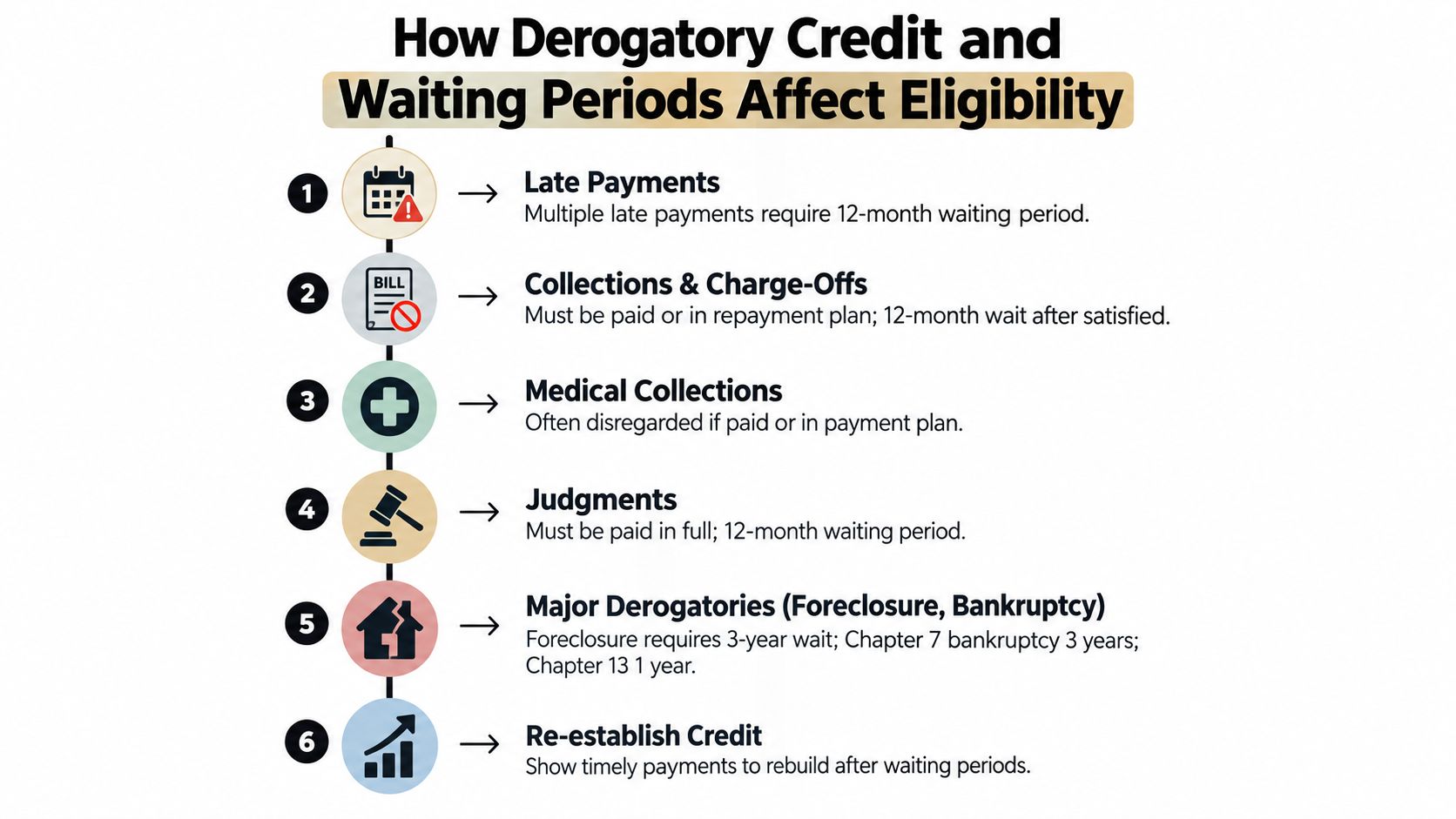
A single older late payment may be viewed differently from a pattern of recent delinquencies. Multiple late payments can lead to closer review because they may suggest difficulty maintaining the proposed housing obligation. Your explanation should be factual and supported by documentation when possible.
A late payment dispute is appropriate only when the reported information is inaccurate, incomplete, outdated, or unverifiable. Credit repair isn't a process for removing accurate information because it's unfavorable. It's a structured review and verification process governed by applicable credit reporting laws.
Collections and charge-offs
Collections and charge-offs can raise questions about repayment behavior and unresolved obligations. A charge-off means a creditor has treated an account as a loss for accounting purposes. It doesn't necessarily mean the debt disappeared. A collection generally means an account has been assigned or sold for collection activity.
Before mortgage underwriting, identify:
- Ownership: Determine which company currently reports or claims the account.
- Accuracy: Compare the balance, dates, account status, and identifying details with your records.
- Resolution: Gather settlement, payment, or repayment-plan documentation when applicable.
- Consistency: Make sure the credit report, lender application, and supporting documents tell the same factual story.
Medical collections may receive different treatment under applicable underwriting guidance, but you shouldn't assume they can be ignored without checking the lender's current requirements. If outdated information continues reporting, handling outdated collections for homebuyers requires careful review rather than an unsupported deletion request.
Judgments, federal issues, and major events
USDA credit requirement summaries reference concerns such as outstanding federal judgments, significant delinquency, and DNP matches. These issues can require specific resolution or documentation before a lender can complete the review. Don't wait until the final loan stage to discover that a record needs attention.
USDA guidance indicates a three-year waiting period after a Chapter 7 bankruptcy discharge, foreclosure transfer date, or short-sale settlement or closing date before a borrower may be eligible again, as described in this USDA waiting-period reference. The exact timing depends on the relevant event date and the lender's review, so keep discharge papers, settlement records, and transfer documents available.
DTI Credit Report Rules and Compensating Factors Lenders Review
Credit is only one part of mortgage readiness. Debt-to-income ratio, or DTI, compares required monthly debt payments with qualifying monthly income. It helps the lender assess whether your budget can support the proposed mortgage alongside existing obligations.
A credit report may show the debts that affect this analysis, but the lender also verifies income, payment obligations, and other application details. Reducing credit card balances may help both your credit profile and your monthly debt picture, but don't move money or close accounts without understanding how the change could affect underwriting. A DTI calculator for borrowers can help you organize your obligations before speaking with a lender.
Credit report age and score selection
USDA guidance says the credit reports used to underwrite guaranteed loans must come from an unaffiliated recognized credit repository. The report must be accurate and complete, and it must be no more than 120 days old at closing. The lender uses the middle score when three scores are available, the lower score when two are available, or the single score when only one is available. These rules appear in USDA credit analysis guidance.
That means the score you see in a consumer app may not be the score used for underwriting. Mortgage scoring can involve different data, repositories, and calculation methods. Ask the lender which report and score selection method applies to your application.
Compensating factors in a manual review
Compensating factors are strengths that help an underwriter understand why a file may present less risk than a score alone suggests. They don't erase inaccurate information or guarantee approval. They provide context for a documented review.
| Review Area | What Lenders Look For | Stronger Signal | Needs Attention |
|---|---|---|---|
| Payment history | Recent and historical repayment behavior | Consistent recent payments | Recent or repeated delinquencies |
| Account stability | Length and reliability of established accounts | Stable, active accounts | Thin or recently opened file |
| Utilization | Revolving balances compared with available limits | Controlled balances | High card balances before application |
| Debt obligations | Monthly payments relative to qualifying income | Manageable recurring debt | Debt that strains the proposed budget |
| Documentation | Accurate reports and supporting records | Complete, consistent evidence | Missing, conflicting, or unverifiable details |
You can reduce DTI for home loan approval by reviewing recurring obligations, avoiding unnecessary new debt, and discussing major financial changes with your lender before making them. Stable employment, cash reserves, clean recent payment history, and controlled utilization may strengthen the overall file, but the lender decides which factors carry weight.
Step by Step Plan to Prepare and Strengthen Your Credit Profile
Mortgage preparation works best as a sequence, not a last-minute score chase. Start by identifying what the reports say, then separate factual errors from accurate negative information. After that, address current behavior and documentation gaps.
Begin with a complete report review
Pull the credit reports available to you and compare the information across bureaus. Look for accounts you don't recognize, duplicate collections, incorrect balances, wrong payment dates, accounts that should no longer report, and personal information connected to identity issues.
Create a simple tracking sheet with the creditor name, account number, reported status, dates, balance, and the evidence you have. Keep statements, payment confirmations, discharge records, settlement letters, and correspondence in one folder.
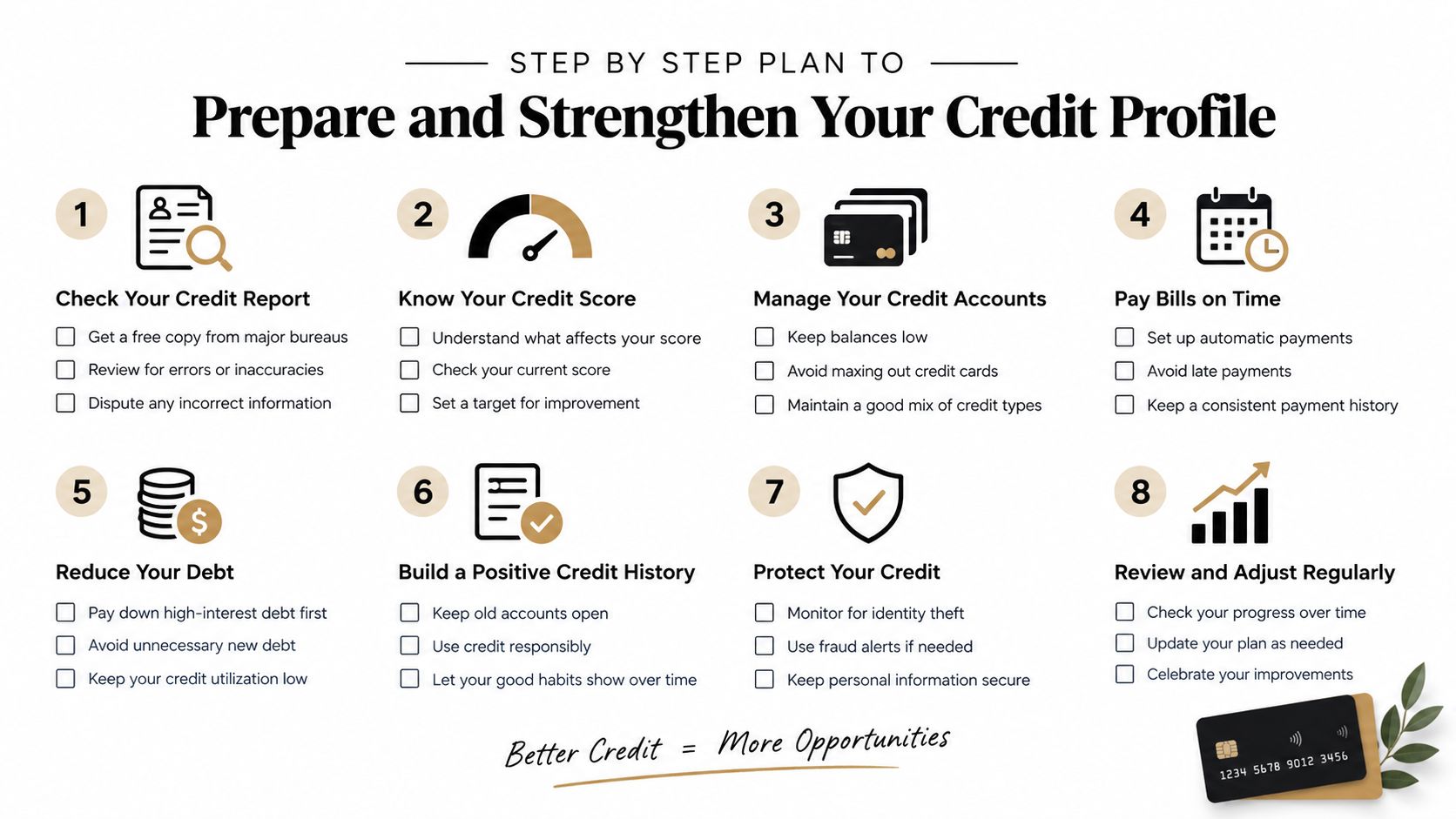
Dispute information that doesn't belong
A dispute should identify the specific information you believe is inaccurate, incomplete, outdated, or unverifiable. Include relevant documentation and retain proof of what you submitted. The furnisher or bureau must investigate under the applicable legal process, but the outcome depends on the evidence, reporting party, and facts of the account.
Don't dispute accurate information because you want it removed. A compliant credit restoration process focuses on accuracy and verification.
Stabilize current accounts
Bring past-due accounts current when possible and prevent new late payments. Set reminders, arrange automatic payments if appropriate, and keep enough money available for scheduled drafts. If hardship continues, contact the creditor before another payment is missed and document the conversation.
High utilization can also affect mortgage readiness. Reduce revolving balances responsibly, avoid charging new debt for major purchases, and don't close older accounts without discussing the potential consequences with a qualified professional.
Match the strategy to the file
A borrower with a thin file may need to establish positive accounts carefully, potentially including a secured card or an appropriate self-reporting option. A borrower with collections needs account-level accuracy review and resolution documentation. Someone recovering from bankruptcy or foreclosure needs a timeline based on the qualifying event date and a plan for timely payments afterward.
Superior Credit Repair can help consumers identify inaccurate, outdated, unverifiable, or misleading credit report information and organize a documentation-based dispute and rebuilding plan. Results vary based on the credit file, available evidence, creditor responses, account history, and current credit behavior. No ethical provider can promise deletions, a specific score increase, overnight credit repair, or mortgage approval.
Next Steps Toward USDA Readiness With Trusted Guidance
USDA credit review focuses on the strength of the complete file, not a score alone. Before applying, prepare documents that let the lender verify income, debts, payment history, assets, and explanations for credit issues.
Frequently asked questions
Can I qualify for a USDA loan below 640?
Possibly. A score below 640 commonly means manual underwriting and lender-specific requirements. A complete file, consistent payment history, manageable debt, and documented compensating factors may support the review.
Does a 640 score guarantee USDA approval?
No. A 640 score may support automated processing through GUS, but delinquencies, unresolved federal issues, inaccurate documentation, debt concerns, or lender overlays can still affect the decision.
What should I bring to a lender?
Prepare recent pay stubs, tax documents when requested, bank statements, identification, housing payment records, and explanations with supporting records for collections, late payments, bankruptcy, foreclosure, or other major credit events. Ask the lender for its exact checklist because requirements can vary.
What should I do about an inaccurate collection?
Gather records, identify the specific reporting error, and submit a documented dispute through the appropriate legal process. Do not request removal of information that is accurate and verifiable.
How long should I prepare before applying?
There is no reliable timeline for every borrower. Start early enough to review reports, correct errors, stabilize payments, manage balances, and organize lender documents.
Superior Credit Repair can review your credit report, help identify inaccurate or questionable items, and explain a step-by-step plan for improving your credit profile. Results depend on the file, available evidence, creditor responses, and current credit behavior. No ethical provider can promise deletions, a specific score increase, or mortgage approval.
Superior Credit Repair provides compliance-focused credit restoration support for consumers preparing for USDA, FHA, VA, conventional, auto, business, and personal financing.
You may share your experience with Superior Credit Repair on its Google Business Profile: https://share.google/ePRpFvtCXwCjiJwOK