


For a manually underwritten FHA loan, the standard debt to income for FHA loan benchmarks are 31% for the front-end housing ratio and 43% for the back-end total-debt ratio. Those percentages are screening benchmarks, not automatic approval or denial limits.
You're probably doing this math at your kitchen table, pay stub in one hand and a listing you love open on your phone. You want to know whether a car payment, a student loan, or a credit card minimum will push you over a line you can't see yet. That uncertainty is normal, and it's fixable. Once you understand which payments a lender counts, how your credit score changes the limits, and how to check every obligation on your credit reports for accuracy, you can walk into an FHA application with numbers you trust.
Table of Contents
- FHA DTI Limits and How Front-End and Back-End Ratios Work
- Which Monthly Debts Count and Which Can Be Excluded
- How Lenders Calculate Your DTI, Step by Step
- What Happens When Your DTI Is Above the Benchmark
- How to Lower Your DTI Before You Apply
- Common Questions About FHA Debt-to-Income Ratios
- Confirm Your Numbers Before You Apply
FHA DTI Limits and How Front-End and Back-End Ratios Work
Debt-to-income ratio, or DTI, compares your required monthly debt payments with your gross monthly income. Gross means income before taxes, not take-home pay. If you calculate with your net paycheck, you'll get a higher, scarier number than the lender gets, and you'll plan around the wrong figure.
Think of the two FHA ratios as lanes on the same road. The front-end ratio is the housing lane only. The back-end ratio is the whole road, housing plus your other recurring debts. A lender checks both, because a home that fits your budget by itself can still strain your budget once a car loan and student loan join it.
The Housing Lane and the Whole Road
The HUD mortgagee letter on FHA qualifying ratios describes a 31% front-end ratio that compares the proposed monthly housing expense, including principal, interest, property taxes, homeowners insurance, and applicable mortgage insurance, to gross monthly income, and a 43% back-end ratio that adds recurring obligations such as auto loans, student loans, and credit-card minimum payments. Child support, alimony, and separate maintenance payments also belong in that back-end total.
Say you earn $6,000 in gross monthly income. At 31%, your housing benchmark is $1,860. At 43%, your total-debt benchmark is $2,580. If your proposed housing payment sits right at $1,860, that leaves $720 for every other qualifying monthly debt combined.
That last step is where many first-time buyers get surprised. A $450 car payment plus $180 in card minimums plus a $200 student loan payment totals $830. Even with a housing payment under the front-end limit, that $830 would push the back-end total past $2,580. Lowering one recurring payment can improve your position even when your income and credit score don't change at all.
Practical rule: The 31% and 43% figures are screening benchmarks, not guarantees. A lender still reviews your credit history, assets, employment, and the loan itself before deciding.
How Your Credit Score Changes the Ceiling
Manual underwriting doesn't give every borrower the same ceiling. The HUD mortgagee letter with the manual underwriting matrix states that borrowers with a minimum decision credit score from 500 through 579, or with no credit score, generally cannot exceed the 31% front-end and 43% back-end ratios, and it identifies no compensating-factor pathway for stretching those limits in that category. Borrowers at 580 or higher may qualify at 31/43 without compensating factors, and higher structures open up when the lender documents specific strengths.
FHA Manual Underwriting Limits by Credit Score and Compensating Factors
| Minimum decision credit score | Front-end limit | Back-end limit | Factors required |
|---|---|---|---|
| 500-579 or no score | 31% | 43% | No compensating-factor pathway in the cited HUD matrix |
| 580 or higher | 31% | 43% | None needed |
| 580 or higher | 37% | 47% | One documented factor |
| 580 or higher | 40% | 50% | Two listed factors |
| 580 or higher | 40% | 40% | No discretionary debt |
| 580 or higher, energy-efficient home | 33% | 45% | Eligibility documented by the lender |
Walk the table from the top. The first row is the firmest. If your minimum decision score is below 580, or you have no score, plan around 31/43 and don't count on extra strengths to stretch it.
The second row is the starting point for scores of 580 or higher. You don't need any documented factor to be considered at 31/43.
The third row allows 37/47 with one documented factor, such as verified cash reserves, a minimal increase in housing payment, or residual income. The fourth row allows 40/50, but it requires two listed factors. The fifth row, 40/40, looks odd at first because the back-end limit is lower, yet it exists for borrowers with no discretionary debt, meaning housing is the obligation being measured.
The last row covers energy-efficient homes at 33/45 when the lender documents eligibility. Don't assume a home qualifies because it has newer windows or appliances. Ask the lender what documentation it requires before you budget around those higher ratios.
Why 43% Is Not a Hard Ceiling for Every File
A compensating factor is a documented strength that offsets a higher ratio. Verified cash reserves, a history of managing a similar housing payment, and a small increase from your current housing cost can all support a file. The key word is documented. A lender can't use savings it can't verify or a payment history it can't see.
Your file may also go through automated underwriting rather than manual underwriting, and that system weighs your overall risk profile instead of applying the ratios in isolation. Individual lenders can add overlays, which are extra rules stricter than FHA minimums. Two lenders can review the same income and debts and reach different DTI comfort levels.
That's why credit repair for FHA approval starts with accuracy, not promises. If a reported payment is wrong, it distorts the math before underwriting even begins. Correcting inaccurate or unverifiable reporting through a legal dispute process is different from asking a lender to ignore real obligations, and that distinction protects you throughout the process.
Which Monthly Debts Count and Which Can Be Excluded
How Common Monthly Obligations Are Treated in FHA DTI
| Obligation | Counted in DTI? | Condition or note |
|---|---|---|
| Proposed mortgage payment | Yes | Principal, interest, taxes, insurance, and mortgage insurance; front-end ratio |
| Installment loans (auto, student, personal) | Yes | May be excluded under the 10-month closed-end rule |
| Revolving minimum payments on credit cards | Yes | Based on the reported or statement minimum |
| Child support, alimony, separate maintenance | Yes | Included in the back-end ratio |
| Closed-end debt paid off within 10 months | Possibly excluded | Combined payments must be 5% of gross monthly income or less |
| Authorized-user account | Usually yes | The lender may exclude it when the primary holder's payment history meets HUD's documentation rules |
| Balance reduced but payment still due | Yes | Lowering the balance alone does not remove the monthly payment |
The 10-Month Closed-End Exception
The HUD Single Family Housing Policy Handbook 4000.1 says a closed-end debt payment may be omitted when the debt will be paid off within 10 months of closing and the combined payments on those debts are no more than 5% of gross monthly income. With gross monthly income of $6,000, the combined payments must be $300 or less. Paying down a balance to create the 10-month condition does not qualify.
For example, a personal loan with eight payments of $140 remaining may qualify because it is due to end within 10 months and its payment is below $300. The lender still needs documentation to support the exclusion. Add other eligible debts before making that assumption: an additional furniture-loan payment of $190 brings the combined amount to $330, above the limit.
Buy now, pay later accounts can also carry monthly payments that are easy to overlook. Check the terms and reporting for these obligations, using Superior Credit Repair's BNPL guide as a reference. Before a major purchase, shoppers may also explore buying guides from HearSmart, while homebuyers should make sure every payment obligation is accurately listed for their lender.
Authorized-User Accounts
An authorized-user account is a credit card account you can use but do not own. Under HUD guidance, its payment generally counts unless the lender documents that the primary account holder made all required payments during the prior 12 months. If fewer than three payments were required during that period, the payment must be included.
Check each liability against your credit reports, loan application, creditor statements, and payoff letters. The reported account, the payment currently due, and the debt you remember may not always match. Confirming the account details helps distinguish a real monthly obligation from a reporting error before the lender reviews your file.
How Lenders Calculate Your DTI, Step by Step
You can rebuild the lender's math at home with five steps. Work slowly, use documents instead of memory, and write each number down.
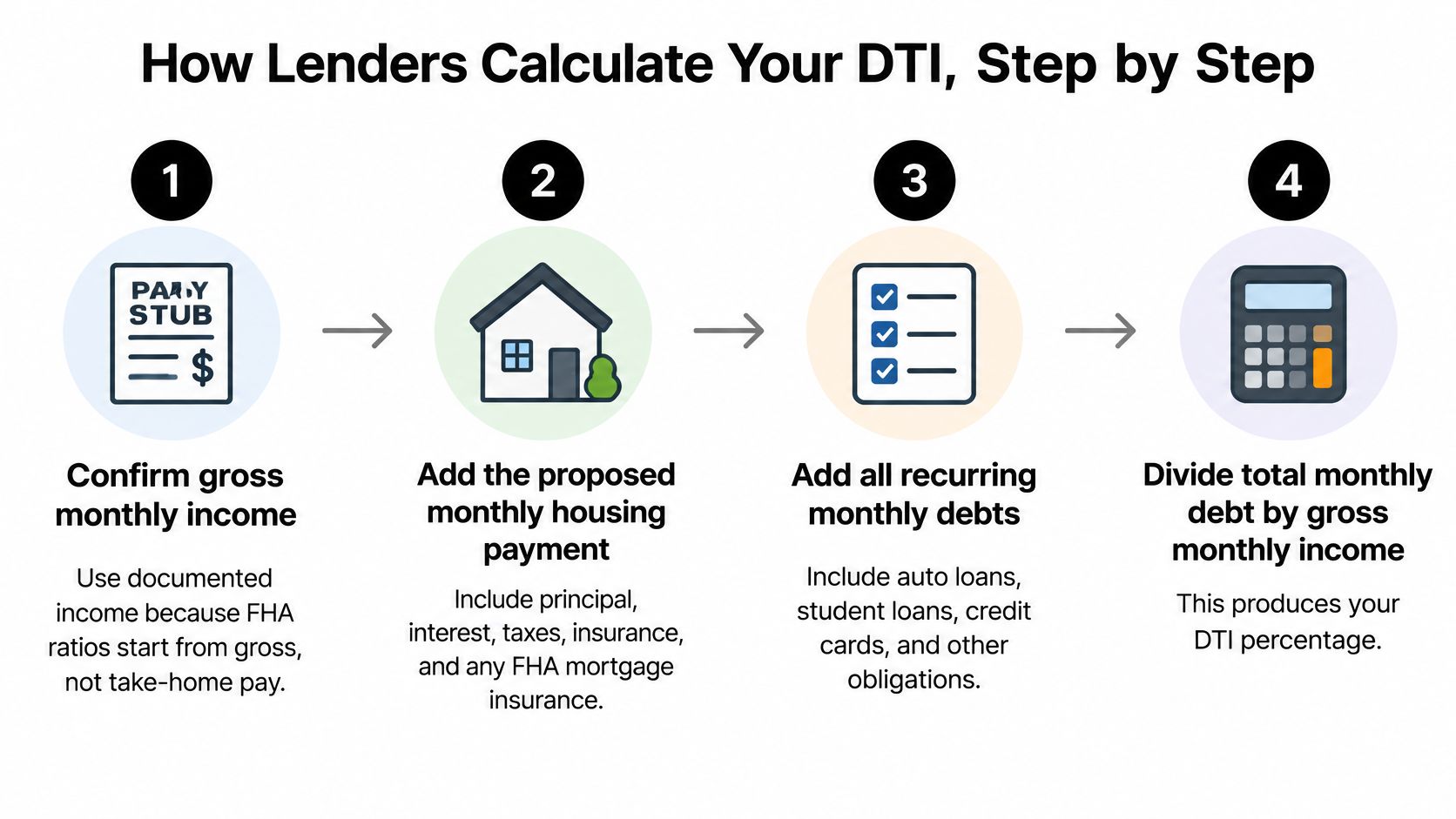
- Confirm gross monthly income: Use your pay stubs or other documented income, because FHA ratios start from gross income, not take-home pay. In this example, gross monthly income is $5,200.
- Calculate the front-end ratio: Add principal, interest, taxes, insurance, and mortgage insurance for the proposed home. If that total is $1,400, divide $1,400 by $5,200 to get 26.9%.
- List every recurring obligation: Pull debts from your credit report, your application, and current statements, and include only the obligations that count under the rules for installment, revolving, support, and similar debts. Say you have an auto loan at $380, a student loan at $250, and card minimums at $120.
- Calculate the back-end ratio: Add $1,400 in housing to $750 in other debts for $2,150, then divide by $5,200 to get 41.3%.
- Compare with the ceilings: At $5,200, a 31% housing ceiling is $1,612 and a 43% total ceiling is $2,236. Your $2,150 total leaves $86 of room, which is workable but tight.
Why Your Number and the Lender's Number Can Differ
Your math can be correct and still differ from the lender's result. The lender uses its own credit report pull, verifies income from source documents, and decides how exceptions apply. A higher reported card minimum, a newer statement, or a debt you treated as excluded can move the ratio.
Treat your home calculation as a readiness check, not a final ruling. If you want broader context on ratios across loan types, review the debt-to-income limits for mortgages before you compare programs. Mortgage approval still depends on lender rules, underwriting, income, debt-to-income ratio, down payment, credit score, and the full loan profile, so a ratio under the benchmarks doesn't guarantee approval.
If your home math leaves less than $100 of room, plan as if you're at the limit. One updated statement can close that gap.
What Happens When Your DTI Is Above the Benchmark
Many first-time buyers assume a back-end ratio above 43% ends the application. Recent FHA portfolio data says otherwise. HUD's Quarterly Report to Congress for the fourth quarter of fiscal year 2025 stated that just over 31% of FHA-insured forward purchase endorsements had total DTI ratios above 50%, while the average DTI was 44.88%. In the first quarter of fiscal year 2026, slightly more than 30% of endorsements had DTI ratios above 50%, and the average declined modestly to 44.64%.

Those figures don't mean a high DTI is harmless. They mean 43% functions as a reference point, and lenders weigh the rest of your file alongside it. Say you earn $6,000 and carry $2,700 in total qualifying obligations. Your back-end ratio is 45%, above the benchmark but below 50%, and different lenders may treat that file differently based on your full profile and their overlays.
What the Lender Weighs Next
- Verified cash reserves: Documented savings left after closing, which show you can absorb an unexpected expense.
- Minimal increase in housing payment: Your new housing cost stays close to what you already pay, so the payment shock is small.
- Residual income: Money left each month after debts and housing costs for household living expenses.
- Credit and payment history: Recent on-time payments and stable income support the case that you can manage the obligation.
FHA's TOTAL Mortgage Scorecard can return an Accept, which means FHA may insure the loan without manual review. An Accept isn't an unconditional approval, and it remains subject to Handbook 4000.1 requirements and any required manual downgrade. If you're preparing a file above the benchmark, focus on documented strengths and accurate debts to improve your chances of loan approval, without assuming any single factor will carry the decision.
How to Lower Your DTI Before You Apply
Lowering DTI is part math and part file accuracy. A wrong payment amount, a duplicate collection entry, or an account that isn't yours can inflate the debt side before you ever discuss income. Work through this checklist in order, and give each item time to update.
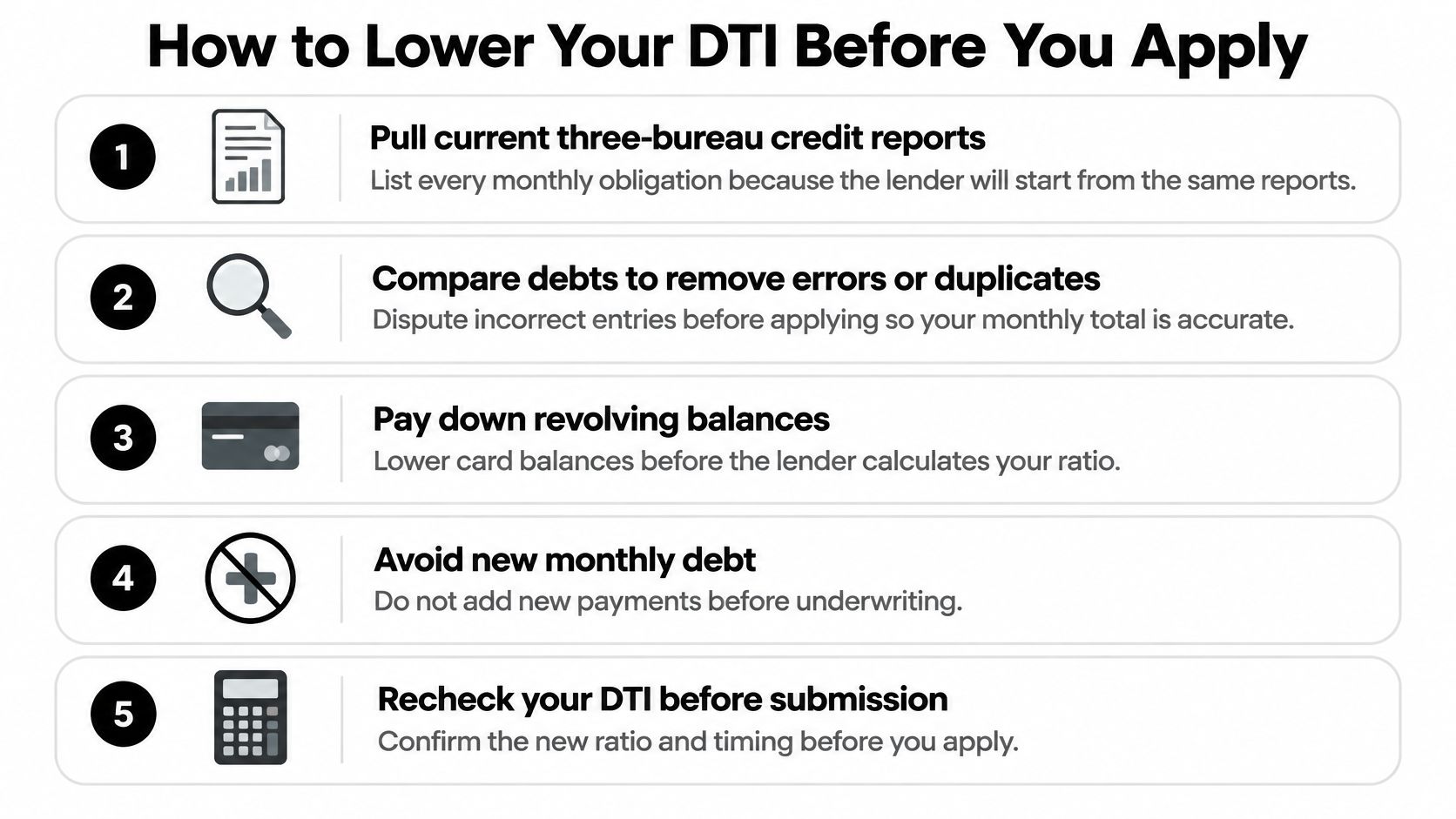
- Pull current three-bureau credit reports: List every monthly obligation because the lender starts from the same reports. Do this first, since disputes and updates take processing time.
- Compare each reported payment with the creditor statement: A mismatch calls for documentation and, where the reporting is inaccurate, a legal dispute. This is core mortgage credit repair work, and it protects the ratio from errors.
- Plan revolving balances around statement dates: Utilization is often a timing matter rather than a dispute, so note when each card reports. If you need a fuller plan to lower monthly debts before applying, start before you request preapproval.
- Avoid opening new installment or revolving debt: A new payment raises the back-end ratio immediately. Hold off on financing furniture, cars, or other large purchases until after closing.
- Gather documents for any inaccurate item: Accuracy documents include current three-bureau credit reports, creditor statements showing balances, limits, dates, and payment history, and collection letters, settlement records, student loan records, or debt-buyer notices.
- Get repayment agreement payments confirmed in writing: If a collection is on a repayment agreement, the documented monthly payment must be counted. Written terms prevent a surprise during underwriting.
Different problems need different handling. A charge-off may need status and date review, a utilization issue may need statement-date planning rather than a dispute, and a student loan reporting concern may need servicer history and status documentation. Matching the fix to the problem is what makes credit repair before buying a home a structured process instead of guesswork.
HUD's page on the FHA TOTAL Mortgage Scorecard states that an "Accept" means FHA may insure the loan without a manual underwriting review, subject to Handbook 4000.1 requirements and any required manual downgrade. Inaccurate late payments, collections, charge-offs, balances, or account ownership should be addressed through documented, legally compliant dispute procedures, and accurate negative information cannot properly be removed merely because it harms a ratio. Results vary based on each person's credit file, documentation, creditor responses, account history, and current credit behavior.
Common Questions About FHA Debt-to-Income Ratios
Does My Credit Score Change My DTI
No, not directly. DTI is built from gross income and monthly obligations, while your credit score is a separate measure of credit behavior. Lenders review both, and your score tier can affect which ratio limits and compensating-factor pathways are available to you.
Why Is My Lender's DTI Different From Mine
The lender uses its own credit report pull, its own verified income figures, and its own treatment of exceptions for debts nearing payoff or authorized-user accounts. Your calculator may use remembered balances or older minimum payments. A small difference in one card minimum can shift the final percentage, so ask the lender to show you each payment it counted.
Does a Collection Account Add a Monthly Payment
A collection balance by itself is generally treated differently from a payment owed under a documented repayment agreement. If you've agreed to a monthly payment plan, that agreement payment must be counted in your ratio. Get the terms in writing before you apply, because an undocumented arrangement can still surface during underwriting and change your numbers.
Can Credit Repair Lower My DTI
Credit restoration can help when inaccurate, outdated, unverifiable, or misleading reporting inflates a payment or adds a debt that shouldn't be there. Correcting credit report errors through a documentation-based dispute process can make the lender's calculation match reality. It can't remove accurate obligations, and it doesn't guarantee a lower ratio or loan approval.
Confirm Your Numbers Before You Apply
A forgotten $40 store-card minimum can shift an FHA debt-to-income ratio the way a misplaced decimal shifts a household budget. Before you apply, pull current statements and match every recurring payment on your credit reports to the debts you will list on the application. Rebuild the ratio with the exact proposed housing payment from a lender estimate, then read that list one last time. Ask the lender which overlays and compensating-factor rules apply to your file, because what mortgage lenders look for extends well beyond one percentage.
Mortgage approval still depends on lender rules, underwriting, income, debt-to-income ratio, down payment, credit score, and the full loan profile. Credit repair cannot guarantee approval for a mortgage, auto, or rental review.
Give that file check real time. Bureau investigation timelines follow bureau and creditor processing cycles, and the payment plan you select does not change those cycles. Superior Credit Repair's mortgage-readiness service is for families preparing for mortgage assistance, FHA review, or preapproval who want collections, late payments, utilization, dispute comments, and other credit-report issues reviewed before a lender opens the file.
A wrong balance, a payment that no longer exists, or a debt left off your worksheet changes the math the underwriter will use. The review looks at inaccurate personal information, collections, charge-offs, late payments, high utilization, and account comments that can change which monthly obligations get counted.
Superior Credit Repair can review the report, identify inaccurate or questionable items, and explain a step-by-step plan for a stronger credit profile. You can request a credit analysis or consultation to understand your options more clearly. Results vary with the credit file, the documentation, creditor responses, account history, and current credit behavior.
Verify the payments, balances, and account details that shape your debt-to-income ratio, dispute inaccurate items through a legal, documentation-based process, and map clear steps to rebuild credit strength. Visit Superior Credit Repair to request a credit analysis and start a mortgage readiness plan with calm, realistic guidance.