

A judgment against you is a court decision that a creditor or other claimant won a civil case, usually over an unpaid debt, and it can allow legal collection steps such as wage garnishment or liens, depending on state law. If you've found a reference to a judgment while checking your credit or preparing to buy a home, the first question isn't whether your score changed. It's what the court record says, whether the judgment is still active, and what your lender needs to see.
The word “judgment” can sound like a credit-report term, but it describes a court ruling. A court file, a credit report, and a lender's underwriting file can each tell a different part of the story. Checking them separately helps you choose a practical next step without assuming that a record is accurate, enforceable, or already resolved.
Table of Contents
- What a Judgment Against You Really Means
- How Judgments Form After a Debt Lawsuit
- Where Judgments Show Up on Public Records and Credit Reports
- How Judgments Affect Mortgage and Loan Decisions
- How Long Judgments and Their Reporting Last
- Ways to Address a Judgment Without Guessing
- Confirm Every Judgment Is Resolved Before You Apply
- Common Questions About Judgments Against You
What a Judgment Against You Really Means
Suppose a medical provider, credit-card company, or other creditor says you owe money. A collection account is like a bill someone says you owe. A judgment is different: it's a court's written decision in a civil lawsuit, and it can give the successful claimant legal tools to collect. The Consumer Financial Protection Bureau describes civil judgments as public records that may allow wage garnishment or seizure of eligible assets, subject to state law and exemptions, as explained in its overview of civil judgments.
That distinction matters. A collection account reflects a claim about a debt; a judgment reflects a court decision. Depending on the state and the facts, enforcement might include taking part of eligible wages, placing a lien on property, or levying funds from a bank account. A lien is a legal claim against property tied to an unpaid obligation. The rules, exemptions, and procedures aren't the same everywhere.
The court record and the credit account are separate
A tradeline is a credit account reported to a consumer reporting company, including information such as its payment history. A judgment and a tradeline aren't the same record. A judgment may appear in court files even if no judgment entry appears on a credit report, while the underlying account may be reported separately as a collection or other credit account.
A satisfaction is a court filing that records that a judgment has been paid. Paying a judgment doesn't automatically update every related record. The court docket, a satisfaction filing, a lien release, and any credit reporting may each require separate steps.
| Record or term | What it means |
|---|---|
| Collection account | A creditor or collector reports or pursues an asserted debt |
| Judgment | A court rules for a claimant in a civil case |
| Lien | A legal claim against property connected to an unpaid obligation |
| Tradeline | A reported credit account and its account history |
| Satisfaction | A court filing showing that a judgment has been paid |
Start with the record, not the label. Find the court name, case number, creditor, amount, judgment date, and current status before deciding what action makes sense.
How Judgments Form After a Debt Lawsuit
A debt judgment often begins when a creditor, debt collector, or debt buyer files a lawsuit. Some cases are contested, but others end without the person being sued responding. Pew Charitable Trusts found that debt-collection suits rose from fewer than 1.7 million in 1993 to about 4 million in 2013. In jurisdictions with available data, courts resolved more than 70% of these lawsuits with default judgments for the plaintiff, according to Pew's report on debt-collection cases in state courts.
A default judgment means the court entered judgment after the defendant generally didn't appear or respond. It doesn't, by itself, prove that every amount claimed was correct. The papers and the applicable court rules matter.
The usual sequence
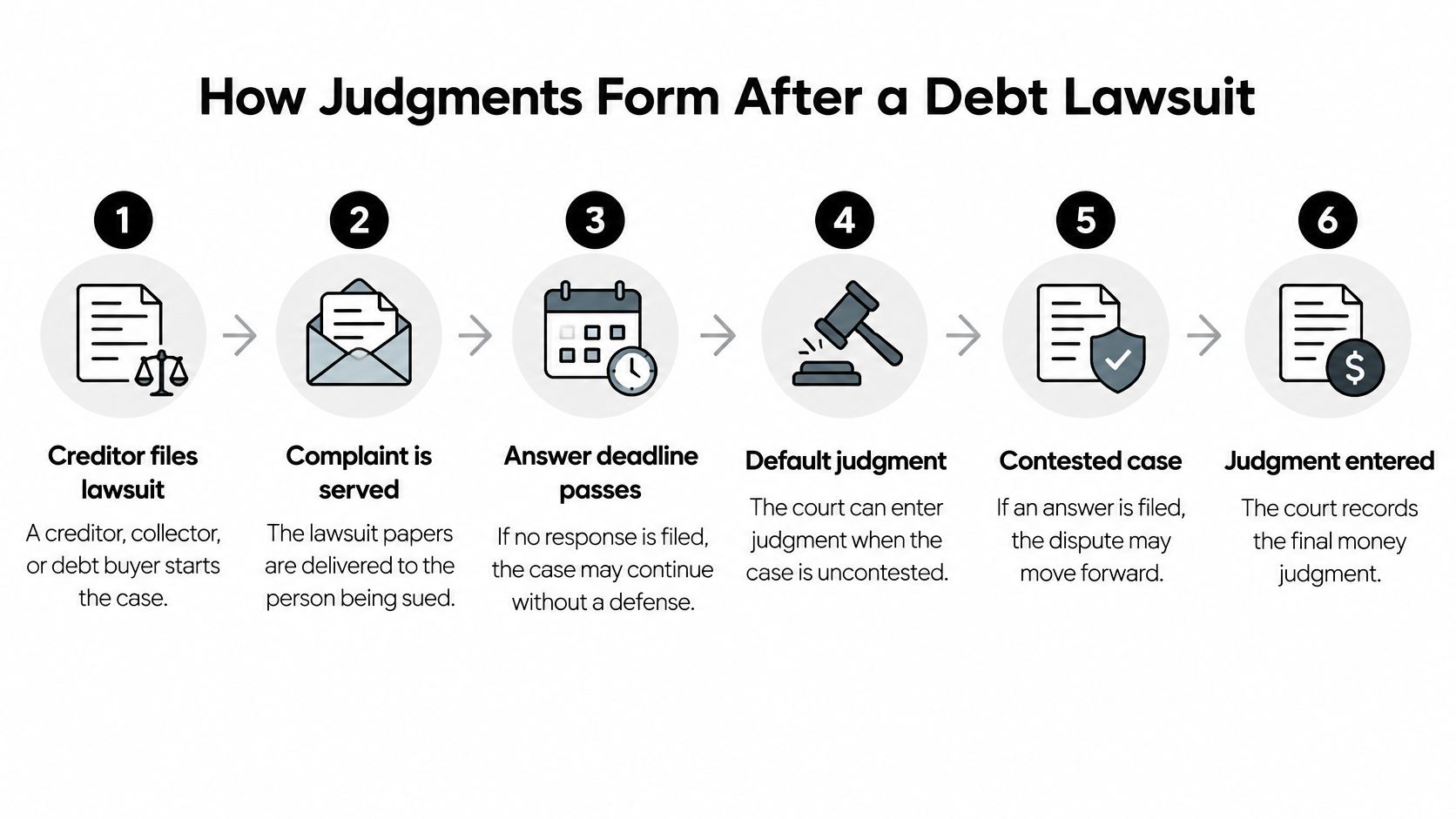
The plaintiff files a complaint. The complaint explains who is suing and what relief they're asking the court to grant. Check the plaintiff's name and whether you recognize the account or debt.
The summons and complaint are served. These documents notify you of the lawsuit. Check the service details and date, because service can affect your response deadline.
The response deadline approaches. Court rules set the deadline, and it may be short. Read the papers carefully and contact a qualified attorney or legal-aid provider if you're unsure what to file.
The plaintiff may request a default judgment. If no response is filed, the case may move forward without your side being heard. Don't assume the lawsuit will go away if you ignore it.
The court decides whether to enter judgment. An order may address the claimed principal and any interest or court costs the court allows. Compare the amount with your statements and payment records.
The judgment is recorded and may be enforced. If the judgment remains unpaid, the creditor may seek collection remedies available under state law. Ask the court or a qualified legal professional what applies to the case.
A lawsuit isn't a reliable measure of whether the debt or amount is valid. Check who owns the debt, whether the balance matches your records, and what response the court requires. Deadlines, limitation periods, exemptions, and enforcement procedures differ by state, so get advice on your specific situation rather than relying on a general rule.
Where Judgments Show Up on Public Records and Credit Reports
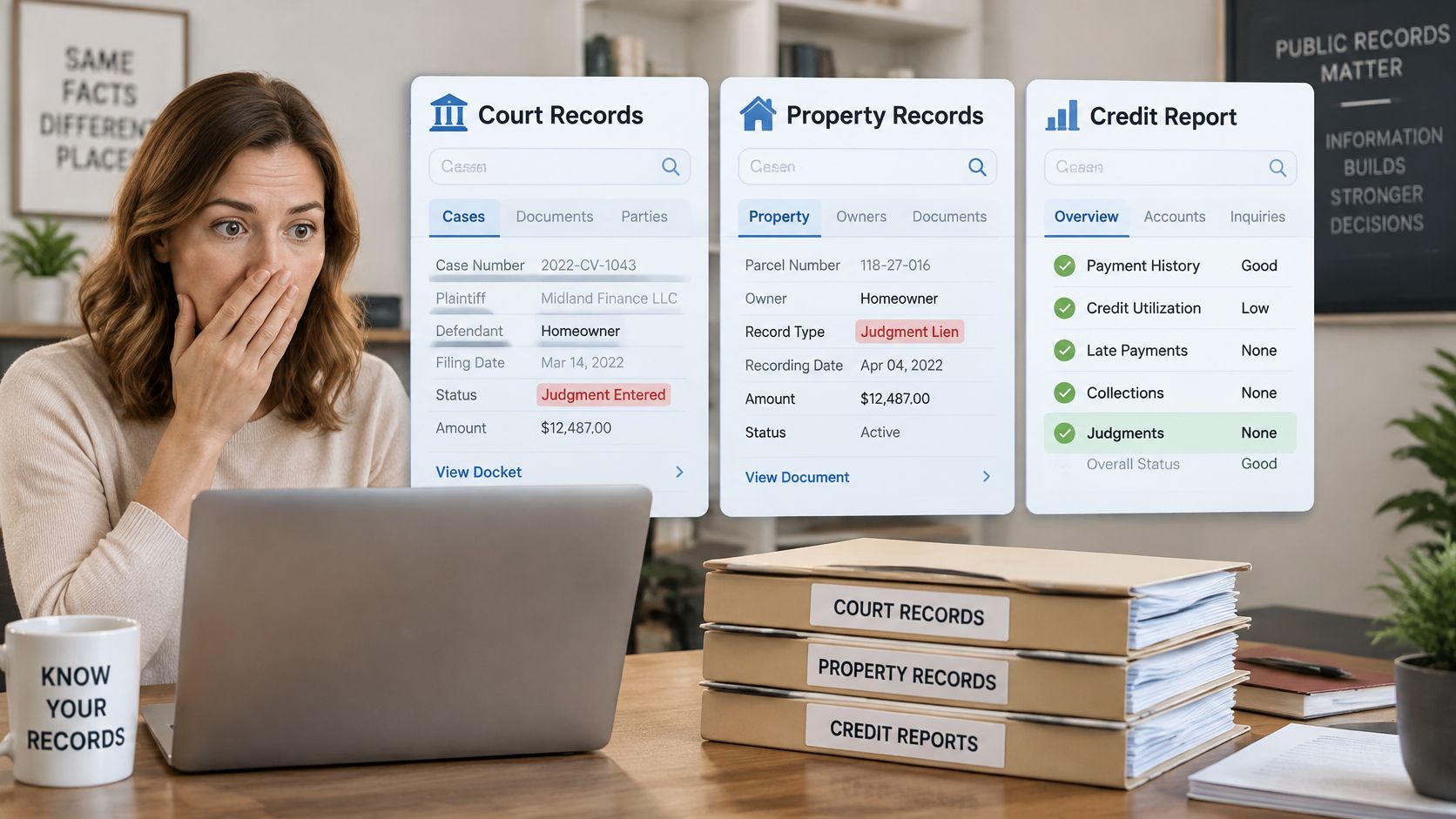
A judgment may not appear on your credit report and still be discoverable through court or property records. The Consumer Financial Protection Bureau found that civil judgments disappeared entirely from the nationwide credit reports it analyzed after changes under the 2017 National Consumer Assistance Plan. That reporting change didn't erase court obligations or prevent lenders, title companies, landlords, or others from finding public records, as the CFPB explains in its analysis of public records in credit reporting.
Three kinds of records to check
| Record location | Who typically searches it | Current status or visibility |
|---|---|---|
| Court docket and public case index | Lenders, title companies, employers, and the public, subject to local rules | May remain in court records until satisfied, closed, or sealed under local practice |
| County land records and judgment lien filings | Title companies, mortgage lenders, and buyers | Appears if a lien was recorded against property in that county |
| Nationwide consumer credit reports | Lenders and screening companies with a permissible purpose | Civil judgments largely removed from nationwide reports since 2017 |
| Tenant and background screening reports | Landlords and screening companies | May appear if the provider's data source includes the record |
For a thorough check, search court records in counties where you've lived or where a case may have been filed, review property records if you own real estate, and pull all three credit reports. Note any entry referring to a judgment, lien, lawsuit, or the underlying account. Confirm the name and other identifying details match you; a similar name or incorrect information can lead to a record being associated with the wrong person.
If something is inaccurate, dispute the specific entry with supporting records. If the judgment is valid, a credit-report dispute isn't a substitute for resolving the court obligation. For a clearer explanation of how court and other public records can relate to credit files, explore public record credit impacts.
How Judgments Affect Mortgage and Loan Decisions
For mortgage underwriting, the central issue may be whether a judgment remains an open liability or affects the lender's lien position, not whether it appears on a conventional credit score report. Fannie Mae's automated-underwriting guidance says open judgments and outstanding liens identified in the public-records section must be paid off at or before closing, with proof of satisfaction and verification of available funds retained in the loan file. Lenders also review the accuracy of the application and credit information, repayment capacity, assets, and other risk factors under Fannie Mae's credit-report analysis guidance.
That review can involve more than a payment receipt. An underwriter may ask for a current payoff statement, proof of payment, a court satisfaction or release, and records showing where the payoff funds came from. If a lien affects property, the lender may also need confirmation that its mortgage can hold the required position. For background on how a judgment lien may attach to property, Tanner Law explains property judgment liens.
Documents to prepare by loan program
| Loan program | What underwriters commonly review | Documents to gather |
|---|---|---|
| Conventional mortgage | Open judgments and liens must be paid at or before closing, with funds verified | Payoff statement, court satisfaction or release, proof of payment, source-of-funds records |
| FHA loan | Judgments and collections under program rules and lender overlays | Payoff proof, payment-plan terms if any, lender-specified records |
| VA loan | Judgments, collections, and debt-to-income under VA and lender guidelines | Payoff or settlement documents, payment-plan terms, lender-specified records |
| USDA loan | Judgments and repayment capacity under program and lender rules | Payoff or settlement documents, income and debt records, lender-specified records |
| Lender-specific case | Additional payoff, title, or source-of-funds proof may be required | Current payoff letter, title search results, written lender requirements |
If a judgment has a payment plan, the monthly payment may affect debt-to-income ratio, the share of gross monthly income used for debt payments. Tell your loan officer about the judgment early, ask which documents apply to your program, and explain whether it's open, paid, or being disputed. Learn about other credit factors that affect mortgage approval. Requirements differ by program and lender, and results vary with the credit file, supporting documents, and underwriting review.
How Long Judgments and Their Reporting Last
A debt lawsuit, a court judgment, and credit reporting each follow a different clock. That distinction matters when a judgment no longer appears on a credit report: the court record and any remaining obligation may still exist.
The three clocks
| Clock | What sets it | What it controls |
|---|---|---|
| Statute of limitations | State law and debt type | How long a creditor has to file a lawsuit on the debt |
| Judgment enforcement and renewal | State law | Whether a judgment can be enforced, renewed, or expires |
| Credit reporting period | Federal Fair Credit Reporting Act | Generally seven years for most adverse information; longer for certain bankruptcies |
The statute of limitations sets the period in which a creditor may bring a lawsuit over a debt. It does not set how long an already-entered judgment may be enforced. State law governs a judgment's enforcement period and renewal process. A court filing may also be needed to show that a balance has been paid.
Credit reporting has its own cutoff. Under the Fair Credit Reporting Act, most adverse information generally cannot be reported after seven years, although longer periods can apply to certain bankruptcies. The Act requires credit-reporting agencies to follow reasonable procedures to assure maximum possible accuracy. The reporting cutoff does not, by itself, end a court debt or remove a lien from property.
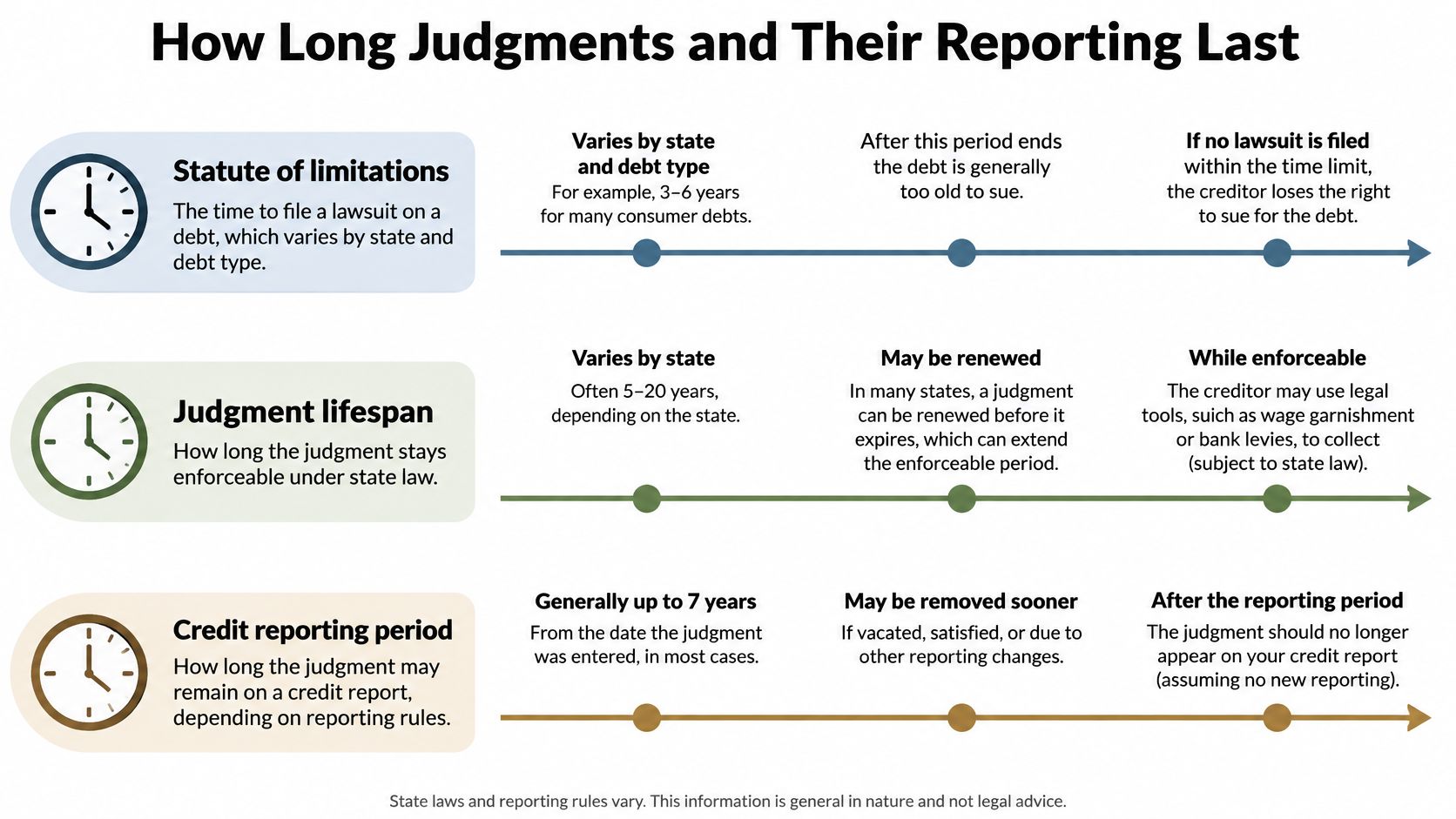
The sequence may begin with a debt, continue with a lawsuit and a court-entered judgment, then move into a period when the judgment may be enforced or renewed. Credit reporting runs alongside these court-related events on a separate timeline. Like two clocks on the same wall, they measure different things: the report's cutoff does not determine the judgment's status.
Check the court docket to understand the judgment's record and status, then compare it with your credit file. Dates and rules depend on the state, debt type, and record. If service or the judgment's validity is in question, ask an attorney about state-specific deadlines. For more detail on understanding the seven-year credit reporting rule, keep the reporting period distinct from the court's enforcement rules.
Ways to Address a Judgment Without Guessing
The right path depends on the facts: whether the amount is accurate, whether the judgment was properly entered, whether it's still open, and whether the problem is in a court record or credit report. A credit-report dispute can address inaccurate reporting, but it doesn't replace a court process for challenging a judgment or clearing a lien.
| Path | When it fits | What you need | What it can accomplish |
|---|---|---|---|
| Satisfy the judgment | The amount is accurate and you can pay | Payoff letter, proof of payment, court filing for satisfaction | The judgment can be marked satisfied, followed by a lien release |
| Negotiate a settlement | The amount is disputed or full payment isn't possible | Written settlement agreement, payment records | An agreed payoff and satisfaction, subject to the terms |
| Dispute the credit reporting | The report shows inaccurate, incomplete, or unverifiable details | Court records, payment records, dispute letter with documents | Correction or removal if the information is inaccurate or can't be verified |
| Vacate or set aside | The judgment was entered without proper service or notice, or was otherwise improper | Court filings, deadline records, attorney or legal-aid advice | The court may vacate it; the outcome depends on the facts and state law |
| Request a lien release | Payment is complete but a judgment lien remains on property | Court satisfaction, county lien-release form | The lien can be cleared from the property record |
A satisfaction filing and a lien release do different jobs. The first records payment of the judgment; the second addresses a recorded claim against property. Keep copies of agreements, receipts, filed documents, and correspondence so you can show what happened.
For a credit-report error, identify the exact entry and explain what's wrong with supporting documentation. A dispute is appropriate when information is inaccurate, incomplete, outdated, duplicated, or unverifiable, not because it has a negative effect. If you're sorting out choosing how to address collection errors, distinguish a dispute about the underlying collection account from a legal challenge to a court judgment.
Credit restoration work can help review credit files, organize documents, and prepare dispute correspondence. Challenges to court orders and legal advice belong with a qualified attorney or legal-aid provider. Choose a route only after checking the records and the requirements that apply to your case.
Confirm Every Judgment Is Resolved Before You Apply
A lender-ready file is easier to review when the court record, credit information, and payment documents tell a consistent story. Use this checklist to organize the facts before discussing a mortgage, auto loan, or other financing.
Pull all three credit reports. Note any entry tied to a judgment, lien, lawsuit, or the account behind it.
Search court records. Check counties where you've lived or where a case may have been filed.
Obtain the docket. Confirm the creditor, amount, judgment date, and current status.
Compare the amounts. Review the court figures against your statements, receipts, and payment records.
Request a current payoff letter. If the judgment is open, ask the creditor or authorized representative for the current amount and payment instructions.
Choose the route that fits the evidence. Pay, negotiate, or pursue a documented dispute or court challenge as appropriate.
Request the satisfaction and lien release. Check that the court and property records reflect the outcome.
Keep proof together. Save agreements, receipts, filed forms, and correspondence as proof of debt repayment.
Tell your loan officer early. Ask which records apply to your FHA, VA, USDA, or conventional application.
Review the effect of any payment plan. Discuss its monthly obligation with the lender, and avoid taking on new debt before closing.
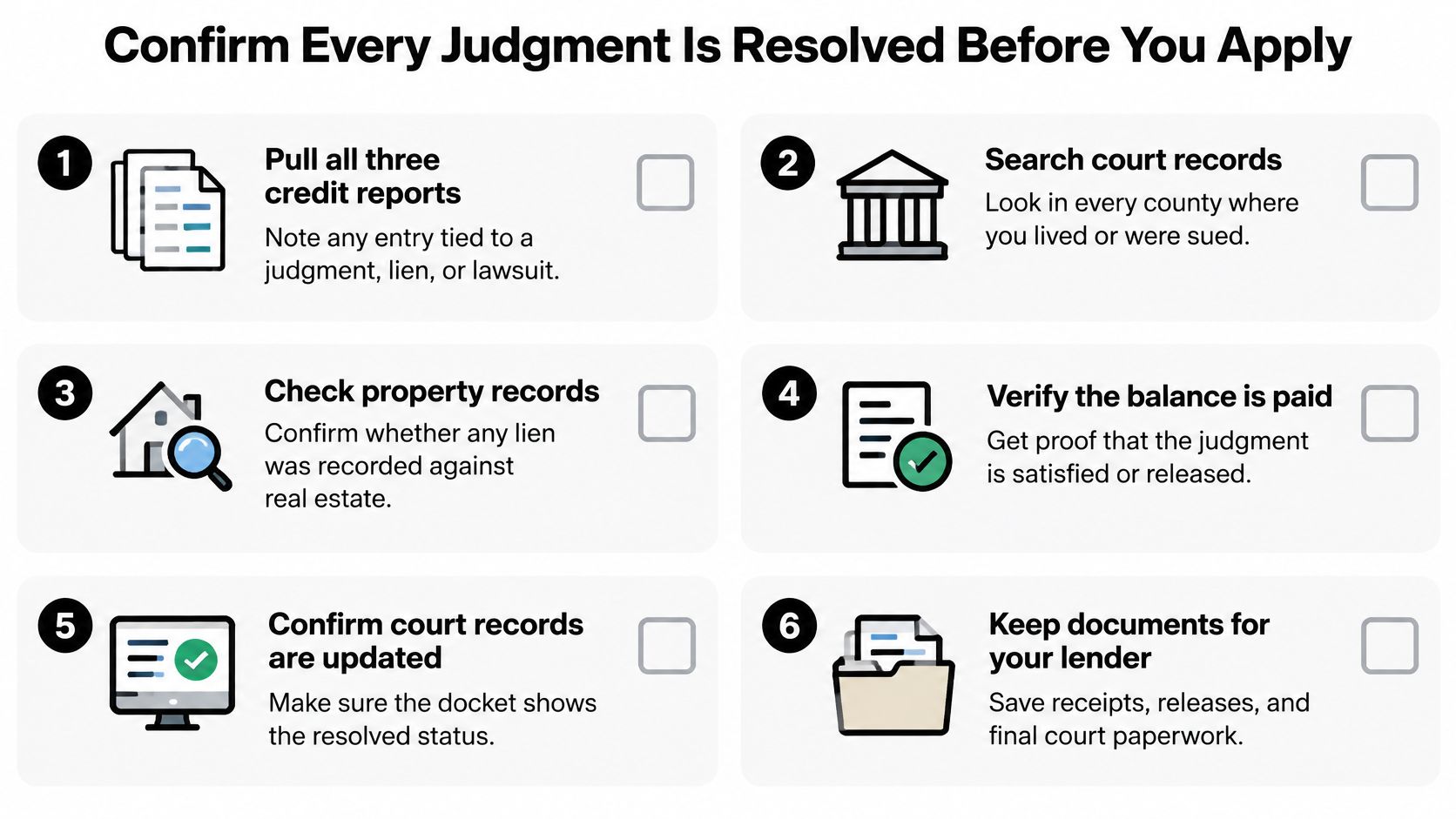
Each step creates a clearer paper trail for lender review. If a record doesn't match your documents, explain the discrepancy and provide the records that support your account rather than waiting for the lender to find it.
Common Questions About Judgments Against You
Does paying a judgment remove it from my records?
No. Payment does not automatically clear the court record or related reporting. The satisfaction filing, lien release, and credit-report updates may each require separate attention.
Can a judgment stop me from buying a home?
An open judgment or lien may need to be resolved before closing, depending on lender requirements. The effect on your application depends on the loan program, your documentation, and the lender's review.
How long does a judgment last?
State law governs enforcement and renewal. Federal credit-reporting limits follow a separate timeline, so check the court docket and credit file independently.
Can Superior Credit Repair remove a valid judgment?
Credit repair can address inaccurate, outdated, unverifiable, or misleading reporting through documentation-based disputes and verification. Accurate information is not guaranteed to be removed. For court matters, consult a qualified attorney or legal-aid provider.
If this information helped clarify your credit report or next steps, you can share your experience with Superior Credit Repair on its Google Business Profile: https://share.google/ePRpFvtCXwCjiJwOK
Superior Credit Repair can review your credit report, help identify inaccurate or questionable items, and build a step-by-step plan to strengthen your credit before a home loan application. Its transparent billing is pay-as-you-go after work is performed. Visit Superior Credit Repair to start the conversation.