

Waiting periods after bankruptcy commonly range from 1 to 4 years, depending on whether you filed Chapter 7 or Chapter 13 and which mortgage program you want. The answer to “how long after bankruptcy can I get a mortgage?” is a matrix of program rules, not one universal countdown.
You may be searching for an answer after receiving a bankruptcy discharge, reviewing apartment or mortgage requirements, or trying to understand whether homeownership is still realistic. That uncertainty is understandable. A bankruptcy can feel like a permanent label, but mortgage underwriting focuses heavily on what happened afterward, including payment behavior, credit reporting accuracy, debt levels, and financial stability.
The calendar matters, but it's only one track. The other track is building a lender-ready credit profile before the waiting period ends. That means checking your reports, correcting inaccurate information through proper dispute processes, managing revolving balances, and creating a consistent record of responsible payments.
Table of Contents
- Understanding Your Mortgage Timeline After Bankruptcy
- Breaking Down Waiting Periods by Loan Program
- The Staged Rebuild Process for Lender Readiness
- Strategic Credit Repair and Utilization Management
- Navigating Common Pitfalls and Misconceptions
- Your Path to Homeownership and Actionable Next Steps
Understanding Your Mortgage Timeline After Bankruptcy
A borrower who has just received a discharge might ask a simple question: “Can I apply for a mortgage now, or do I need to wait?” The honest answer depends on the bankruptcy chapter, the loan type, and whether the case ended in a discharge or dismissal. A Chapter 7 borrower and a Chapter 13 borrower can face very different timelines, even when they contact the same lender on the same day.
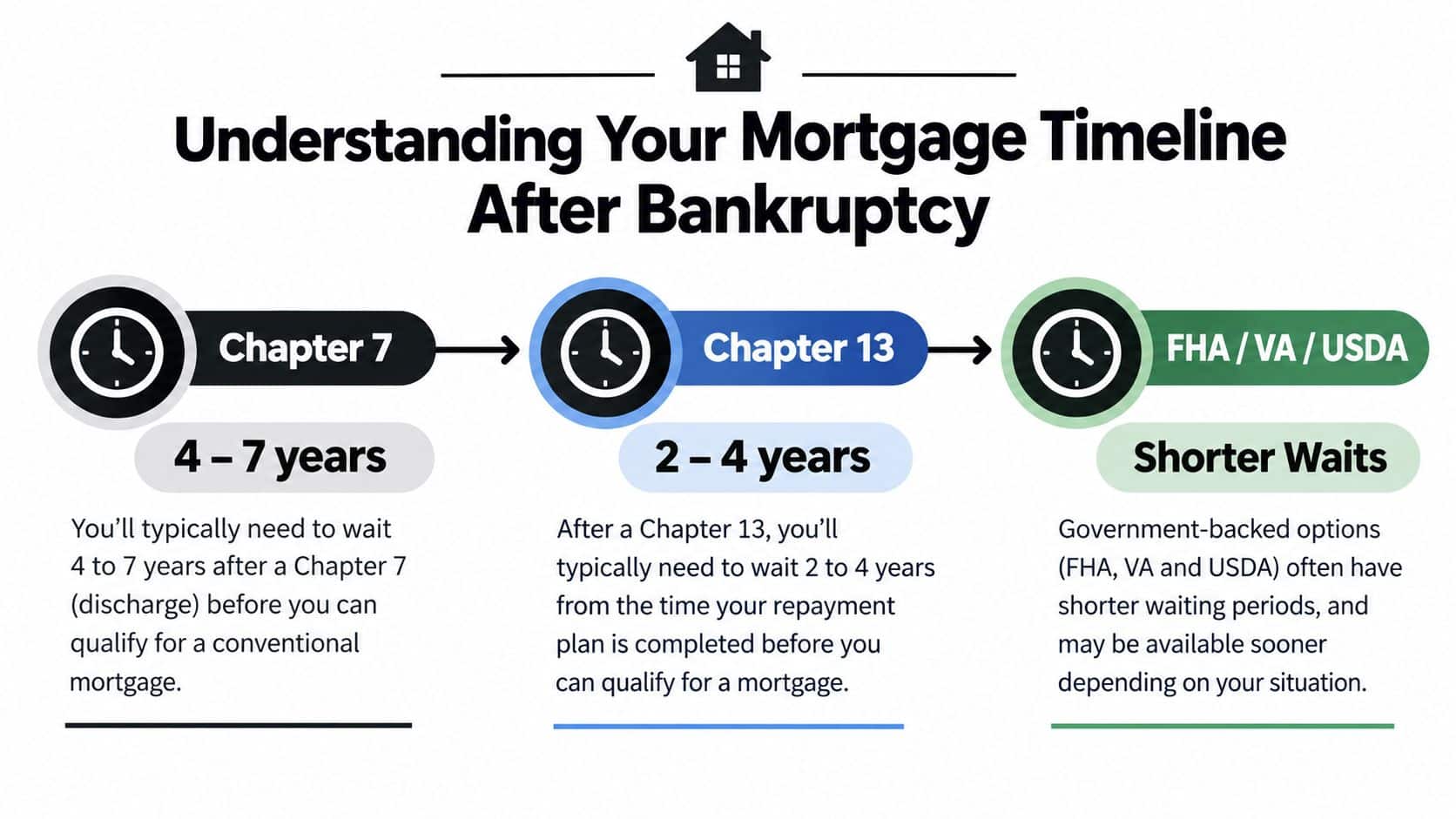
For most major U.S. mortgage programs, the waiting period is measured from the relevant discharge or dismissal date and commonly falls between 1 and 4 years. A widely cited industry overview explains that Chapter 7 borrowers commonly wait 2 years for FHA or VA financing, 3 years for USDA financing, and 4 years for conventional financing, while some Chapter 13 borrowers may qualify sooner under program rules (Debt.org's mortgage guidance after bankruptcy).
Why the bankruptcy chapter changes the answer
Chapter 7 generally involves a discharge of eligible debts, so lenders often focus on the date that discharge occurred. Chapter 13 involves a court-approved repayment plan, which can make payment history during the plan especially important. A borrower may be evaluated differently if the plan was completed and discharged than if the case was dismissed before discharge.
The loan program creates another layer. Conventional financing is generally the strictest benchmark. FHA, VA, and USDA programs may provide a shorter route, but shorter doesn't mean automatic approval. The lender can still review your credit history, debt-to-income ratio, income, documentation, and recent payment activity.
Practical rule: Never calculate eligibility from the filing date alone. Confirm whether the applicable program counts from discharge, dismissal, or a payment milestone within a Chapter 13 plan.
A calendar date is only the starting point
Suppose two consumers both filed Chapter 7. One wants a conventional mortgage, while the other is exploring FHA financing. Their expected waiting periods may differ even though their bankruptcy chapter is the same. If either borrower has new late payments, unresolved credit report errors, or high revolving balances, meeting the calendar threshold may not be enough.
That's why preparation should begin well before you're ready to submit a mortgage application. A realistic credit rebuilding timeline can help you organize report reviews, documentation, disputes, and positive credit habits around the date you may become eligible. The purpose isn't to promise a particular result. It's to make sure your file is stronger when a lender reviews it.
Breaking Down Waiting Periods by Loan Program
A borrower who has already met one bankruptcy waiting period can still be blocked by the next question, which loan program is being used. Each program applies its own rules, so the file has to match the program, not just the calendar. Conventional mortgages are usually the strictest benchmark. FHA, VA, and USDA financing can offer a faster path, but each one still looks at credit repair, payment history, income, and overall documentation before giving a yes (Fannie Mae's derogatory credit guidance, Chase's mortgage education).
| Bankruptcy situation | Common program timeline | Important qualification issue |
|---|---|---|
| Chapter 7, conventional | 4 years after discharge | Conventional underwriting is generally the strictest |
| Chapter 7, FHA or VA | 2 years after discharge | Credit and post-bankruptcy stability still matter |
| Chapter 7, USDA | 3 years after discharge | Lender and program interpretation can affect the file |
| Chapter 13, FHA, VA, or USDA | Sometimes 1 year of on-time plan payments with approval, or sooner after discharge | Payment history and court or trustee approval may be required |
| Chapter 13, conventional | 2 years after discharge or 4 years after dismissal | The ending event must be identified correctly |
This table is a planning tool, not an approval decision. A lender may still ask for the bankruptcy records, credit reports, and payment history to confirm that the file fits the rule being used. Fannie Mae's prior guidance also shows why the exact ending event matters, since its standard framework distinguishes between discharge and dismissal for different bankruptcy types (Fannie Mae's prior derogatory credit guidance).
Chapter 7 timelines
For Chapter 7, the main task is matching the loan type to the right waiting period. A borrower comparing conventional, FHA, VA, and USDA financing should start with the program rules, then check whether the credit file supports the application. That file review often matters as much as the date itself.
For example, a borrower considering qualifying for an FHA loan still has to show that the rest of the profile makes sense. Late payments, unresolved errors, or a thin recent credit history can create issues even after the waiting period has passed. The lender may also review the bankruptcy petition and discharge order to confirm the event date.
The practical point is simple. A file can be late on timing, or it can be on time but still unready. Both problems can lead to a denial.
Chapter 13 timelines
Chapter 13 needs a different lens because the repayment plan itself becomes part of the mortgage review. Some FHA, VA, and USDA borrowers may qualify after a year of on-time plan payments if they have the needed court or trustee approval and the lender accepts the file under program rules (The Mortgage Reports on Chapter 13 mortgage approval). In some cases, approval may also be possible after discharge, depending on the program and the lender.
That makes documentation a trigger, not just a formality. Lenders may want proof of plan payments, written approval where required, and a clean recent payment pattern on other debts. They will also look at income and debt levels to decide whether the borrower can carry a mortgage payment on top of existing obligations.
USDA usually has the longest standard Chapter 7 wait among the major government-backed options, at 3 years from discharge. Chapter 13 borrowers may qualify after a year of documented repayment history with approval, or after discharge in some lender situations (Experian's guidance on mortgages after bankruptcy). Because program rules vary, the safest approach is to confirm which date the lender will use before starting an application.
The Staged Rebuild Process for Lender Readiness
Waiting passively can leave a borrower with the same problems that would have caused a denial earlier. A better approach treats mortgage readiness as a staged rebuild. You satisfy the applicable waiting period while improving the credit and documentation parts of the file.
Step one confirms the controlling date
Start by locating your bankruptcy records and identifying the chapter, discharge date, and, if relevant, dismissal date. Don't rely on memory or an old credit report entry. The date shown in your records may determine whether the lender sees you as eligible under a particular program.
Next, identify the loan types that fit your circumstances. A veteran may compare VA financing with conventional financing. A rural-property buyer may review USDA requirements alongside FHA options. A first-time buyer may consider FHA while also evaluating whether a conventional mortgage could make sense after the longer waiting period.
Step two maps the loan program to the file
Use a simple decision matrix:
- FHA or VA target: Review whether the applicable Chapter 7 or Chapter 13 waiting rule has been met, then prepare evidence of re-established credit and stable recent payments.
- USDA target: Confirm the property and borrower requirements separately, then verify the Chapter 7 or Chapter 13 timing with the participating lender.
- Conventional target: Plan around the stricter benchmark and pay close attention to whether the case ended in discharge or dismissal.
- Active Chapter 13 case: Ask about the required plan-payment history, court permission, trustee involvement, and documentation before applying.
FHA guidance commonly allows a Chapter 7 borrower to qualify after 2 years from discharge, while a Chapter 13 borrower may qualify after 1 year from discharge in many cases. Other Chapter 13 pathways can depend on on-time plan payments and approval (Bankrate's mortgage guidance after bankruptcy).
Step three builds proof, not just hope
Gather discharge paperwork, account statements, housing payment records, and evidence that disputed items were investigated or corrected. Review your revolving accounts for late payments, inaccurate balances, collections, charge-offs, or accounts that don't belong to you.
A 90 day credit rebuild plan can provide structure for reviewing reports and establishing consistent habits. It can't guarantee a score change or mortgage approval, because outcomes vary with the credit file, documentation, creditor responses, and current behavior. The point is to remove avoidable uncertainty before underwriting begins.
Strategic Credit Repair and Utilization Management
Satisfying the waiting period is only half of mortgage preparation. The second half is making sure the credit report accurately reflects your current financial behavior. A lender may still question a file that contains recent late payments, unresolved collections, charge-offs, or high revolving balances after the bankruptcy event.
Start with accuracy
Request and review your credit reports from the major reporting agencies. Compare each account with your records. Look for inaccurate payment statuses, duplicate collections, outdated balances, accounts reported after resolution, or information that cannot be verified.
A dispute should be specific and supported by documentation. Explain what is inaccurate, identify the account, and attach relevant records. Credit repair isn't a process for removing accurate negative information just because it is inconvenient. It's a structured review and verification process for inaccurate, outdated, unverifiable, or misleading reporting.
Collections and charge-offs deserve careful attention because lenders may ask how they were resolved or whether balances remain. Medical collection credit repair also requires an account-by-account review. Don't assume every negative item has the same dispute path or mortgage impact.
Manage utilization before underwriting
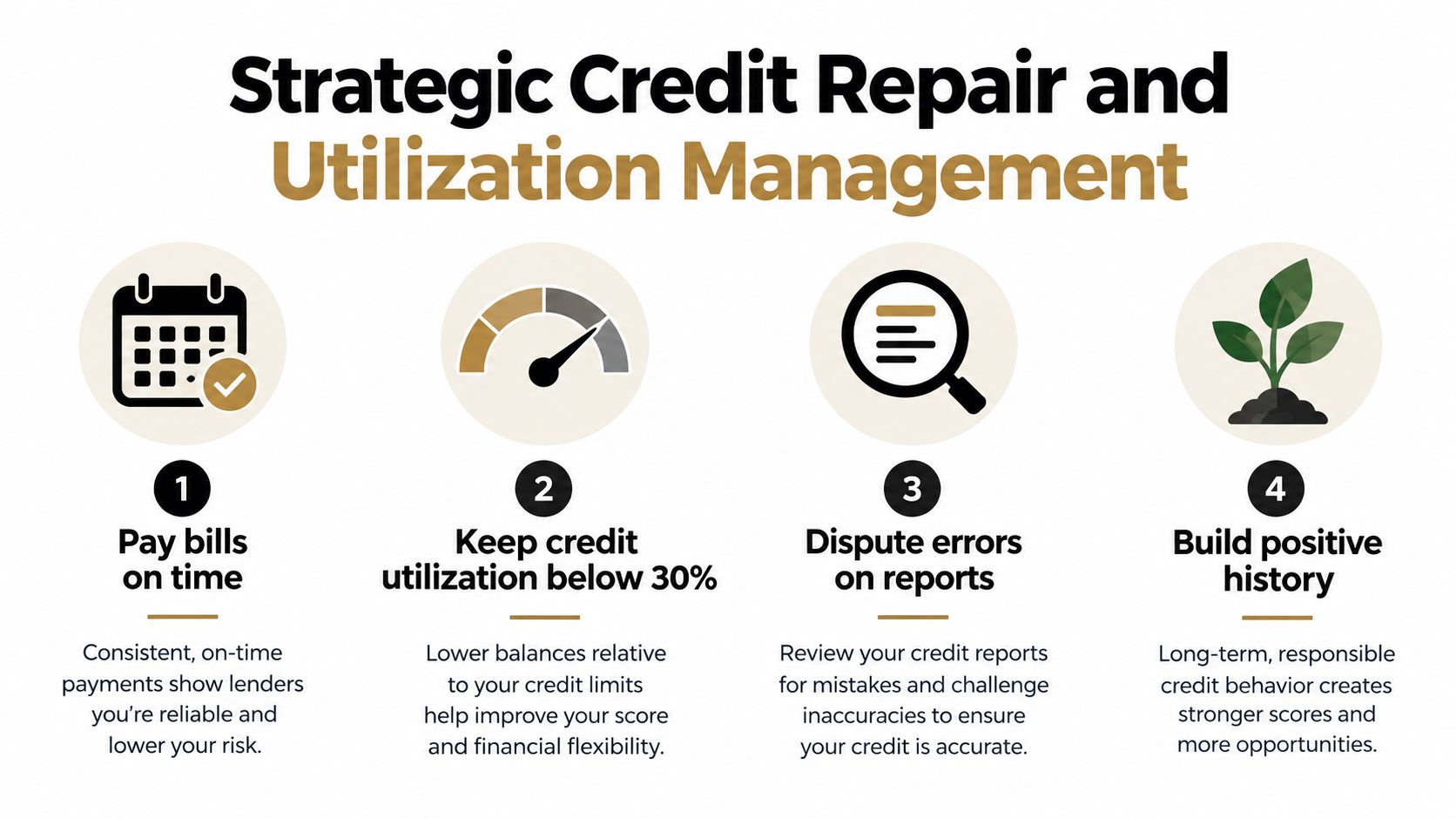
Credit utilization describes how much of your available revolving credit you're using. High balances can make a profile look strained even when every payment is on time. Pay attention to reported balances, not just whether you paid by the due date, because lenders and scoring systems may evaluate what appears on the report.
The required infographic references keeping utilization below 30%, but that visual benchmark shouldn't be treated as a guarantee of approval or a universal lender rule. Your overall debt, income, account history, and loan program still matter. Resources that explain ways to boost your credit score can help you understand utilization and other credit factors without replacing personalized mortgage guidance.
Build stable positive history
Use accounts responsibly and avoid opening unnecessary credit before applying for a mortgage. Pay every obligation on time, keep balances controlled, and maintain stable housing payment records. If your file is thin, ask a qualified professional or lender about appropriate ways to establish positive history rather than adding accounts without a clear purpose.
Superior Credit Repair can help consumers review reports, identify questionable reporting, organize documentation, and understand mortgage-readiness issues. Its role should be understood as credit education, dispute support, and rebuilding strategy, not a promise of deletion, a score increase, or approval. Consumers comparing options can also review guidance on strongest mortgage pricing with Superior Credit Repair while considering how utilization fits into their broader application.
Navigating Common Pitfalls and Misconceptions
The most expensive mistake is treating the waiting period as the only approval requirement. A borrower may reach the required date and still face a denial because recent payment behavior is weak, revolving balances are high, debt-to-income is unacceptable, or the lender cannot verify the bankruptcy timeline.
A discharge isn't the same as a dismissal. A discharge generally means eligible debts were released under the bankruptcy process. A dismissal means the case ended without the same result, and certain mortgage programs may measure their waiting period from the dismissal date instead. Chapter 13 applications can also depend on whether the borrower completed the plan, made the required payments, or seeks financing while the case remains active.

Waiting versus preparing
Passive waiting means watching the calendar while unresolved credit report errors, late payments, and high balances remain in place. Active preparation means using the same period to correct inaccurate reporting, maintain payment consistency, document housing history, and learn which loan program matches the file.
Neither approach changes the applicable underwriting rules. Preparation can, however, reduce avoidable problems when the borrower becomes eligible. A technically eligible application can still be denied if the lender finds new derogatory events or cannot establish that financial conduct has stabilized.
A clean calendar date opens the door to review. It doesn't carry the applicant through underwriting.
Common errors to avoid
- Using the filing date automatically: Confirm whether the program uses discharge, dismissal, or plan-payment history.
- Applying to every loan type at once: Compare the program rules and choose a realistic target based on eligibility and affordability.
- Ignoring collections: Review collections individually and determine whether reporting is accurate and complete.
- Opening unnecessary accounts: New applications can complicate a mortgage review, especially close to underwriting.
- Assuming credit repair guarantees deletion: Disputes must be based on accuracy, documentation, and lawful verification.
- Forgetting housing history: Stable rent or mortgage payments can help explain current financial behavior, though the lender still applies its own standards.
If you rent while rebuilding, mortgage preparation can also support apartment approval and rental screening. Consumers who need coverage while navigating difficult credit may find general information about bad credit insurance options Southeast useful, but insurance guidance doesn't replace mortgage underwriting or credit counseling.
Your Path to Homeownership and Actionable Next Steps
Homeownership after bankruptcy is best approached as a comparison between two paths. Waiting without preparation may satisfy a date while leaving the file vulnerable. Waiting while rebuilding gives you time to understand the reports, correct inaccuracies, control utilization, and prepare documents for a lender.
The right next step depends on your chapter, the outcome of the case, the loan program, and the condition of your credit today. A consumer targeting FHA or VA may have a different planning horizon from someone pursuing conventional financing. A USDA applicant must also confirm the program's property and borrower requirements, not just the bankruptcy timeline.
A practical preparation checklist
- Verify the legal timeline. Find the discharge or dismissal date in your bankruptcy records, then ask the lender which date applies to the program you're considering.
- Review every credit report. Flag inaccurate, outdated, duplicate, unverifiable, or misleading information and collect supporting records.
- Protect recent payment history. Keep current accounts paid on time, including housing, revolving credit, installment debts, and any active Chapter 13 plan obligations.
- Reduce unnecessary strain. Manage revolving balances and avoid taking on new debt that could affect utilization or debt-to-income.
- Organize the file. Keep discharge paperwork, dispute correspondence, account statements, and explanations for any financial hardship.
- Seek a lender-readiness review. Ask a mortgage professional what remains before preapproval and whether the file fits FHA, VA, USDA, or conventional guidelines.
If you're still unsure how to get approved for a home, focus on the difference between eligibility and readiness. Eligibility concerns whether the waiting rule may be satisfied. Readiness concerns whether your credit behavior, income, debts, documentation, and housing history support a credible application.
Results vary based on your credit file, documentation, creditor responses, bankruptcy outcome, and current credit behavior. Credit restoration can help identify and dispute reporting errors, but no ethical company can promise a specific score, deletion, interest rate, or mortgage approval.
Superior Credit Repair can review your credit report, help identify inaccurate or questionable items, and explain a step-by-step plan for improving your credit profile after bankruptcy. Visit Superior Credit Repair to request a free credit analysis or consultation and better understand your mortgage-readiness options.
If this information helped you better understand your credit report or your next steps, we would appreciate your honest feedback. You are welcome to share your experience with Superior Credit Repair on our Google Business Profile.