

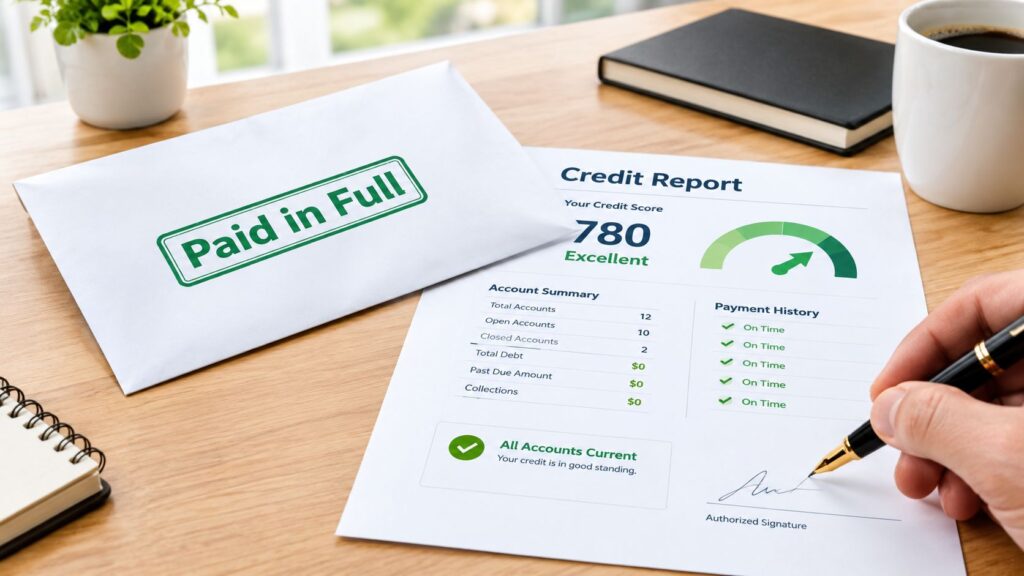
A paid-in-full letter proves that you satisfied the debt, but it does not delete negative credit history. Mortgage borrowers may receive payoff confirmation within 10 days after payoff, yet the letter still needs to be matched against the credit report and supported by a formal dispute when the reporting is inaccurate.
You may be looking at a credit report right now and seeing a balance on an account you already paid. Or perhaps a lender has asked for proof that a collection, charge-off, or old loan was resolved before reviewing your mortgage application. In either situation, a paid in full letter can provide important evidence, but it isn't a magic delete button.
The document marks an administrative change from active debt to resolved debt. It can support credit report corrections, mortgage underwriting, refinancing, and future disputes. Results vary based on your credit file, documentation, creditor responses, account history, and current credit behavior, so responsible credit repair focuses on accuracy and verification rather than promises of deletion or a specific score increase.
Table of Contents
- Why a Paid in Full Letter Matters for Credit Accuracy and Mortgage Readiness
- Paid in Full vs Settled Debt What Actually Happens on Your Credit Report
- How to Request and Verify a Paid in Full Letter Correctly
- Where to Send the Letter and How to Dispute Credit Report Errors
- How a Paid in Full Letter Affects Your Credit Score and Loan Programs
- Preparing a Lender-Ready Credit Profile for Home Purchase and Refinance
- Next Steps for Better Credit and Clearer Mortgage Readiness
Why a Paid in Full Letter Matters for Credit Accuracy and Mortgage Readiness
A consumer pays the final amount, saves the bank confirmation, and assumes the account is finished. Later, a credit report still shows a balance, an open collection, or a status that doesn't match what happened. Without written proof, the consumer may have to rely on phone conversations and incomplete payment records.
A paid in full letter is written confirmation from a creditor or collection agency that the obligation has been satisfied. It commonly includes the account identifier, original creditor, final amount paid, and proof of the last payment. Mortgage payoff guidance from Rocket Mortgage explains why borrowers should retain payoff confirmation with the final statement and recorded satisfaction documents.

Evidence is not erasure
The letter supports a request to update an account to a zero balance or paid status. It doesn't automatically remove a collection, charge-off, late payment, or other negative history. Paid collections and charge-offs can remain on a credit report for up to seven years from the original delinquency date, as explained in consumer guidance about paid debt records.
That distinction matters during credit restoration. A compliant review asks whether the information is accurate, complete, current, and verifiable. If the report says you still owe money after the creditor confirmed payment, the letter becomes useful documentation for a dispute. If the negative history is accurate, payment alone may change the balance without eliminating the history.
Practical rule: Treat the letter as part of an evidence trail. Keep it with the payment receipt, final statement, account correspondence, and later credit reports.
Why lenders care
Mortgage underwriters need a clear record of resolved obligations. A paid-in-full letter can help explain a collection or installment loan during FHA loan preparation, VA loan preparation, USDA loan preparation, or conventional mortgage preparation. It can also help a borrower preparing to refinance or apply for an apartment where the screening report doesn't yet reflect the payment.
The letter won't guarantee mortgage approval. Lenders also review payment history, credit utilization, debt-to-income concerns, account stability, and the overall credit profile. Still, clear documentation can prevent an unresolved account from looking like an active obligation when the file is under review.
Paid in Full vs Settled Debt What Actually Happens on Your Credit Report
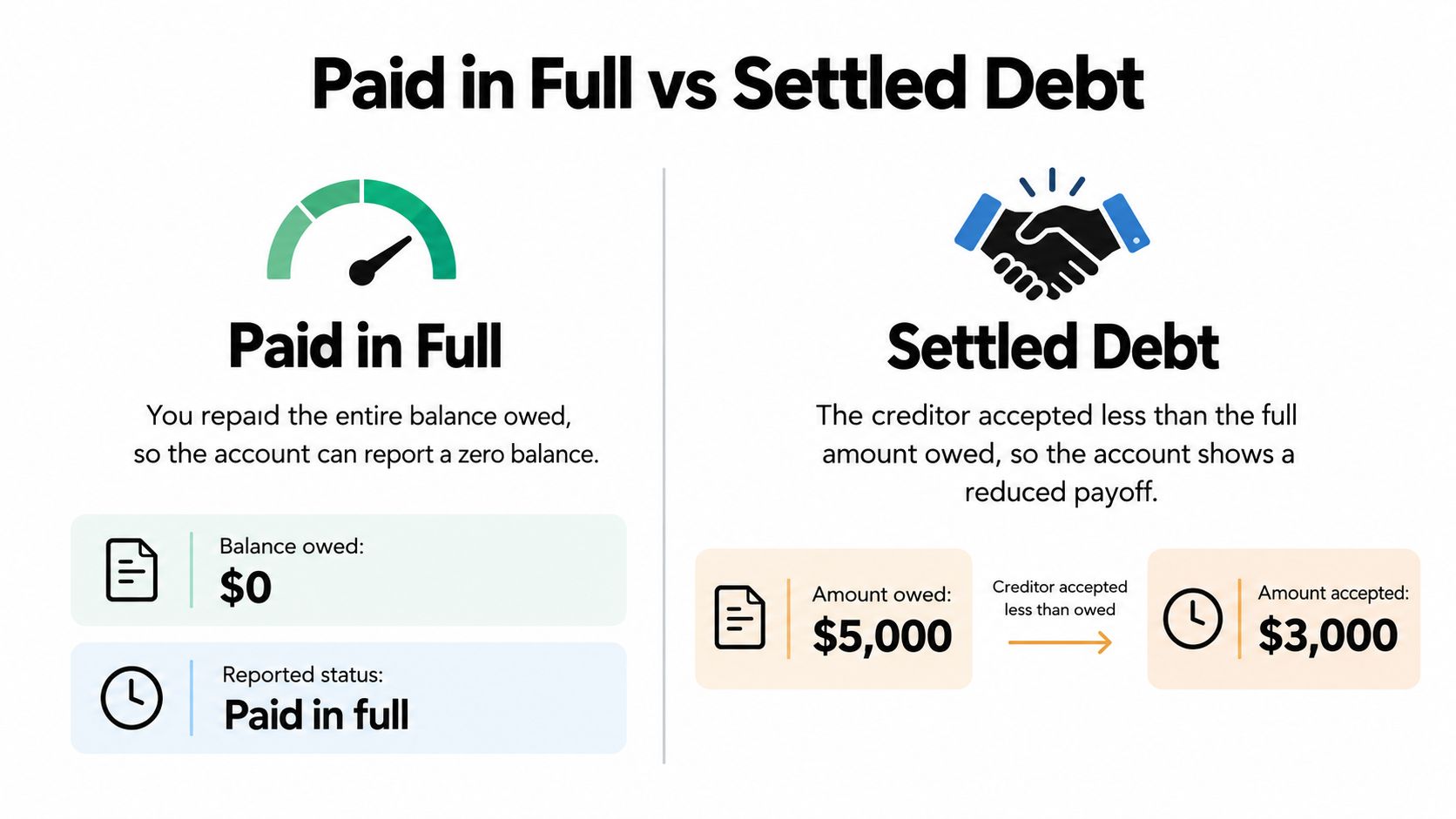
The words paid in full and settled describe different financial outcomes. Paid in full means the borrower repaid the full balance owed. Settled means the creditor accepted less than the full amount, leaving a different reporting history and a different explanation for an underwriter.
A paid-in-full notation shows that the obligation was satisfied as agreed. A settled account means the creditor accepted a reduced payoff, and the account remains derogatory. That distinction can matter for everyday credit decisions, mortgage review, and future disputes. MoneyLion's explanation of settlement language outlines why consumers should confirm the exact status before paying.
The wording changes the meaning
| Status | What it means | What to verify |
|---|---|---|
| Paid in full | The full balance was repaid and the account should show no remaining balance. | Confirm the creditor uses explicit paid-in-full language and reports a zero balance. |
| Settled | The creditor accepted less than the full amount owed. | Confirm the remaining balance is released and understand that the negative history may remain. |
A settlement agreement should never be treated as a paid-in-full confirmation unless the creditor agrees to that language. A consumer who pays a reduced amount may receive a letter saying settled, settled for less than owed, or another variation. Those terms aren't interchangeable.
For readers preparing to dispute a credit report error, documentation is just as important as the dispute wording. Keep what to save before a credit dispute organized before sending anything to a bureau or furnisher.
How this affects mortgage review
A settled account may demonstrate that the debt is no longer collectible under the agreement, but it can still appear derogatory. A paid-in-full account presents a stronger record of full repayment, yet it still doesn't promise removal or approval. The lender may review the original delinquency, the current status, and the applicant's broader pattern of repayment.
Before making a payment, ask the creditor to state in writing whether the account will be reported as paid in full or settled. Don't assume that a payment receipt alone controls the tradeline. The furnisher's reporting language matters.
How to Request and Verify a Paid in Full Letter Correctly
The safest workflow begins before the final payment. First, confirm the creditor, account number, balance, payment terms, and reporting language in writing. Then make the payment through a traceable method, keep proof, and request a final letter after the payment clears.
A strong operational letter should identify the creditor or collector and state that the balance is now zero. It should also show the account number, payment date, amount paid, and the exact phrase paid in full. Practical guidance on proof of paid-in-full status recommends including the consumer's contact information, creditor details, account information, and final payment details.
Follow a documentation-first process
Verify the terms. Match the account to your records and confirm what payment will satisfy the obligation. If the creditor is accepting less than the balance, get the settlement terms and remaining-balance treatment in writing before paying.
Make the payment carefully. Use the payment instructions supplied by the creditor or collector. Save the confirmation number, bank record, canceled check, receipt, and any correspondence showing when the payment was made.
Request written confirmation. Ask for a paid-in-full letter after the final payment clears. A phone representative may confirm the account verbally, but verbal confirmation is harder to use in a credit dispute or mortgage file.
Review every field. Check the name, account number, original creditor, payment date, amount paid, balance, and status language. An account number mismatch can weaken the connection between the letter and the tradeline.
Compare it with the report. Obtain current reports and check whether the account shows a zero balance and the correct status. Look for differences between the letter and each bureau's version of the account.
Preserve the file. Store the letter with payment evidence, statements, dispute correspondence, delivery receipts, and investigation results. A complete record helps you explain what happened months later.
What the letter can't do
A paid-in-full letter proves resolution. It doesn't erase accurate negative history, remove a legitimate late payment, or guarantee a score change. The account may remain visible because credit reporting records historical payment performance as well as current balances.
Mortgage borrowers should also distinguish a payoff confirmation for an installment loan from a debt settlement letter. A mortgage payoff letter helps show that the loan was closed, while a lien release or satisfaction of mortgage is the legal document that clears title. Lenders may send payoff confirmation within 10 days after payoff, according to Truist mortgage payoff guidance.
For additional homebuyer credit repair advice from Superior Credit, focus on documentation and report accuracy instead of assuming that one letter will resolve every issue.
Where to Send the Letter and How to Dispute Credit Report Errors
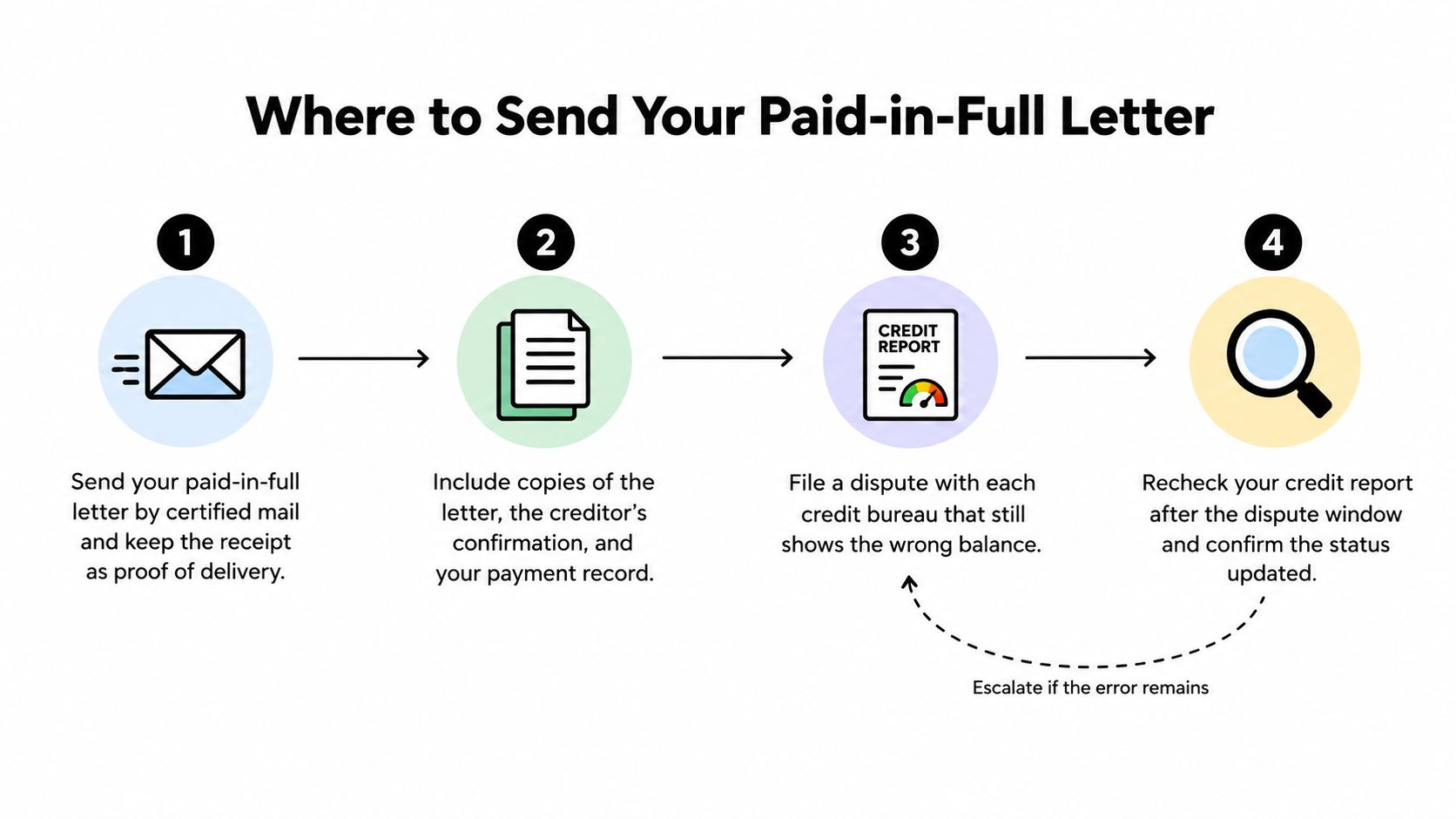
Once the letter is verified, send copies to each credit bureau that still reports the wrong balance or status. You may also dispute directly with the creditor or collection agency that furnished the information. Sending the same evidence to both parties can create a clearer record when the account remains inaccurate.
Use a traceable delivery method, such as certified mail with return receipt. Keep the letter you sent, every enclosure, the receipt, the delivery confirmation, and a copy of the dispute wording. Send copies rather than irreplaceable originals.
Build a focused dispute packet
A useful packet normally contains:
- A clear explanation: State what is inaccurate, such as a balance that remains after payment or a status that says unpaid.
- Supporting records: Include the paid-in-full letter, payment proof, final statement, and relevant account correspondence.
- A specific correction: Ask the recipient to investigate and update the account to the accurate status and balance.
- Identification details: Provide enough information to match the dispute to the correct tradeline, while protecting sensitive information that isn't necessary.
- Delivery evidence: Retain certified-mail records and return receipts so you can show when the dispute was received.
The Fair Credit Reporting Act generally requires inaccurate or unverified information to be corrected or removed. Negative information usually can't be reported after seven years, while bankruptcy information is generally permitted for 10 years, according to federal credit reporting guidance.
Track the investigation
A credit bureau investigation usually takes about 30 days, with a possible extension to 45 days when additional information is provided, according to Experian's guidance on showing an account as paid. Those timeframes don't guarantee a particular result. The furnisher may verify the information, correct it, or determine that the existing reporting is accurate.
After the investigation, compare the result with your paid-in-full letter. If the balance remains wrong, review the response for the furnisher's explanation and consider a focused follow-up dispute or complaint through the appropriate consumer-protection channel. Avoid sending repetitive disputes without new documentation or a clear explanation of the remaining error.
A detailed credit dispute letter for mortgage applicants should connect each requested correction to specific records. Mortgage applicants should share the updated report and supporting documents with their loan professional when appropriate, rather than waiting until the final underwriting review.
How a Paid in Full Letter Affects Your Credit Score and Loan Programs
The score effect depends on the scoring model and the way the furnisher reports the account. FICO 9 and FICO 10 ignore collections reported as paid in full, but older mortgage workflows may use models where a paid collection can continue to affect scoring until the item ages off or is removed through a separate dispute process. HSH's mortgage guidance on paying collections describes this model and loan-program uncertainty.
That means a paid-in-full letter can improve the stability and clarity of a mortgage file without producing a predictable score increase. The same account may be treated differently by a consumer score, a mortgage score, and an underwriter reviewing the complete application.
Loan programs don't all evaluate files identically
For FHA, VA, USDA, and conventional borrowers, a paid status can provide useful evidence that the obligation is resolved. It doesn't automatically remove the derogatory mark, override underwriting rules, or guarantee approval. The lender may still consider the account's original history, current reporting, payment behavior, utilization, and debt-to-income ratio.
A common error is paying a collection without confirming how the furnisher will report it. The tradeline might update as settled or paid, rather than paid in full, and the original negative history may remain visible. Before paying, consider the balance, written language, timing, and mortgage lender requirements together.
A letter can strengthen your file's documentation without changing every scoring input.
If you're also budgeting for homeownership, separate credit preparation from property-related costs. A resource such as 2026 flood insurance costs explained can help you examine insurance considerations independently from your credit documentation.
For borrowers facing overcoming paid collection hurdles for home loans, the practical strategy is to verify the reporting, preserve the evidence, and ask the lender how the specific loan program evaluates the account. Don't pay solely because you expect an immediate score change.
Preparing a Lender-Ready Credit Profile for Home Purchase and Refinance
Mortgage readiness involves more than resolving one collection. A lender-ready profile should present accurate accounts, consistent recent payments, manageable revolving balances, and documentation that explains any resolved debt. The paid-in-full letter fits into that larger file as proof of one completed obligation.
For an FHA applicant, preparation may include reviewing collections, late payments, utilization, and debt-to-income concerns. A VA applicant may need the same accuracy review while organizing documentation that explains prior hardship. Conventional and USDA applicants also benefit from an early review because an unresolved reporting error can become harder to address close to underwriting.
Organize the file before applying
Create a mortgage credit folder with:
- Current credit reports: Mark balances, statuses, account dates, collections, charge-offs, and late-payment information that needs verification.
- Resolution records: Save paid-in-full letters, payoff confirmations, final statements, and payment evidence.
- Budget information: Track recurring obligations and revolving balances so you understand debt-to-income pressure before a lender reviews the file.
- Payment history records: Keep evidence of on-time payments and avoid new late payments while preparing.
- Written explanations: Prepare a factual explanation for unusual events, such as divorce, separation, illness, or financial hardship, when a lender requests one.
High credit utilization can make a profile look strained even when all payments are current. Paying a collection doesn't automatically address utilization, thin credit, recent late payments, repossessions, or inaccurate medical collections. A credit restoration plan should prioritize the issues that are both inaccurate and relevant to the consumer's financing goal.
Protect stability during the application period
Avoid opening or closing accounts without understanding the effect on the complete profile. Don't move forward based on a verbal promise that an account will be corrected. Ask for written confirmation and compare the credit report again before the lender pulls or reviews it.
First-time buyers can use a first-time buyer mortgage checklist to organize questions about payment history, utilization, collections, income obligations, and required documentation. Renters preparing for homeownership should apply the same discipline because apartment screening and mortgage underwriting both depend on the accuracy and presentation of financial information, even though their evaluation methods differ.
A paid-in-full letter supports readiness when it matches the report and the account history. It can't replace responsible credit habits. Timely payments, controlled balances, careful new-credit decisions, and complete records give a lender a more coherent picture of financial stability.
Next Steps for Better Credit and Clearer Mortgage Readiness
Start by checking whether the account is resolved and whether the credit report says the same thing. If the letter and report conflict, collect the payment proof, final statement, and account correspondence before disputing the inaccurate balance or status.
Credit repair should be treated as a structured review process, legal dispute and verification process, documentation-based process, and long-term rebuilding strategy. Results vary by credit file, documentation, creditor responses, account history, and current credit behavior. No responsible professional can guarantee deletion, an immediate score increase, or mortgage approval.
Superior Credit Repair can review your credit report, help identify inaccurate or questionable items, and explain a step-by-step plan for improving your credit profile. You can request a free credit analysis or consultation to better understand your options.
If this information helped you better understand your credit report or your next steps, we would appreciate your honest feedback. You are welcome to share your experience with Superior Credit Repair on our Google Business Profile.
Superior Credit Repair helps consumers review paid-in-full documentation, identify inaccurate or questionable reporting, and prepare organized credit profiles for home, auto, business, and personal financing. If you need a calm, documentation-based review before disputing an account or applying for a mortgage, visit Superior Credit Repair to learn about a free credit analysis or consultation.