


There is no single legal minimum credit score for apartment approval, but many landlords start looking favorably at 600 to 650, while 670 or higher is generally viewed as a stronger range. A score alone doesn't guarantee approval because landlords also review the full credit report, rental history, income, and screening results.
You may be sitting at your kitchen table after submitting a long apartment application, watching the status page refresh while one question keeps circling in your mind: Is my credit score high enough? The answer depends on how the landlord measures risk, what kind of apartment you're applying for, and what the rest of your application says about your ability to pay rent consistently.
An apartment screening is usually a layered review rather than a simple pass-or-fail score check. A screening company may summarize your credit profile, while a property manager reviews payment history, collections, income, prior rental conduct, and eviction information. If something is inaccurate or outdated, a documentation-based credit review may help you understand whether it can be disputed through the proper legal process.
Table of Contents
- Why the Apartment Approval Credit Score Question Feels So Stressful
- Understanding Credit Score Ranges for Apartment Approval
- How Landlords and Screening Services Actually Evaluate Applicants
- How Approval Standards Change by Unit Type and Market
- Credit Factors That Can Quietly Sink an Apartment Application
- Practical Strategies to Improve Your Approval Chances
- Turning Apartment Approval Into a Step Toward Homeownership
- Frequently Asked Questions About Apartment Approval Credit Scores
Why the Apartment Approval Credit Score Question Feels So Stressful
Maya had spent weeks comparing apartments, calculating moving costs, and gathering employment documents. She finally found a place close to work, completed the application, paid the application fee, and clicked submit. The form seemed routine until the screening section asked for permission to review her credit.
Her score wasn't the only concern. She remembered an old collection account, a late payment from a period of financial hardship, and a balance on one credit card that had grown while she was moving between jobs. The application suddenly felt less like a housing request and more like a judgment of her entire financial history.
That reaction is common because a rental application compresses a complicated credit file into a decision made on a short timeline. In a competitive market, applicants may worry that a landlord will choose another renter before they have a chance to explain an old account. A soft inquiry or tenant screening inquiry may also feel threatening, even though the larger concern is usually the information returned to the landlord and how the property applies its criteria.
What happens after you submit
A screening service may pull consumer-report information, generate a rental-focused score, and flag items that need review. A property manager may then compare those results with income documents, rental references, eviction history, and the building's internal standards. A private landlord might inspect the report personally, while a larger management company may rely more heavily on automated rules.
The landlord isn't necessarily asking whether you're a perfect borrower. The practical question is whether your application gives enough evidence that rent will be paid reliably and that the lease relationship is likely to remain stable.
Practical rule: Treat your credit report as part of your rental application paperwork. Review it before applying, just as you would check an employment letter or prior landlord reference.
If your schedule is already crowded, organization matters. A simple document folder and application checklist can prevent missed deadlines and incomplete explanations. Superior Credit Repair busy schedule advice can help you organize credit records while managing work, family, and housing decisions.
Understanding Credit Score Ranges for Apartment Approval
Landlords don't use one universal apartment approval credit score. Experian explains that no single score guarantees approval, while rental guidance commonly places favorable attention around 600 to 650, with 670 or higher often viewed as stronger. Experian's apartment rental guidance also emphasizes that applicants in the 600 to 650 range may have better odds, but the property and the rest of the application still matter.
The FICO scoring range runs from 300 to 850, and scores from 670 to 739 are generally considered good, while 740 and above is considered excellent, according to myFICO's explanation of rental credit scores. Those labels describe credit risk broadly, not a binding apartment rule.
A practical way to read the bands
A score below 600 can make a standard approval more difficult, especially when the report also shows recent delinquencies, collections, or limited payment history. Scores from 600 to 650 may fall into a workable range, but the landlord may look for strong income, savings, a clean rental history, or a guarantor.
Scores from 650 to 700 often present a more comfortable profile for many mid-market rentals, although property standards vary. At 700 and above, an applicant may face fewer questions, but approval still depends on the full report and the building's screening policy.
| Score Range | Typical Landlord Response | Approval Difficulty | Common Requirements |
|---|---|---|---|
| Below 600 | More detailed review or conditional consideration | Often difficult | Strong income documentation, explanation, guarantor, or additional risk controls |
| 600 to 650 | Possible approval when other factors are solid | Moderate | Reliable income, rental references, and a stable payment profile |
| 650 to 700 | Often viewed as a more comfortable range | Moderate to lower | Standard documentation, subject to property rules |
| 700 and above | May appear lower risk to many landlords | Often easier, but not automatic | Complete application and verification |
Why the score isn't the whole decision
Zillow reports that 600 or higher is generally acceptable in many rental settings, while scores above 700 may be viewed as lower risk. Its guidance also notes that some landlords set practical cutoffs between 620 and 700, depending on the property and local market. You can learn more about the factors behind a score through this resource on understanding credit scores for homebuyers.
A landlord may also see different scoring models or bureau information than you see through a consumer app. Don't assume that one displayed score represents every score used in screening. The most useful approach is to review the underlying reports, identify errors, and prepare an honest explanation for legitimate negative information.
How Landlords and Screening Services Actually Evaluate Applicants
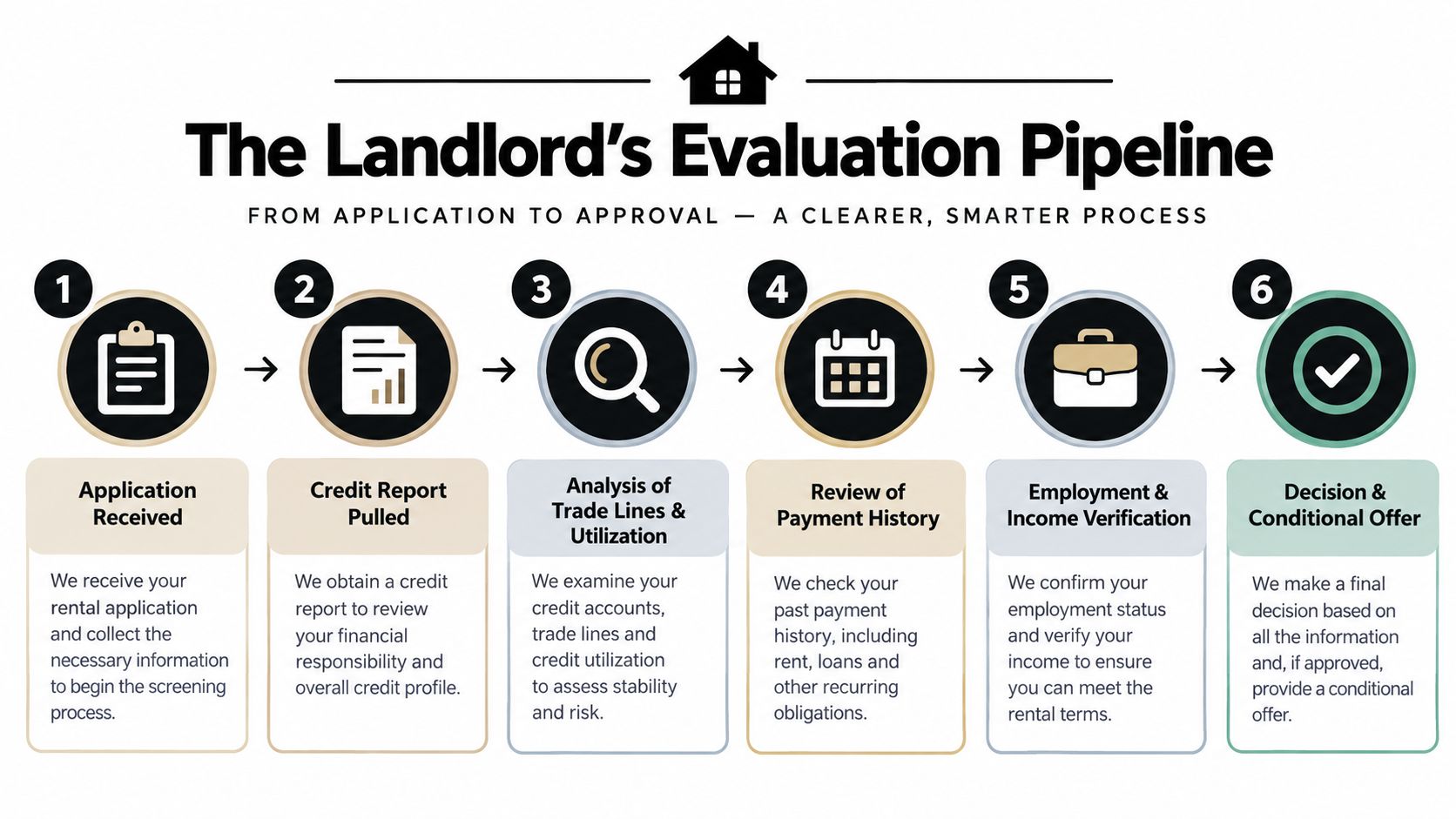
After submission, the application usually moves through several filters. The score may appear first because it's easy to summarize, but the screening company and landlord can evaluate much more than that number.
The report behind the score
The reviewer may inspect revolving accounts, installment loans, payment patterns, balances, collections, charge-offs, and recent account activity. A score acts like a summary, but the report provides context. A renter with a borderline score and a clean recent payment record may appear more stable than someone with a higher score and a newly reported delinquency.
Some screening products are designed specifically around rental performance. Apartments.com says its screening score ranges from 350 to 850 and is calibrated to estimate the likelihood of paying rent on time, with additional weight on credit factors connected to rental behavior. That means a landlord may focus on the parts of your file that suggest ongoing payment instability rather than treating every account equally.
Income and rental history
Income verification helps answer a different question: can the applicant afford this rent from current cash flow? Landlords may verify employment, review pay documentation, contact previous landlords, and examine rental payment history. They may also review eviction records and criminal records where permitted by applicable law.
A tenant history check can include more than a simple reference call. This overview of what a tenant history check covers is useful for understanding why rental history and prior housing records can influence the final decision.
Large property managers may use products such as TransUnion SmartMove, RentPrep, or Experian Connect to produce screening information and recommendations. Smaller landlords may review documents manually and ask follow-up questions instead. The same renter can therefore receive different outcomes from two properties because the landlords apply different risk models.
Conditional approvals are common
A landlord may approve an applicant with conditions rather than issue a flat denial. Possible controls include a co-signer, guarantor, larger security deposit, or additional proof of income and savings. Redfin's rental guidance identifies these alternatives and notes that a debt-to-income ratio at or below 43% can strengthen a tenant profile. Read Superior Credit Repair rental approval advice for more context on collections and rental screening.
How Approval Standards Change by Unit Type and Market
The same credit file can receive different treatment at different properties. A historical renter dataset cited by Redfin found an average renter credit score of 638, with minimum scores varying by unit type: 597 for low-end units, 626 for mid-level units, and 669 for high-end units. The pattern illustrates why rent level and market segment influence approval standards.
A low-cost apartment or individually owned rental may place greater weight on current income and landlord references when the applicant's score is below the property's preferred range. A professional mid-level complex may apply a formal screening threshold and request consistent documentation. A luxury building may use stricter standards because the rent, amenities, and applicant pool create a different risk profile.
| Unit Tier | Typical Credit Score Range | Income Requirement | Screening Rigor |
|---|---|---|---|
| Lower-end housing | May accept weaker scores when other factors are strong | Verified income and ability to pay | Varies widely by landlord |
| Mid-level complex | Often uses a formal threshold influenced by property policy | Stable, documented income | Screening service, credit, rental, and background review |
| High-end or luxury housing | Frequently expects a stronger profile | Detailed employment, savings, and affordability review | More extensive verification and stricter standards |
Location matters too. A building with many qualified applicants can raise its practical threshold, while a property trying to fill vacancies may consider more compensating factors. Corporate management often follows written criteria, whereas an individual owner may have more discretion, subject to fair housing and consumer-reporting rules.
Don't read the table as a promise that a particular score will qualify you. Use it to decide how much preparation your application needs. If the property is competitive or high-end, correcting report errors and assembling strong documentation becomes more important.
Credit Factors That Can Quietly Sink an Apartment Application
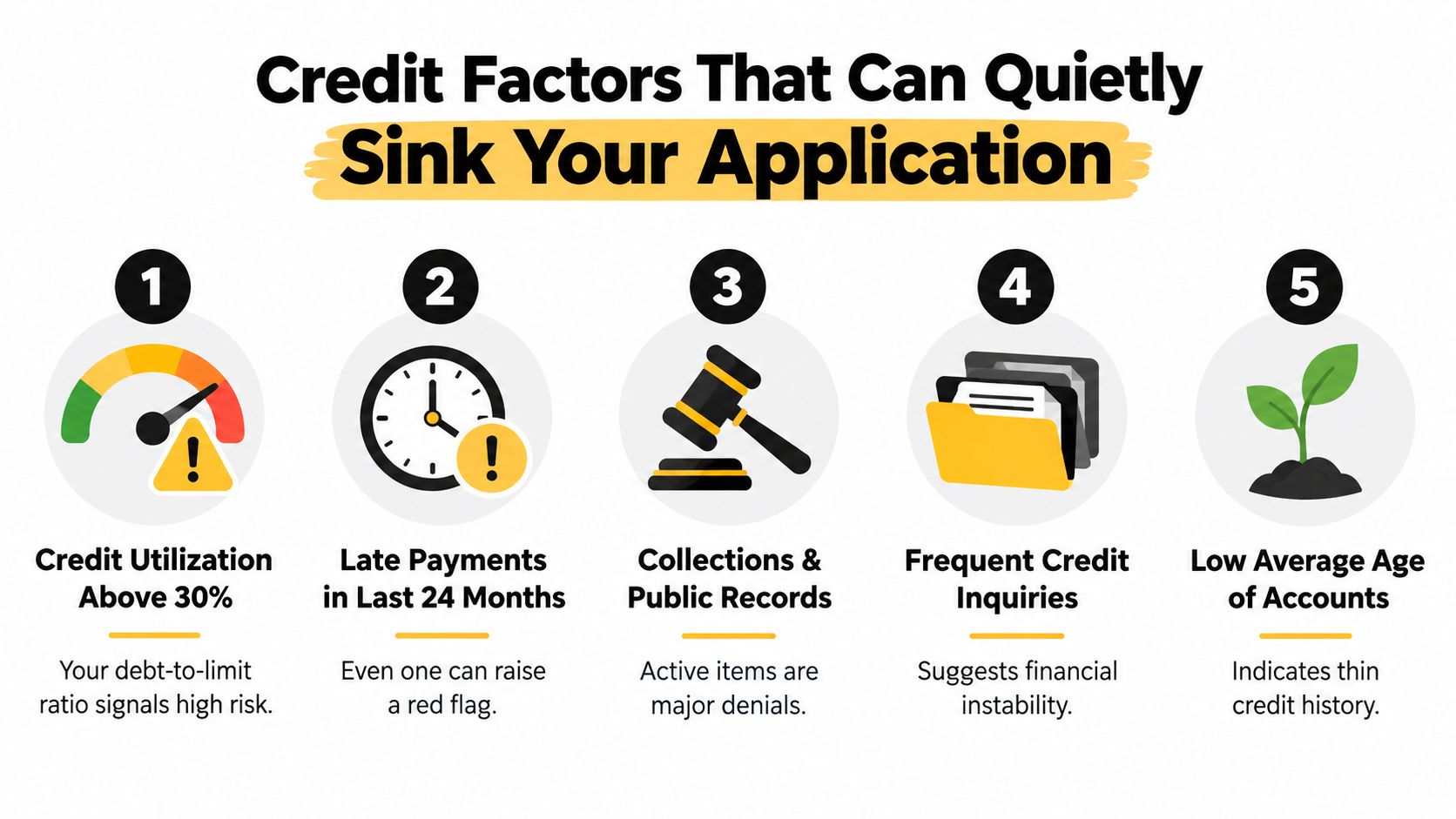
A headline score can hide the issue that concerns a landlord most. A reviewer may see a score that appears acceptable, then notice recent late payments, active collections, charge-offs, or balances that suggest financial strain.
Credit utilization is one example. It describes how much of your revolving credit limit you're using. The higher the balance relative to the limit, the more a landlord may wonder whether your current cash flow is under pressure. The often-cited 30% utilization marker appears in consumer guidance, but it isn't a universal apartment rule or a guarantee of approval.
What deserves attention before applying
- Recent late payments: A recent missed payment can carry more practical concern than an older isolated issue because it may indicate a current problem. Review this guide to late payments and credit before deciding whether an account needs correction or explanation.
- Collections and charge-offs: An unpaid account transferred to collections or charged off by a creditor can raise questions about repayment behavior. Verify whether the account is accurate, belongs to you, and is being reported consistently.
- High revolving balances: Large balances can affect both the score and the landlord's view of available monthly cash flow. Paying balances down can help, but don't take on new debt to make an application look better.
- Thin credit files: A limited history gives the screening system less information. A landlord may compensate by requesting stronger income evidence, a guarantor, or rental references.
- Eviction and public-record information: Tenant screening reports can contain housing-related records that aren't identical to the information shown on a traditional credit report. Review those records for completeness and accuracy.
A clean recent payment pattern can sometimes be more persuasive than a modestly higher score with a new delinquency. That's why a renter should inspect dates, account status, balances, and creditor names rather than focus only on the number shown in an app.
Separate errors from accurate hardship
Credit restoration should address inaccurate, outdated, unverifiable, or misleading information through documentation and lawful dispute processes. It shouldn't promise removal of accurate negative information. Results vary according to the credit file, supporting records, creditor responses, account history, and current behavior.
Start with items you can verify. Compare the account owner, dates, balances, payment status, and reporting history across your bureau reports. Keep copies of statements, correspondence, settlement records, and identity documents that support a dispute.
Practical Strategies to Improve Your Approval Chances
Preparation can make a borderline application easier to understand. It won't guarantee approval, but it can reduce avoidable surprises and give the landlord a complete picture.
Review before you apply
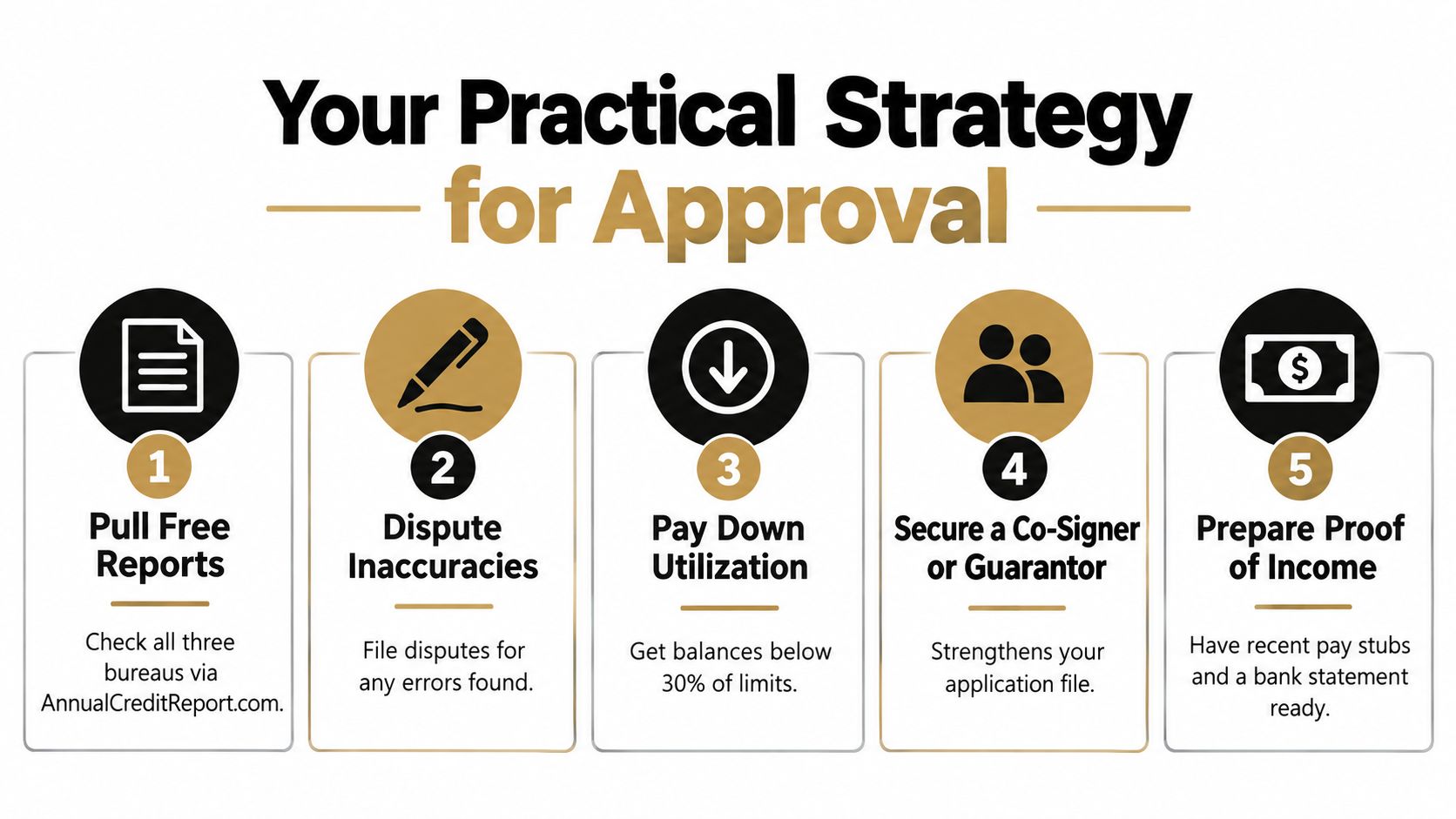
Pull your reports from all three bureaus through AnnualCreditReport.com, then look for inaccurate personal information, duplicate accounts, incorrect balances, wrong dates, and accounts that don't belong to you. If you find an error, dispute it with the reporting bureau and, when appropriate, the furnisher. Send clear documentation and keep proof of delivery.
Next, review revolving balances and create a realistic payoff plan. Lower utilization may support a healthier profile, but paying rent and essential bills must remain the priority. Don't close older accounts or open several new accounts without considering how those actions may affect the rest of your file.
Build an explanation package
If a legitimate hardship caused a late payment or collection, prepare a short factual letter. Explain what happened, state what has changed, and attach useful documentation such as proof of on-time rent, employment verification, bank statements, or evidence of resolved debt.
A complete application can also include:
- Income records: Provide the documents the property requests, with consistent names and dates.
- Rental references: Ask prior landlords whether they'll confirm payment history and lease compliance.
- Savings evidence: Show available funds if the landlord permits this type of documentation.
- Credit explanations: Address only relevant issues, without making unsupported claims or blaming unrelated parties.
A co-signer or guarantor may strengthen an application, but that person accepts meaningful obligations. Depending on the lease, the guarantor may become responsible for unpaid rent, fees, or damage if the tenant fails to meet the agreement. Read the contract carefully before asking someone to sign.
Some landlords may consider a larger security deposit or advance rent where local law and property policy allow it. These aren't automatic rights, and they don't replace accurate screening. A rent-reporting service can also add positive payment information, but renters should confirm what it reports and understand that late rent could create negative information if reported.
For practical moving preparation after approval, a first apartment packing list Boston can help you plan the household details separately from the credit and screening work.
Use lawful, realistic support
Credit repair scams often promise guaranteed deletions, overnight results, or a specific score increase. Those promises aren't a substitute for evidence. A compliant process reviews the file, identifies potentially inaccurate information, prepares disputes where supported, and combines correction work with long-term rebuilding habits.
Superior Credit Repair offers credit report review, dispute preparation, and credit improvement planning for consumers working toward rental approval and broader financing goals. Its nationwide credit repair guide provides additional education about reviewing reports and developing a structured improvement plan.
Turning Apartment Approval Into a Step Toward Homeownership
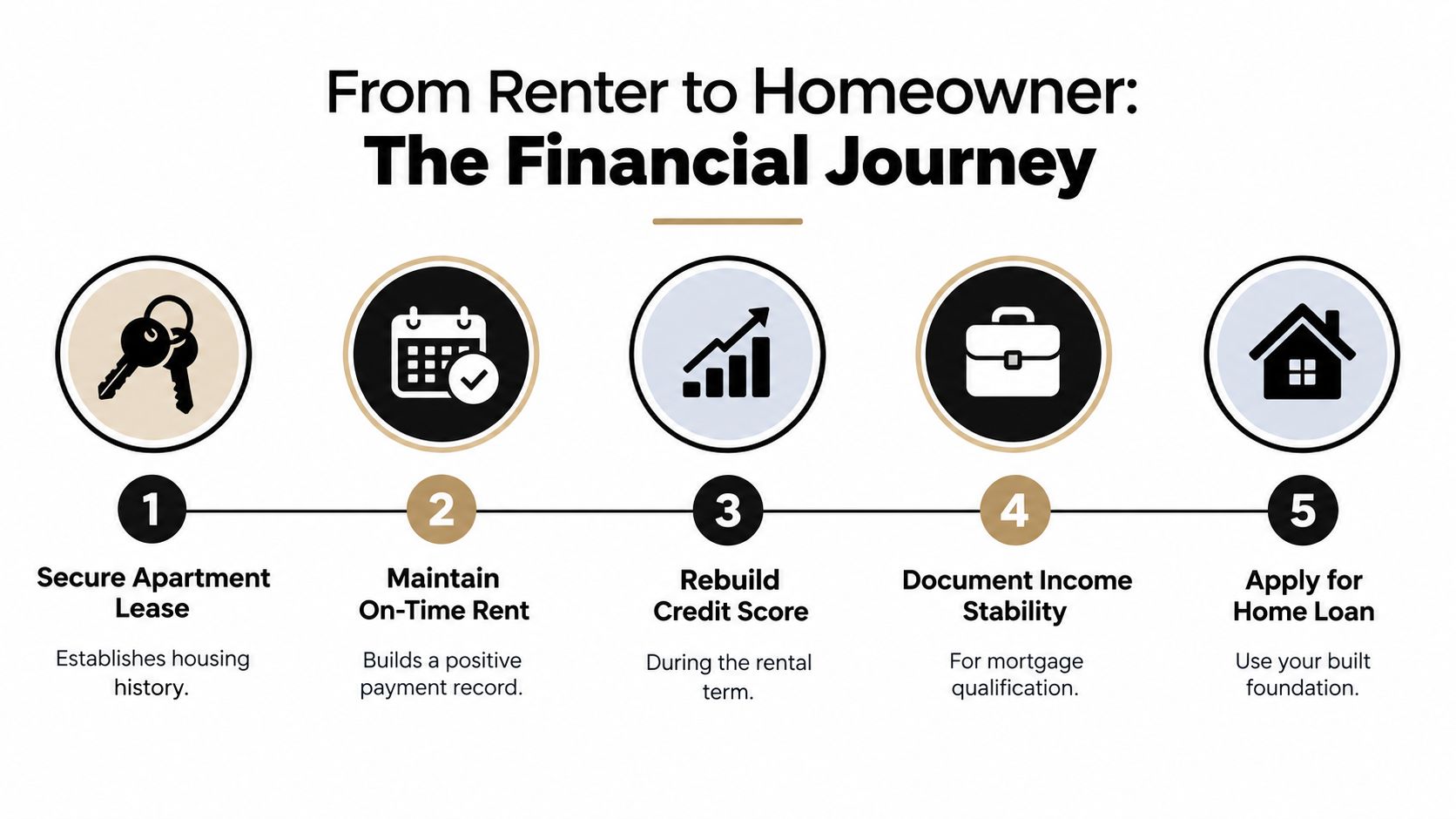
An apartment lease can become part of a larger financial record. Paying rent on time, keeping revolving balances manageable, preserving stable employment, and avoiding unnecessary new debt can help you build habits that matter when you later prepare for a mortgage.
Rent payments don't automatically appear on the major credit reports. A renter generally needs a qualifying rent-reporting service or a landlord that participates in reporting. Before enrolling, confirm which bureaus receive the information and understand the service's terms.
The habits transfer
A future mortgage lender will review more than a score. Lenders may examine payment history, debt obligations, income stability, account balances, and the overall consistency of the credit file. The same habits that help you present a stronger apartment application can support preparation for FHA, VA, USDA, or conventional mortgage financing, although each program and lender applies its own requirements.
Use the rental period to create records. Save lease documents, payment confirmations, renewal notices, and income records. If a landlord reports rent, check your reports periodically to make sure the information is accurate.
Homeownership also requires cash planning beyond the credit score. Renters who want to prepare can review resources about saving for a house in 2026 while keeping their credit strategy focused on accurate reporting, stable payments, and manageable debt.
The apartment application is therefore more than a one-time screening event. It can show you which parts of your financial profile need attention before you speak with a mortgage lender, and it gives you an opportunity to practice the documentation and payment discipline that homeownership demands.
Frequently Asked Questions About Apartment Approval Credit Scores
What minimum score do most landlords accept?
There isn't a universal legal minimum. Many landlords start viewing 600 to 650 favorably, while 670 or higher may be stronger, but property type, market conditions, income, rental history, and the full report can change the result. Redfin's rental credit guidance also shows that historical minimums differed by unit segment.
Can a score of 580 qualify?
It can be possible, but approval may require compensating strengths such as reliable income, strong rental references, savings, a guarantor, or a larger deposit where permitted. A private landlord and a corporate property manager may apply different standards.
How does bankruptcy affect rental approval?
A bankruptcy can lead to closer review of the credit report and may affect the landlord's risk assessment. Its practical impact depends on the report, discharge status, current payment behavior, income, rental history, and the property's screening policy. Ask the landlord what records it considers and review any consumer report for accuracy.
Does a co-signer guarantee approval?
No. A co-signer may reduce perceived payment risk, but the property can still evaluate income, rental history, eviction information, background-screening results, and application completeness. The co-signer also accepts contractual responsibility defined by the lease.
What if two people apply together?
The property may evaluate each applicant separately and may combine income, depending on its written policy. One applicant's strong profile may not erase another applicant's recent delinquencies, collections, or housing-related records. Ask how the landlord handles joint applications before paying an application fee.
How long do negative items remain visible?
The answer depends on the type of information, the reporting source, applicable law, and the screening product. A landlord may review traditional credit reports and separate tenant-screening records, so request and inspect the reports used in an adverse decision. Under consumer-reporting rules, applicants generally have rights to receive certain notices and dispute inaccurate information.
Superior Credit Repair can review your credit report, help identify inaccurate or questionable items, and explain a step-by-step plan for improving your rental profile. Visit Superior Credit Repair to request a free credit analysis or consultation and better understand your options before applying.
If this information helped you better understand your credit report or your next steps, we would appreciate your honest feedback. You are welcome to share your experience with Superior Credit Repair on our Google Business Profile. Share your feedback