


Under federal mortgage-servicing rules, a servicer generally cannot make the first formal foreclosure notice or filing until your loan is more than 120 days delinquent, approximately four missed monthly payments, although a serious demand or acceleration letter can arrive around the third missed payment. State law, loan type, and your account's status affect the exact dates.
You may be reading this with an unopened mortgage statement nearby, wondering whether another missed payment means losing your home. The most useful next step isn't guessing how much time remains. It's finding out exactly where your account stands, what assistance is available, and which deadlines require a response.
Table of Contents
- What Homeowners Usually Face When Payments Slip
- A Month by Month Look at Late Mortgage Payments
- Why Loan Type Changes the Timeline
- What Actually Happens Before a Foreclosure Sale
- Homeowner Options That Can Stop a Foreclosure
- Where Credit Repair Fits Without Overpromising
- A Practical Four Step Action Plan
- Questions Homeowners Usually Ask Next
What Homeowners Usually Face When Payments Slip
A missed payment, a foreclosure warning, and a foreclosure sale are different events. Understanding that distinction can help you respond without assuming either that you're out of options or that you have plenty of time.
The federal timing protection generally gives borrowers an opportunity to contact their servicer and seek assistance before foreclosure begins. It isn't a guaranteed waiting period measured from the day you open a warning letter, and exceptions can apply, including abandonment and certain completed loss-mitigation situations, according to the Consumer Financial Protection Bureau's foreclosure timeline guidance.
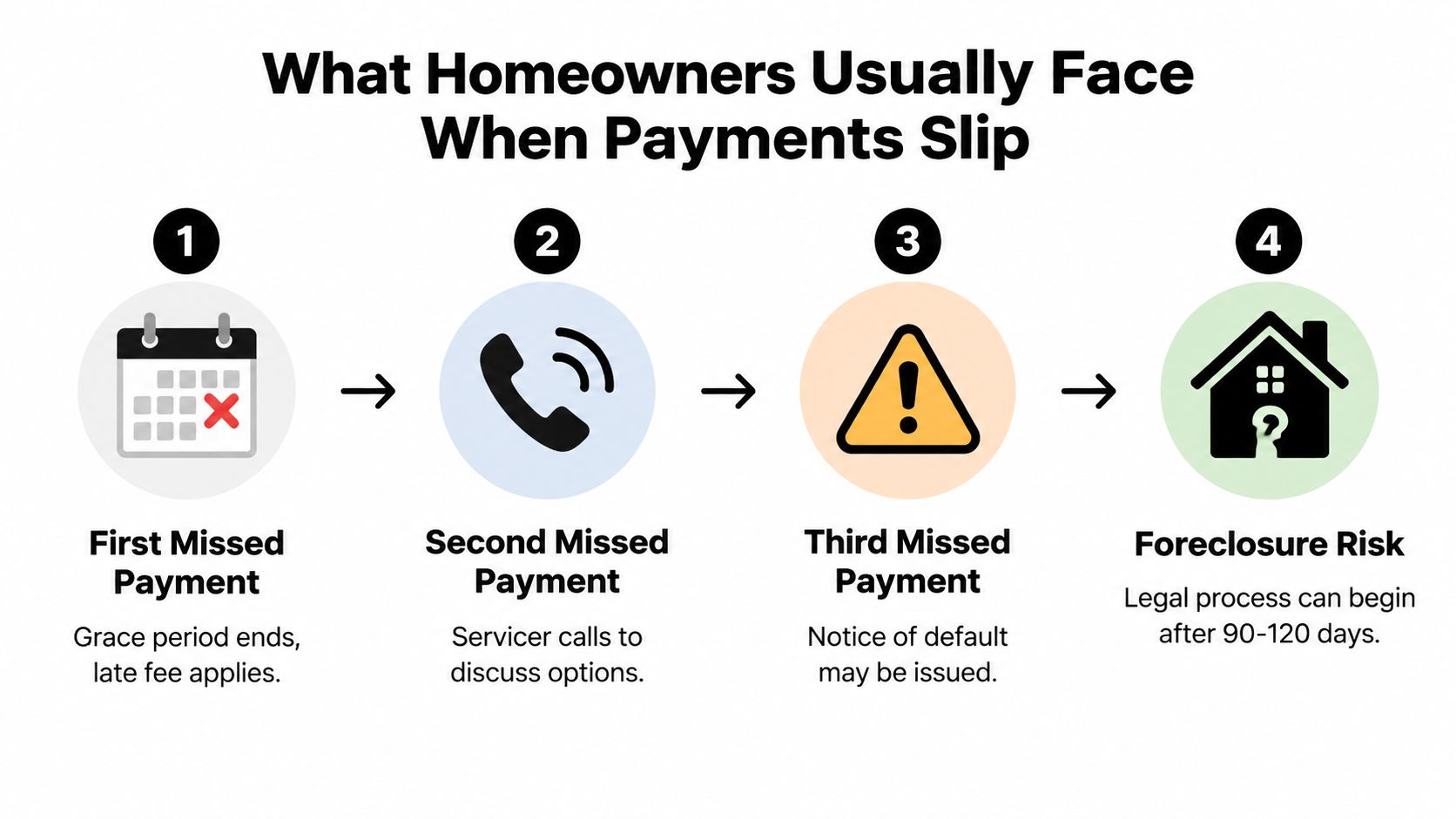
Treat the illustration as a broad escalation overview, not a legal countdown. Its early foreclosure-risk range shouldn't replace the federal rule described above or the deadlines in your actual notices.
Separate the problems before choosing a response
Homeowners often face several problems at once. A household may have enough income to resume regular payments but not enough savings to cover the overdue balance. Another may need a lasting payment adjustment, while also discovering that a credit report shows the wrong delinquency date.
Organize your response around these parallel tracks:
- Resolve the overdue balance. Find out what it would take to bring the mortgage current.
- Request mortgage assistance. Ask the servicer to evaluate an affordable alternative through its loss-mitigation process.
- Review reporting accuracy. Compare your credit reports with payment records and investigate discrepancies.
Loss mitigation means working with the servicer on an alternative to foreclosure. A credit-report dispute serves a different purpose: checking whether the information being reported is accurate.
Practical rule: Don't wait for your credit report to change before addressing the mortgage account itself.
For reporting questions, understanding how late payments affect credit can help you separate account administration from credit history. When asking how many late mortgage payments before foreclosure, remember that payment count identifies a warning stage, not your complete legal position.
A Month by Month Look at Late Mortgage Payments
A calendar can help organize your response, but the servicer's records and written notices matter more than the month name. Don't assume that making a partial payment, leaving a voicemail, or requesting paperwork has resolved the delinquency.

The first and second missed payments
Early contact is your opportunity to describe the problem before the account reaches a legal warning stage. Explain whether the hardship has ended, whether your income remains reduced, and whether you can afford your regular payment going forward.
Open every statement and message. Check how the servicer applied your last payment, whether it lists an outstanding amount, and whether it has requested information from you. Review your loan documents rather than assuming a particular grace period or fee applies.
Your immediate jobs are practical:
- Confirm the account record. Compare the statement with your bank's payment confirmation.
- Explain the hardship clearly. Describe what changed and whether the change is temporary.
- Request the assistance checklist. Ask what documents the servicer needs to evaluate your situation.
The third missed payment and the fourth-month threshold
HUD describes an escalation pattern in which initial contact becomes more intensive after the second missed payment, a demand or acceleration letter may follow the third, and that letter may give 30 days to cure the delinquency or arrange an alternative. HUD also describes possible referral to attorneys around the fourth month and warns that legal fees can then become part of the overdue balance, as explained in its guidance on avoiding foreclosure.
Read a demand letter for its required action, not just its title. Put the response deadline on your calendar and ask the servicer whether your assistance application is complete.
A phone conversation is useful, but it isn't the same as a completed application. Keep copies of uploaded documents, confirmation messages, and requests for missing information so you can show what you submitted and when.
Why Loan Type Changes the Timeline
Your mortgage program matters, but it doesn't supply a standalone foreclosure countdown. Ask the servicer to identify the loan type and the applicable investor or program requirements instead of relying on what happened to a neighbor.
The distinction is especially important when comparing a government-backed mortgage with a conventional loan. A program label helps identify which assistance questions to ask. It doesn't prove that a particular workout is available or that a referral deadline applies without exceptions.
Typical Delinquency Profile by Loan Type
The Mortgage Bankers Association reported 3.93% overall delinquency, 10.57% FHA delinquency, and 4.32% VA delinquency in Q2 2025; these are historical portfolio measures, not individual foreclosure probabilities (MBA mortgage delinquency reporting).
| Loan Type | Approx. Delinquency Rate | Typical Early-Stage Trigger | Referral Standard |
|---|---|---|---|
| FHA | Higher delinquency in the cited comparison | Confirm delinquency and request program-specific assistance | Verify applicable servicing requirements |
| VA | Lower than FHA in the cited comparison | Ask about available borrower-assistance channels | Verify applicable servicing requirements |
| USDA | Not stated here | Identify the applicable USDA servicing process | Confirm directly with the servicer |
| Conventional | No separate rate stated here | Review investor requirements and occupancy status | Fannie Mae has a specific principal-residence standard |
| Subprime or other nonagency | Not stated here | Review the contract and servicing correspondence | Don't assume a Fannie Mae rule applies |
For applicable principal-residence loans, Fannie Mae requires foreclosure referral no earlier than the 121st day of delinquency, subject to law and specified exceptions, including certain occupancy circumstances, under its foreclosure referral timing standard.
That standard shouldn't be extended automatically to every conventional loan or attributed to another investor. Likewise, a higher portfolio delinquency rate doesn't mean an FHA borrower receives fewer legal protections.
A loan program tells you which rules to investigate. It doesn't tell you whether your individual application has been approved.
For future financing, the guide to passing mortgage underwriting offers a useful preparation framework. Keep servicing questions about today's delinquency separate from underwriting questions about a future mortgage.
What Actually Happens Before a Foreclosure Sale
A frightening letter can be an early warning, a legal filing, or a sale notice. Those documents don't mean the same thing, and they don't call for the same response.
Start by identifying the sender, the document's title, the action requested, and the deadline. If you don't understand its legal effect, ask a qualified local foreclosure attorney rather than assuming a customer-service explanation resolves it.
Recognize the documents without assuming a fixed sequence
A demand letter or breach letter generally identifies an alleged failure to meet the mortgage agreement and requests corrective action. A notice to accelerate may warn that the lender intends to demand the full debt rather than only overdue installments.
A notice of default addresses the loan's default status. Depending on the applicable process, it may carry a different significance from an earlier collection letter. Don't infer its meaning from the title alone.
Other milestones deserve separate attention:
- Attorney referral. The servicer sends the account for legal handling; that isn't the sale itself.
- Foreclosure filing. A formal legal step begins the applicable foreclosure process.
- Publication or sale notice. Review any stated sale information and response requirements immediately.
- Sheriff's or trustee's sale. This is the potential sale event, not another collection notice.
Identify the deadline that applies to you
Judicial and nonjudicial foreclosure procedures follow different paths. Don't assume that a lawsuit must arrive before your situation becomes urgent, or that a public notice gives you a fresh assistance period.
HUD's guidance cited earlier states that the interval from a demand or acceleration notice to sale can be as short as two to three months in some states. That description is not a nationwide sale schedule.
Keep separate calendar entries for document requests, application deadlines, legal response deadlines, and any sale date. During an assistance review, ask for written confirmation of the application's status and what, if anything, remains scheduled.
Keep the deadlines separate: A pending phone inquiry isn't written confirmation that legal activity has stopped.
A complete assistance application may provide procedural protections during evaluation, but don't assume those protections apply to an incomplete submission. Get case-specific advice when legal papers or a sale notice arrive.
Homeowner Options That Can Stop a Foreclosure
The right question isn't "Can I skip another payment?" It's "Which arrangement addresses the reason I fell behind, and can I realistically keep it?"
Ask the servicer which alternatives it will evaluate, what documentation each requires, and whether the proposed arrangement would preserve homeownership. Availability and approval depend on the account, program, and circumstances.
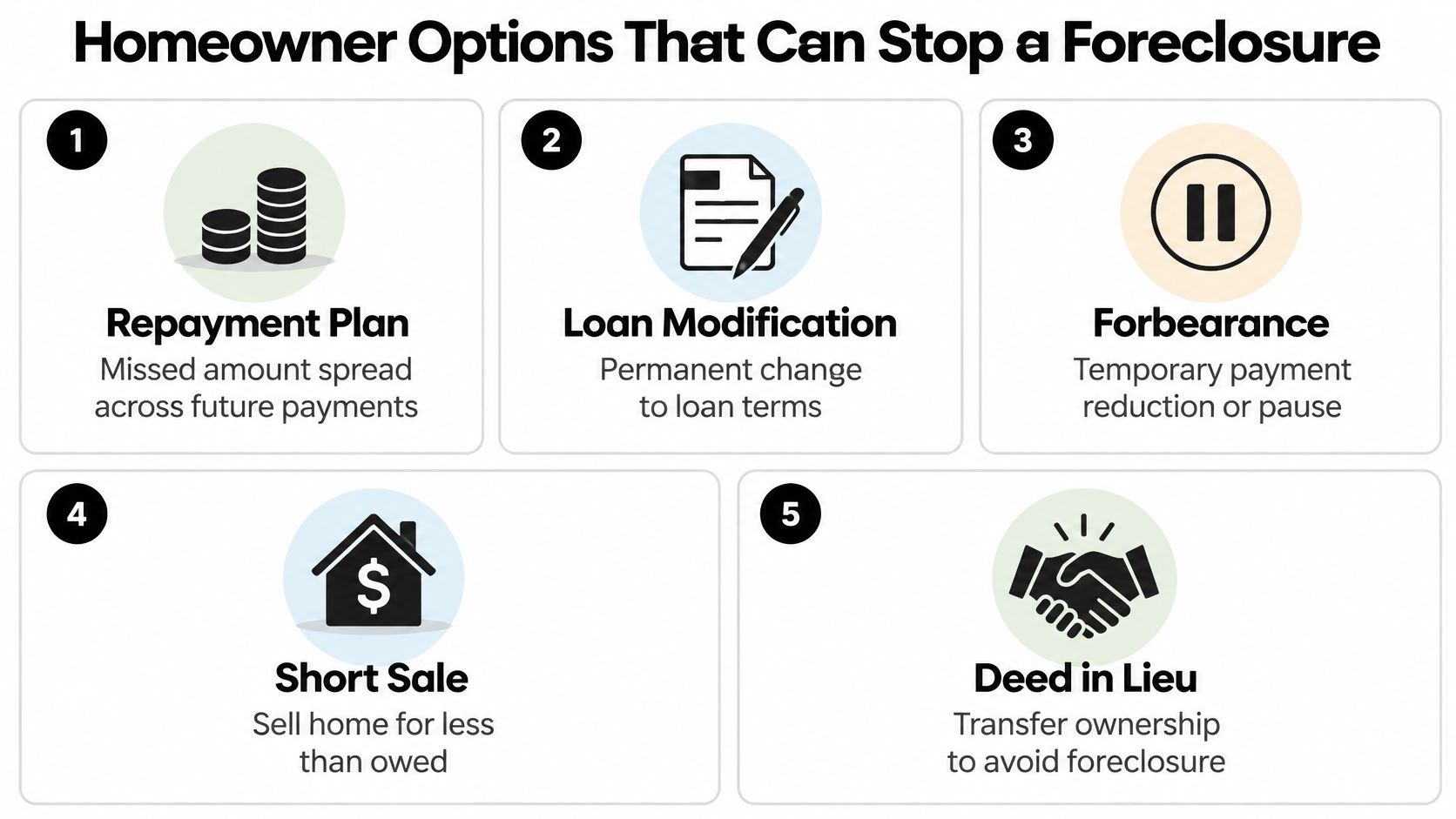
Options intended to keep the home
A repayment plan spreads overdue amounts across future payments. Consider asking about it when the hardship has ended and your budget can support the regular payment plus the agreed catch-up amount.
For example, returning to work doesn't necessarily mean a repayment plan is affordable. Build a household budget first, including essential expenses, rather than agreeing to an amount you hope you can manage.
Forbearance temporarily reduces or pauses payments under an approved arrangement. Before accepting it, ask how the missed amounts will be handled afterward. Don't treat temporary relief as debt forgiveness.
A loan modification changes approved loan terms to address longer-term affordability. Ask exactly which terms would change, whether any trial arrangement is required, and what written conditions must be satisfied.
Alternatives when keeping the home isn't workable
A short sale involves seeking lender approval to sell for less than the mortgage balance. A deed in lieu of foreclosure involves transferring ownership to the lender under an agreed arrangement.
These alternatives don't preserve ownership, and neither should be presented as consequence-free. Ask a qualified attorney about the proposed agreement, any remaining obligations, and whether additional advice is needed before signing.
Use this decision checklist when discussing an offer:
- Affordability. Can you meet the proposed obligation without neglecting essential expenses?
- Documentation. What income records, hardship information, and signed forms are required?
- Completion. What makes the arrangement effective, and how will the servicer confirm that?
- Reporting. How does the servicer expect to report the account afterward?
For another resource to discuss with counsel, LifeBack Law Firm mortgage guidance from LifeBack Law Firm, P.A. addresses options for missed mortgage payments.
Don't choose an arrangement solely because you hope it will protect your credit score. Focus first on whether it resolves the mortgage problem sustainably, then confirm the reporting and future-financing implications.
Where Credit Repair Fits Without Overpromising
Correcting a credit report doesn't pay the mortgage debt. A reporting dispute and a mortgage-assistance application address different records, different decisions, and different obligations.
If your bank records show that the servicer received a payment but your credit report lists it incorrectly, that discrepancy deserves investigation. If the payment was not made, dissatisfaction with its credit effect isn't a basis for deleting accurate history.
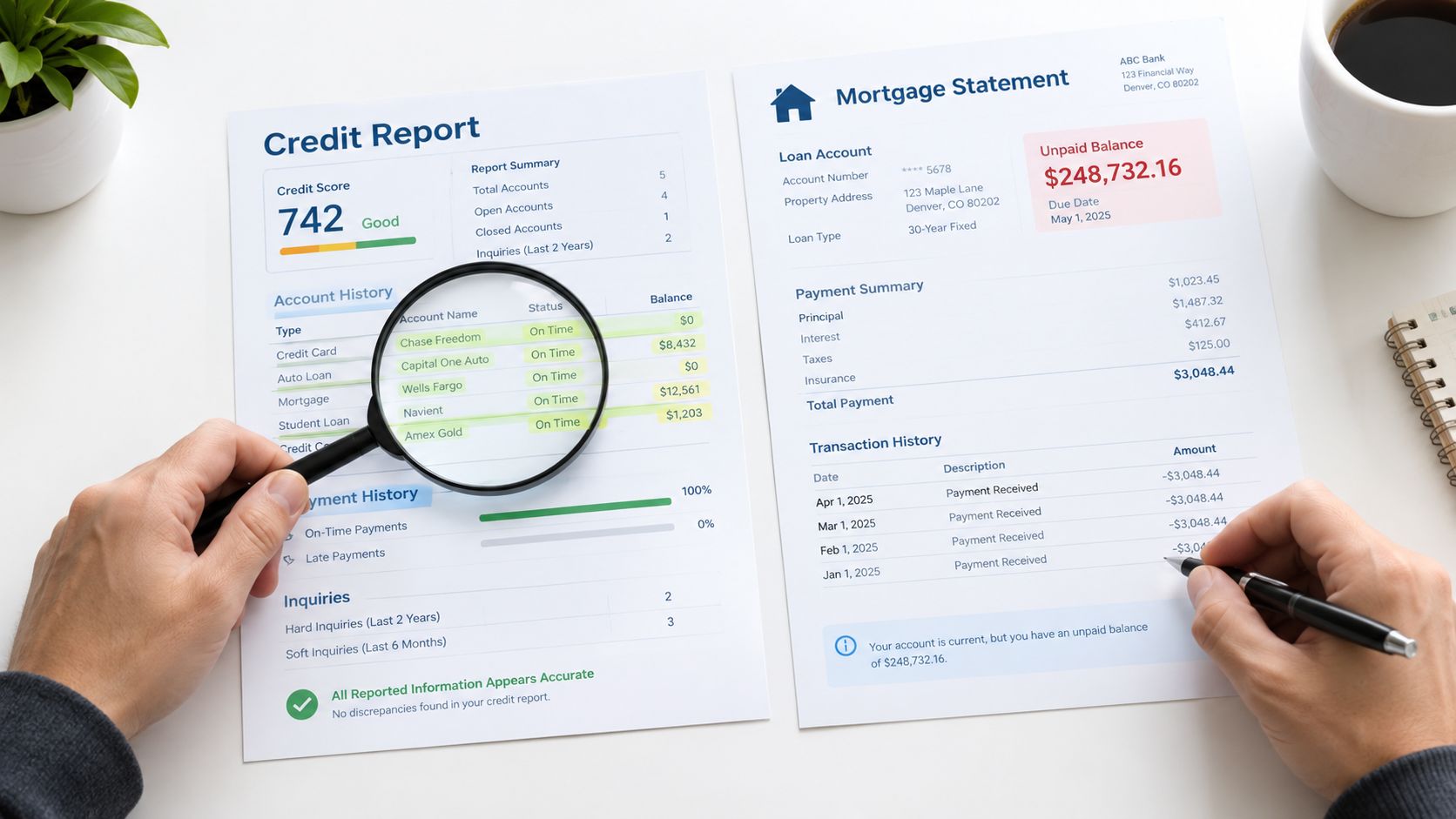
Review dates and severity, not just the score
Fannie Mae's payment-history guidance distinguishes 30-, 60-, and 90-day delinquencies and directs lenders to evaluate frequency, recency, and severity; it also states that recent late payments generally present greater risk than those older than 24 months, according to its payment-history evaluation guidance.
That's why a useful review compares the reported history with supporting records:
- Payment confirmations. Match transaction details to the mortgage account.
- Bank statements. Identify the payment's withdrawal and any returned transaction.
- Servicer correspondence. Preserve explanations, corrections, and approved workout terms.
- Account statements. Check dates, balances, and the status being reported.
A legitimate credit restoration process uses documentation to identify inaccurate, incomplete, outdated, unverifiable, or misleading information and pursue appropriate dispute and verification procedures. It doesn't involve disputing every negative entry without a factual basis.
Mortgage readiness requires more than a higher score
Under Fannie Mae's specified conventional-loan guideline, excessive prior mortgage delinquency includes one or more 60-, 90-, 120-, or 150-day delinquencies within the preceding 12 months, making the loan ineligible for delivery under that rule (Fannie Mae's previous mortgage payment history requirements).
That isn't a universal rule for every lender or program. For FHA, VA, USDA, and conventional preparation, ask the prospective lender how it evaluates your particular history.
For help organizing a reporting concern, consult Superior Credit Repair late payment guidance. Credit repair results vary with the credit file, supporting documentation, creditor responses, account history, and current behavior. It cannot guarantee deletion, a score increase, mortgage approval, or a stopped foreclosure.
A Practical Four Step Action Plan
Start with a folder labeled for your mortgage account. Keep correspondence, submitted documents, payment records, and conversation notes together so you're not reconstructing events whenever someone requests an explanation.
Establish the account status and complete the application
Step one is a focused servicer call. Ask for the exact delinquency status, written reinstatement amount, foreclosure referral status, and assistance deadlines. Record the representative's name, the date, and any reference number, then request written confirmation of important answers.
Don't describe only the missed payments. Explain whether the problem involves reduced income, an unexpected expense, a payment-processing disagreement, or an ongoing affordability gap.
Step two is a documented assistance submission. Ask for the servicer's checklist before gathering records. Depending on what it requests, your package may include pay stubs, bank statements, tax returns, a hardship explanation, or relevant medical or military documents.
- Save the submission. Keep a complete copy of every document sent.
- Preserve delivery evidence. Retain upload confirmations or other delivery records.
- Resolve missing items. Ask whether the package is complete and what still needs attention.
Verify reporting and rebuild deliberately
Step three is a credit-report review. Obtain your reports from the nationwide credit bureaus and compare the mortgage entries against your records. Flag inconsistent dates, balances, or account statuses for a documented investigation rather than assuming every difference proves an error.
Keep reporting disputes in their own file within the mortgage folder. The guidance on documenting late payments for mortgage approval can help you organize evidence while an account remains open.
Step four is a sustainable rebuilding plan. Prioritize on-time obligations, manageable credit-card balances, and thoughtful decisions about new credit. Review collections, charge-offs, or medical collection entries for accuracy, but don't divert money needed for a mortgage arrangement without considering the full budget.
Choose a plan you can repeat during a difficult month, not just a plan that works when nothing goes wrong.
If future homeownership, refinancing, rental screening, or other financing is the goal, prepare questions for the relevant decision-maker. A credit review can clarify reporting issues; the servicer handles mortgage assistance, and the prospective lender determines financing eligibility.
Questions Homeowners Usually Ask Next
What does a reinstatement amount include?
Request a written, itemized reinstatement figure, including its effective date and payment instructions. Ask the servicer to explain the overdue installments and any listed charges, including legal fees if the account has been referred. Don't substitute the balance on an older statement.
Will an isolated missed payment prevent another mortgage?
Not necessarily. Distinguish a payment missed on its due date from a reported delinquency, then ask the lender to evaluate its severity and recency. The Fannie Mae eligibility rule discussed above concerns specified delinquency categories, not a blanket prohibition on every isolated late payment.
What should I say when calling the servicer?
Try: “I'm calling about mortgage assistance. Please confirm my delinquency status, reinstatement amount, foreclosure referral status, and application deadlines.” Then explain your hardship and ask how to submit documents securely.
What if a foreclosure sale is already scheduled?
Contact a qualified local foreclosure attorney immediately and notify the servicer's assistance department. Ask counsel whether any emergency remedy, including bankruptcy, is appropriate; don't assume that an inquiry, dispute, or unfinished application postpones the sale.
For credit-review expectations, consult Superior Credit Repair's results timeline. Bring your questions and records to a consultation rather than relying on a generic payment count.
Superior Credit Repair offers a documentation-based credit review to help identify questionable mortgage reporting and explain appropriate dispute and rebuilding steps alongside your servicer's assistance process. Visit Superior Credit Repair to request a free credit analysis or consultation and discuss a realistic plan for your credit profile.
Was this guide helpful?
Superior Credit Repair Online provides educational credit guidance for individuals and families preparing for major financial goals like buying a home, applying for a mortgage, refinancing, or rebuilding after credit challenges.
If this information helped you better understand your credit report or your next steps, we would appreciate your honest feedback. You are welcome to share your experience with Superior Credit Repair on our Google Business Profile.