


LaGrange, a mill town that reinvented itself
LaGrange grew up around textile mills, and the Callaway family’s influence still shows in Hills & Dales Estate, the public gardens, and the foundations that fund much of downtown’s revival. Lafayette Square now has a fountain, restaurants, and loft apartments. The Thread trail loops through neighborhoods, LaGrange College sits on its hill above town, and West Point Lake draws boaters on weekends.
Jobs changed along with the town. The Kia plant in West Point and its suppliers along I-85 employ thousands, and Wellstar West Georgia Medical Center is one of the largest employers in Troup County. Many of those workers are buying their first homes here, where prices remain far below metro Atlanta’s.
A home loan credit report review is the place to start. It shows what a mortgage lender will read in your file before you apply, and it gives you time to correct what is wrong.
How lenders see you
Mortgage lenders pull a 3 bureau credit report that merges your files from Experian, Equifax, and TransUnion. They use the middle of the three scores to set your pricing. If one bureau has an error, it can drag down the very score that matters.
A snapshot of where you stand
We begin with a credit snapshot: every open and closed account, each balance and payment status, any collections, and the inquiries from the last two years. That first picture shows how your file looks today and where the problems sit.
Then we compare the bureaus. It is common for a card to report to only two of the three, or for a collection to show at one bureau but not the others. A 3 bureau credit comparison makes those gaps easy to see.
Updating the picture
A credit snapshot is not a one-time event. We take a fresh credit snapshot after each round of disputes, so you can see exactly what changed and what was verified.
Why the files disagree
The three credit reporting agencies do not share data with each other. Each lender chooses which bureaus to report to, and each bureau processes updates on its own schedule. A payment might reach Experian and TransUnion today but Equifax weeks later.
That is why a fix at one bureau does not always carry over. When you dispute an error, send it to every bureau showing it. Otherwise, the mistake keeps appearing on the 3 bureau credit reports a lender pulls.
Personal information and the mixed file
Your name, Social Security number, birth date, and addresses form your credit identity. If any detail is off, a bureau may attach someone else’s accounts to your file, creating a mixed file. This happens most often with relatives who share a name and an address, like a father and son in the same house.
What the review checks line by line
Each account is compared against your statements. We look at:
- Balances on accounts you paid off or closed.
- Late payment marks in months you paid on time.
- Delinquent accounts reported with the wrong dates.
- Collections that appear twice for the same debt.
- Personal details that do not match your records.
Inaccurate credit reporting like this is more common than most people think. Federal studies have found that about one in five consumers has an error on at least one report.
The paperwork behind each dispute
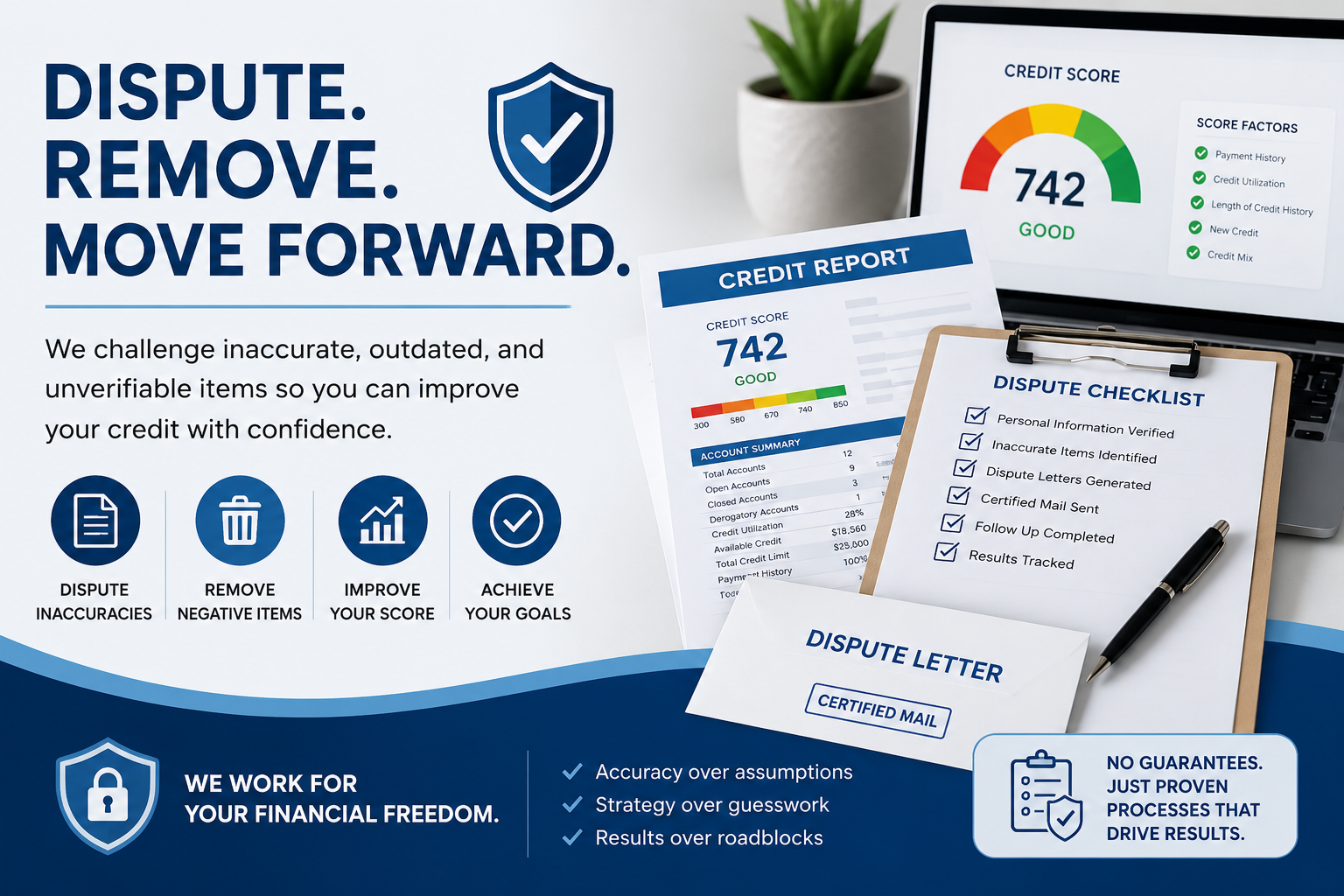
Good dispute documentation makes the difference between a quick correction and a form letter. For each item, we collect the statement, payoff letter, or bank record that proves the error. Dispute documentation that names the account and attaches proof tends to get a real investigation.
Your rights under federal law
The Fair Credit Reporting Act sets the rules for how bureaus handle your data. Under the FCRA rules, a bureau has thirty days to investigate a dispute, must forward your evidence to the company that reported the item, and must correct or remove anything that cannot be verified.
The FCRA requirements apply to the companies furnishing data too. A lender that receives your dispute from the bureau has to check its records and report back. If it keeps reporting something it knows is wrong, you can file a complaint with the CFPB.
Reporting time limits
Most negative items can stay for seven years from the date of first delinquency. Chapter 7 bankruptcies stay ten. After that, the bureau must remove them. Dates matter, so any item with a wrong delinquency date is worth disputing.
Old debts and the deadline to sue
Georgia’s statute of limitations on most written debts is six years. After the SOL passes, a collector cannot win a lawsuit, though it can still ask you to pay. Paying a portion can restart the clock in some situations, so get advice first. Each state’s SOL differs, so a debt from a former Alabama address may follow Alabama’s clock.
The SOL and the reporting period are different clocks. A debt can be past the statute of limitations, yet the FCRA lets it stay on your report until seven years from the original delinquency. Knowing both dates helps you plan.
Asking a collector to prove it
If a collector contacts you, you have thirty days from its first notice to ask it to verify debt details in writing. The collector must show what you owe and to whom. Many old accounts sold several times cannot be verified at all.
When the bureaus verify an error anyway
Sometimes a bureau comes back saying an item was verified, even though your records show it is wrong. That does not end the matter. Ask for the method of verification, then send a second dispute straight to the company that reported it, with stronger proof attached. Equifax, Experian, and TransUnion each run their own investigation, so one bureau may fix what another kept.
Credit report mistakes that survive two rounds may need a complaint to the CFPB or the state attorney general. Furnishers that keep up inaccurate credit reporting after being told can face liability, so a paper trail matters. Credit repair firms often handle this second round for clients.
Proving who you are
When a mixed file or identity theft is the problem, the bureaus will ask for proof of identity: a driver’s license or state ID, a Social Security card or W-2, and a utility bill or bank statement showing your address. Send copies, never originals, and send the same packet to Experian, Equifax, and TransUnion, all three credit reporting agencies.
Fraud cases also need an identity theft report from the FTC. With that report and your proof of identity, the bureaus must block fraudulent accounts within four business days.
A scam to avoid
Some sellers offer a CPN, or credit privacy number, as a fresh credit identity that hides past problems. Using one on a mortgage application is federal fraud. No lender will knowingly accept it, and anyone caught faces prosecution. Walk away from any offer of a CPN.
Choosing outside help
You can dispute errors yourself for free. For a long list, a credit repair company can manage the letters and deadlines. Federal law, through CROA, protects you here.
CROA requires a written contract, a three-day cancellation window, and no payment before the work is done. Credit repair companies that ask for money upfront are breaking the law.
What to ask before signing
Ask how the firm decides what to dispute, what it does when a bureau verifies an item, and whether you will see copies of every letter. A credit repair service that cannot answer those questions clearly is not ready for your file.
Building great credit after the fixes
Removing errors clears the way, but positive history builds the score. Keep card balances under thirty percent of each credit limit, and under ten percent if possible. Pay every bill on time. Keep old accounts open, since a longer credit history helps.
Great credit takes time, but it brings lower interest rates on your mortgage, your car, and your insurance. Even a small score improvement can save thousands over a thirty-year loan. Credit scores climb as on-time months add up, and lower interest on a car loan follows too.
Keeping the file clean after closing
A clean credit file is easier to keep than to rebuild. Set up autopay for at least the minimum on every card, and pull a credit snapshot from Experian, Equifax, and TransUnion every few months at the official free report site. If something new appears, dispute it while your records are fresh.
Store every statement and payoff letter in one folder. Those papers become your dispute documentation if an old account ever reports wrong again. Lenders also like to see a long, steady credit history, so leave your oldest cards open even if you rarely use them. That is how great credit lasts.
Staying on top of things
Many card issuers offer free tools to monitor credit changes. Use one. It will alert you to new inquiries, new accounts, balance changes, or a credit limit cut by an issuer, which helps you maintain credit habits through closing and beyond.
Our approach
Superior Credit Repair handles credit restoration one file at a time. We dispute what is wrong, document everything, and tell you plainly what will not change. Credit restoration that respects the law is slower than the promises some companies make, but it lasts. Credit repair at its best is careful paperwork.
The second review
About two weeks before you apply, we do another credit report review. That final check catches any new inquiry or balance before the lender pulls.
Getting ready to apply
Gather pay stubs, W-2s, tax returns, and two months of bank statements. Lenders read the last two years of your credit history most closely. Kia and supplier workers on rotating shifts should collect overtime records if they want them counted. Keep your accounts quiet until closing, and pull one last credit snapshot the week before you apply.
When your credit report and score look right, the home loan process in LaGrange tends to move quickly. Pay on time, avoid new accounts, and answer the lender’s requests the same day.
Start your LaGrange review
Ask for your LaGrange home loan review and see what your reports show.
What LaGrange buyers ask
Which bureaus does a mortgage lender check?
All three credit reporting agencies: Experian, Equifax, and TransUnion. A 3 bureau credit report merges them, and the lender uses the middle score. Equifax, Experian, and TransUnion each feed that merged file, and our credit report review reads all three. Start with a credit snapshot of each; a clean credit file at all three helps.
How do I fix a mixed file?
Send each bureau your proof of identity and a dispute listing the accounts that are not yours. Credit repair firms can help organize the dispute documentation. Proof of identity is the first thing the credit reporting agencies check, and a credit report repair service should collect it for you. All three credit reporting agencies accept online disputes; check the corrected credit report afterward.
What does the FCRA say about how long a dispute takes?
The federal FCRA gives the bureau thirty days. The FCRA also requires the furnisher to investigate, and those FCRA requirements apply even to small lenders. Under FCRA rules, delinquent accounts must carry accurate dates.
Does the statute of limitations FCRA timeline differ?
Yes. Georgia’s SOL limits lawsuits under the statute of limitations. FCRA reporting rules limit how long an item can appear, which is separate from credit reporting on how much you owe.
Is a credit repair company worth it in LaGrange?
For a long list of errors, it can save time. A credit repair company must follow CROA and cannot bill upfront. Good dispute documentation shortens the process. Credit repair costs should be weighed against savings, and a credit restoration service should explain its fees in writing.
What credit scores do lenders want here?
Most conventional loans need 620; FHA allows lower. Great credit above 740 gets the best rates. The credit reporting agencies each compute their own numbers, so Experian, Equifax, and TransUnion may show different results. A long credit history helps too. Your credit report and score at each bureau feed the middle number, and credit repair that removes errors can move it.
How do I check repair credit near me in LaGrange?
Ask for the contract and sample letters, and make sure fees come after the work. A credit restoration service with nothing to hide will share both.
How often should I pull a credit snapshot?
Every few months, plus once before you apply. It helps you monitor credit changes, maintain credit habits, and catch credit report mistakes early. A second credit snapshot after disputes shows what credit repair changed, and a final credit report review confirms it.
What if a collector cannot verify debt details?
If a collector cannot verify debt ownership, it must stop collecting, and the account should be disputed with Experian, Equifax, and TransUnion. Your 3 bureau credit reports should then drop it, and the federal FCRA gives you recourse if they do not. Keep the collector’s response with your dispute documentation.
Is repair credit near me better than credit restoration services online?
Not necessarily. Good credit restoration services and a solid credit report repair service work the same way wherever they are. Credit repair companies that dodge questions about process are telling you something, and any credit repair service should welcome them. Credit repair stays honest when you can see every letter.
LaGrange buyers, take the next step
Begin your LaGrange home loan review and apply with a clean file.