


Begin with the age and mix of accounts you already hold
A rebuilding program should begin with a picture of the consumer’s existing obligations. List the open revolving accounts, installment loans, closed accounts still reporting and any collections. Add opening dates, current balances, payment status and the bureau that displays each entry. Credit repair is only one part of this work. It can address verifiable inaccuracies, while the rest of the plan must protect present payments and avoid creating new expenses for the sake of a short-lived score movement.
The mix of account types may influence some scoring models, but it is not an instruction to borrow money unnecessarily. A person with an existing auto loan and two cards already has a different history from someone whose file contains only one recently opened account. Credit repair companies that recommend a new installment loan to everyone are not treating those consumers as distinct. A new product can add fees, a hard inquiry and a payment obligation. Before applying, ask what problem the product would actually solve.
Length of history is affected by the age of individual accounts and the broader file. Closing a mature card can change available revolving limits even when its prior history remains visible for some time. Keeping an expensive card open may also impose fees. Credit repair services should not present either action as universally correct. Look at the cost, utilization effect, account terms and upcoming borrowing decisions. A credit report review can identify whether the card’s age and limit are reported accurately before a household changes its arrangements.
A borrower with poor credit may be tempted by claims that the entire past can be replaced in thirty days. That is not how normal reporting works. Accurate delinquencies may remain for their lawful periods, while current positive information can accumulate over time. Credit repair, credit usage and repayment planning operate on related but different schedules. The rebuilding program should not promise that a new card will erase an older charge-off or that every collection becomes disputable merely because it is inconvenient. Building your credit means making enough stable payments that future account information can be evaluated on its own merits. To build credit safely, maintain available cash for bills; to build credit with a new account, read the fees and terms first. Better credit is not merely an app number, and better credit does not require a fresh loan every month.
Create an account inventory with a column for actions the consumer controls. Paying a current bill, confirming autopay and reducing an unaffordable balance are direct choices. Challenging an incorrect delinquency date requires documentary evidence and a response from a reporting institution. Asking a lender about a mortgage requirement is another conversation entirely. Credit repair professionals can explain these tracks, but they should not combine them into a one-size-fits-all deletion package. A credit repair company should describe the exact credit record being disputed rather than advertise that it will remove negative items without examining them. Keeping each decision distinct makes the plan easier to maintain.
If one report contains an account you do not recognize, identify the creditor and account-opening details before dismissing it as fraud. In some cases a debt buyer uses a new trade name; in others an identity mix-up or theft may have occurred. Credit repair credit decisions should not begin with a false identity-theft declaration. Start with the documented ownership question and secure personal accounts if there is a genuine indication of misuse. A lawful credit restoration service should explain what evidence is needed to tell the difference.
Treat rented tradelines as a risk, not a rebuilding foundation
Authorized-user accounts may serve genuine household needs when a family member is allowed to use a card. But buying a seat on a stranger’s mature account is a different arrangement, often advertised as a quick score tactic. Lenders and scoring models can evaluate such accounts differently, and the primary holder’s payment behavior may affect the authorized user. Credit repair companies should not market a purchased tradeline as equivalent to correcting an inaccurate report. It adds information to the file; it does not prove earlier derogatory items were wrong.
Read the service terms for any authorized-user arrangement. Ask who controls the card, how long the status is expected to remain, whether fees are refundable and what happens if the primary holder closes the account. There may be little control over future purchases or late payments. Credit repair services that claim an automatic mortgage approval from this arrangement are overlooking the lender’s underwriting standards and the consumer’s actual debts. A rebuilding program must consider the whole file, not just one artificially favorable account age.
A credit repair company may also promote its own tradeline product or refer clients to a separate business. The financial relationship should be transparent. Some products claim that a borrower will obtain a specific score increase, but no vendor can know every model or how a lender will treat a purchased authorized-user account. Credit repair pricing for reporting assistance should be distinguished from the price of unrelated products. The consumer should be able to decline the additional purchase without losing access to records already paid for lawfully.
A provider should not claim it can remove negative items that are accurate merely by renting a tradeline. An accurate account’s history cannot be replaced through a paid authorized-user trade line. If the consumer has a valid collection, the obligation remains a separate issue even after positive account data appear elsewhere. Credit repair, credit behavior and identity safety should therefore be reviewed independently. Building your credit may involve keeping existing bills current or using a personally controlled, affordable card, rather than renting another person’s account for a short interval. Those options carry different duties and costs.
For someone with no established positive history, a secured card or credit-builder loan may be considered, but the new commitment should fit actual income and monthly needs. The deposit, annual fees and reporting practices deserve scrutiny. A credit repair lawyer is not necessary to decide whether to buy a card, yet qualified advice may matter if a business misrepresents its contract or fee rights. The credit repair business should not present a legal-sounding promise as a substitute for ordinary consumer caution.
The goal of fast-track rebuilding is controlled progress. A person who cannot afford a new payment should not add one solely to obtain a different account mix. Positive history develops from obligations that can be met over time. Free credit repair materials and authorized disclosures may help consumers see whether their existing information is correct. Free credit repair review steps do not require paying a subscription or buying a tradeline. A credit restoration service can address verifiable errors without depending on the purchase of a tradeline or the addition of a new loan.
Avoid applications that do not serve an actual need
A new hard inquiry is not always harmful enough to prohibit an application, but it should have a purpose. If a consumer has a necessary automobile replacement or a planned mortgage, rate shopping may be appropriate. Applying for several unrelated store cards in the same week is a different decision. Credit repair services should explain that inquiries related to authorized applications are not generally removable just because the resulting offer was unattractive. Credit inquiries should be examined for legitimacy and correct purpose, not treated as a list of automatic deletion targets.
Many FICO models have particular rules for grouping certain rate-shopping inquiries within a designated window, although the duration varies by model and loan type. That does not mean every inquiry is invisible, and the lines may remain on a disclosure longer than they affect a score. A consumer should keep the dates and names of lenders contacted. Credit repair companies that promise to wipe all inquiries with one request may be encouraging a dispute without factual grounds. A legitimate authorization is a different issue from an unfamiliar company accessing the report without permission. The FCRA governs important aspects of permissible purpose, and the FCRA also provides rights concerning inaccurate reported information. Credit inquiries should be reviewed by type before any action is taken.
Before applying for additional credit, compare the household’s debt-to-income position, available funds and upcoming expenses. A new loan can create a monthly obligation even if it temporarily increases available credit. The amount of credit a model sees is only part of a lender’s assessment. Credit repair, credit utilization and borrowing capacity can change in different directions after an application. The better choice may be to reduce the cost of existing debt rather than replace one balance with a more expensive product.
An account already in good standing can sometimes be managed without a new application. Ask an existing issuer about normal reporting dates, fees and the conditions for a legitimate limit review. Some requests can involve a hard inquiry, so confirm the process before authorizing it. A credit report review can reveal whether the issuer is already displaying the correct limit. Credit repair is unnecessary when the only issue is an accurate but high balance; paying or managing that obligation is a separate matter.
A borrower who has been denied credit may receive an adverse-action notice. Save it, identify the reporting agency and review the stated reasons. If the denial rests on a truly inaccurate entry, that field may warrant correction. If the problem is insufficient income, high existing payments or an underwriting rule, the answer is not necessarily another dispute. Credit repair professionals should tell the consumer which concern they can address and which belongs with a lender or financial adviser.
If a suspected unauthorized inquiry appears, verify the company through an official channel, document the date and consider whether identity theft protection is needed. A false declaration of fraud can cause serious problems, so separate unfamiliar from unauthorized. Credit repair law and consumer reporting rights provide avenues for factual challenges, but the underlying evidence matters. The national credit bureaus can hold different inquiry lists, and a concern on one file may require a specific submission there rather than a blanket complaint to every agency. Credit inquiries appearing after a denied application are not automatically unauthorized. Before making the request, a credit repair company should preserve the date and creditor identity, explain the disputed purpose and send factual requests only where they are justified. A borrower who has several competing priorities can get a rebuilding plan built around your reports by starting with the dated disclosures and the obligations already due.
Give every month a separate and realistic purpose
The first month is about stabilization. Establish reliable payment methods, obtain the three disclosures and identify each potentially inaccurate entry. Verify card statement closing dates and lender-reporting intervals, but do not assume they are identical. Credit repair work that begins with a written account inventory is less likely to create contradictory disputes. At this stage, prioritize urgent identity concerns and genuinely wrong delinquency statuses over cosmetic changes to accurate old history.
The second and third months can focus on responses and updates. If a bureau investigates an error, retain the submission, response and revised disclosure. If a card balance has been reduced, compare the next statement with the amount that actually appears. Credit repair, credit score movement and debt repayment may occur in parallel, but not every score change is caused by the dispute. A household should keep its payment calendar running throughout this period, rather than treating the investigation as a reason to pause obligations.
In the fourth month, check whether the earlier actions changed the intended fields. An accurate account that remains visible is not proof that the process malfunctioned. The next step may be to ask for missing evidence, correct an incomplete claim or seek qualified advice, depending on the circumstances. When an account is questioned, credit repair services should not begin another paid round merely because a client wants a bigger number. A good rebuilding program explains when the file has moved from active dispute work into ordinary account management.
Months five and six are suitable for checking budget durability. Are monthly payments consistently made by their due dates? Has the balance on a heavily used card declined? Has an emergency expense forced new borrowing? Credit repair companies can discuss general credit improvement, but these outcomes depend on income, cash reserves and choices outside an adviser’s control. If the consumer remains unable to meet current bills, nonprofit credit counseling or other qualified financial guidance may be more appropriate than purchasing another service package.
Months seven through nine can provide a chance to evaluate established positive information. Older accounts may continue reporting; newer credit can develop a longer on-time record. If a consumer with poor credit is preparing for a mortgage, the lender should explain whether the existing history satisfies its requirements. Free credit repair tools can organize the chronology, yet they do not establish loan qualification. Keep credit scores from different models labeled so a change in one is not mistaken for a bureau error in another.
The final quarter is a review, not a new promise. Recheck reports for errors, compare balances with current statements and decide what tasks are complete. The process may need longer than twelve months for some financial objectives, and certain accurate adverse entries remain until their lawful reporting periods end. Credit repair firms should help clients understand that reality. A national credit scoring model cannot be forced to use identical data or weights as every lender. A program succeeds when its steps remain truthful, documented and affordable.
Decide when paying down balances matters more than another card
A card with a high revolving balance may affect a score differently from a small installment obligation. The utilization calculation compares the reported revolving balance with the reported limit, both account by account and overall. Paying before a statement date may reduce the number sent to a bureau, but the issuer’s actual schedule controls when that happens. Credit repair does not require a bureau dispute to update an accurate balance. The household should consider interest costs and upcoming bills before deciding how much extra to pay.
For a borrower with limited savings, an aggressive payoff can create risk if it leaves too little money for rent or insurance. Create a practical cushion rather than assuming that the largest possible card payment is always best. Paying off debt should also account for interest rates and any fees associated with moving balances. After checking the dates, credit repair services should not recommend a high-cost loan to create the appearance of lower utilization on a current card. The full financial cost is relevant even when the score changes favorably.
If a creditor has reported a payment incorrectly, keep the statement for the period and proof of receipt. A dispute can then name the wrong month or amount. Accurate late payments generally do not disappear merely because the consumer has since paid the balance. Credit repair and debt relief must be described separately; a settlement agreement and an accuracy investigation are not interchangeable. With written evidence available, a credit repair company should explain that distinction before charging for either kind of work.
Paying off debt can change the mix of outstanding obligations. That is not inherently bad, and consumers should not keep paying interest solely because a scoring model might respond differently to an open installment balance. The purpose of borrowing is to meet genuine needs, not to sustain avoidable costs. A credit repair lawyer may advise about legal questions involving very old debts or disputed collection conduct, but ordinary payments on accurate current accounts remain the consumer’s financial decision.
Sometimes a lower card balance will appear before a dispute result, and sometimes the opposite happens. Log both events without attributing them to the same cause. During an initial review, a credit report review should record what the institution actually updated. Credit scores may react in different ways, so a newly corrected credit report remains the primary evidence of what changed. Credit repair services free from misleading claims avoid assigning every score increase to their work. The honest explanation may be that a consumer reduced utilization while a separate factual dispute remained unresolved.
If an upcoming loan application creates pressure, ask the lender which balances and dates are relevant to its review. It may look at debt obligations beyond the reported score and may have product-specific underwriting rules. Review the current statements and disclosures before choosing a plan linked to actual account dates. A credit restoration service can help classify reporting issues; it cannot substitute for the lender’s qualification decision.
Compare paid and unpaid collections under the right model
Payment of a collection can alter its status, but it does not always remove the historical entry. Some newer scoring models disregard paid collections in particular circumstances, while older mortgage models may treat them differently. The account’s type, age and underlying accuracy all matter. Credit repair companies should not present a paid collection as a universal automatic score increase. Ask the lender which scoring model is relevant and whether the file’s current account information meets its underwriting rules.
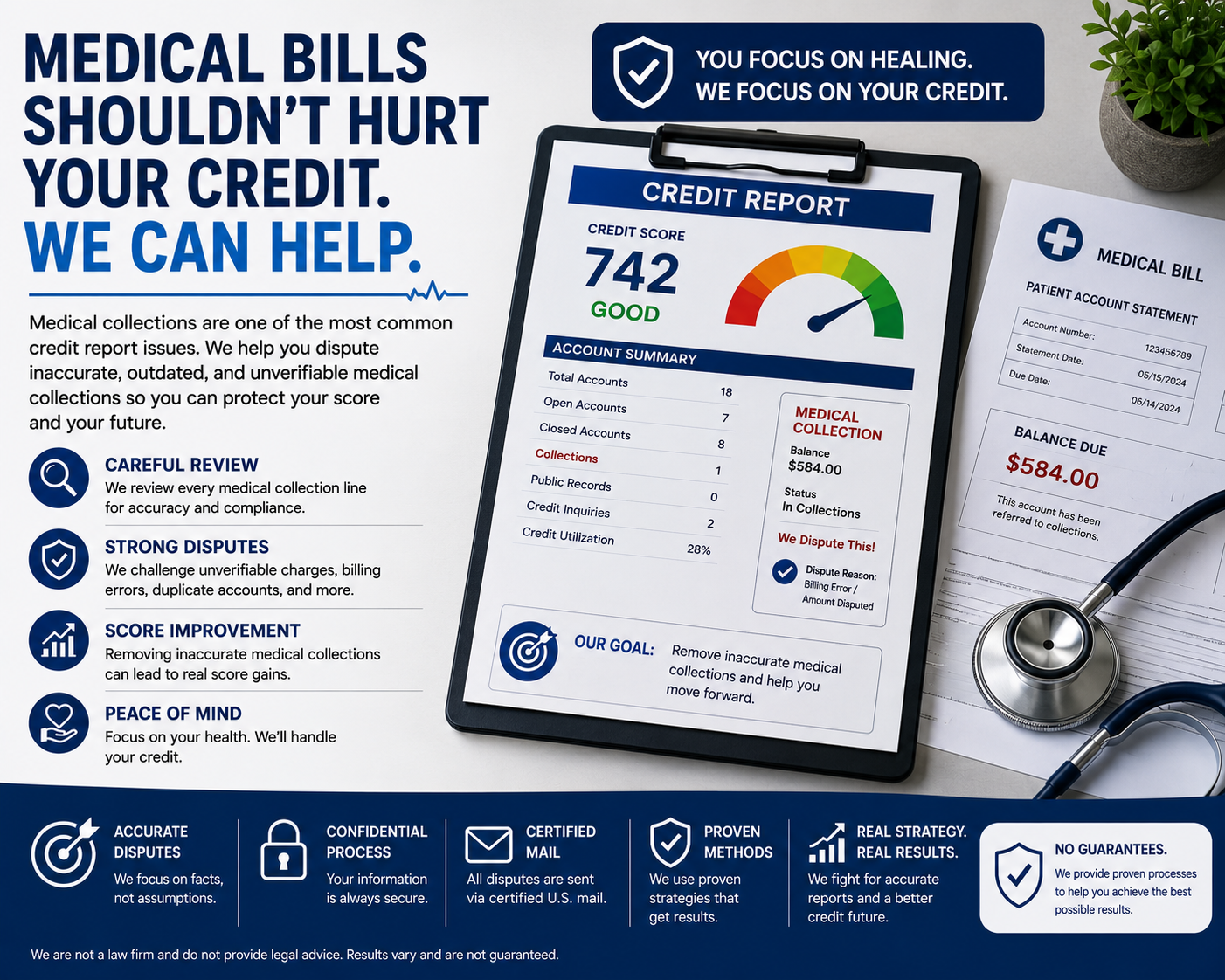
Medical collections require additional care. The nationwide bureaus adopted voluntary policies generally excluding paid medical collections and some smaller medical collections, with timing practices that differ from ordinary debt. A separate federal rule adopted in 2025 was vacated, so an advertisement claiming all medical collections are universally prohibited is unreliable. If details do not match, a credit report review should identify the amount, medical status and applicable bureau policy for the specific entry. Credit repair and current medical billing correction may involve different documents.
For a nonmedical collection, check the original creditor, present collector, amount, date of first delinquency and any settlement agreement. A debt buyer’s new name does not automatically make the entry fraudulent, nor does it reset the federal reporting clock for the underlying delinquency. A credit report repair service may help organize a dispute about a demonstrably wrong field, but it cannot make a valid collection disappear on request. Fixing your credit through valid corrections requires the source record, not an unsupported removal demand. An accurate account can be unpleasant without being a reporting error.
If a collector sends a demand, read the notice and the consumer rights provided under applicable debt-collection laws. A collection dispute may concern the existence or amount of the obligation, while a reporting dispute concerns what appears in a consumer file. Credit repair law does not replace every debt-collection remedy. Where an old obligation raises limitation-period questions, a qualified attorney may be appropriate before a new payment acknowledgment is made. The best course depends on the documents, not on a generic marketing script.
Keep records of the disposition after any payment. A paid-in-full letter, settlement confirmation and transaction receipt may support a correction if the bureau later displays the wrong current status. Once a response arrives, a credit repair company should compare the actual agreement with the updated report. Credit repair, credit monitoring and ordinary debt management should remain separate tasks. The consumer can watch for a change without assuming that monitoring itself compels the creditor to provide it.
When evaluating progress, distinguish the score displayed by a consumer app from the score used in a mortgage application. A national credit reporting agency can supply the same account fields to more than one scoring model, with different numerical results. For a single credit record, compare the account details before attributing a model difference to a reporting error. Credit scores may also reflect changes unrelated to collection payment. It is more reliable to confirm the precise entry status than to promise a set number of points from a settlement or deletion.
Preserve copies of every letter and account record
A rebuilding project can become confusing when it involves several bureaus, creditors and collectors. Make a separate folder for each account and put the original disclosure first. Behind it, place the document supporting the disputed field, the date the request was sent and every investigation response. While checking current balances, credit repair services should return or provide access to this history so a consumer can understand what was asked and what happened. A temporary dashboard notification is not a substitute for a record that can be read later. At the next reporting cycle, a credit repair company should provide documentation that helps the consumer verify its actual work.
Keep copies rather than sending irreplaceable originals unless a specific lawful process requires them. For identity information, use the institution’s approved verification method and share only what is necessary. Where the file differs, credit repair companies should maintain appropriate privacy safeguards and explain how staff or vendors handle sensitive material. A letter that misidentifies the account may delay a valid inquiry, so checking the account reference and the requested correction before mailing is worthwhile. The quality of the claim matters more than the number of envelopes.
A correspondence log should include the recipient, submission method, confirmation number and response date. If a bureau returns a verified result, compare it against the particular evidence that was sent. A credit repair lawyer or consumer attorney may be useful when a material documented error persists and legal rights are in dispute. An ordinary response confirming accurate history does not by itself establish a legal violation. Credit repair professionals should explain what additional facts, if any, justify a follow-up.
Duplicate copies are valuable if a later report shows a previously corrected field incorrectly again. Preserve the dates so the earlier and later versions can be compared. A credit record can change through legitimate monthly updates, debt transfers or factual corrections, and those events should not be assumed to be identical. Credit repair companies that keep good documentation can give clients a clear chronology rather than simply asserting that a score moved. A consumer can then discuss the actual change with a lender if needed.
Do not include unrelated personal documents merely to make the file look substantial. An account with a wrong payment month may require a bank statement and issuer ledger, not a stack of old insurance papers. A credit restoration service should be able to identify evidence that is relevant and appropriate. Free credit repair worksheets can help categorize documents, but a person should still review each item before giving it to an outside provider.
At the end of each month, write a short result note: what changed, which institution confirmed it, and what remains unresolved. This can prevent a new dispute letter from repeating a question that has already been answered. Credit repair laws permit certain factual challenges and investigations, but do not turn repetitive correspondence into an independent source of rights. Accurate recordkeeping is itself one of the strongest tools in a realistic rebuilding program. Fixing your credit becomes easier to manage when each old question has a written result rather than an unverified allegation.
Read service terms before buying a long program
A rebuilding service may offer account reviews, correspondence preparation, monitoring, budgeting education or other tasks. Ask which tasks are included and which are optional. Credit repair services are subject to important federal and potentially state rules, including restrictions on collecting fees for covered work before the law permits them. A credit repair business that sells by telephone may face additional requirements. Under consumer law, credit repair transactions may be regulated by both the service description and the sales method. The law, credit repair obligations and billing rules should be reviewed together rather than assumed away. Renaming the service a coaching plan or administrative package does not automatically change the legal treatment of the actual work.
The written agreement should identify fees, cancellation rights, disclosures and what the client receives. If a company says it can repair credit by mailing the same template for twelve months, ask what new evidence each month would justify the correspondence. Legitimate disputes address facts, not the passage of time alone. On a careful reading, credit repair companies should be able to stop or change the work when the underlying issue is resolved. Continuing to bill for repetitive letters without a defined purpose is not a sound measure of progress.
Some consumers ask whether free credit repair resources are enough. For a simple, well-documented mistake, direct bureau dispute channels may be suitable. More complicated ownership records, mixed files or unresolved responses may justify professional assistance. The provider’s title is not the deciding factor; clarity of scope, data protection and legal compliance are. The phrase credit repair services, free disclosures and financial education describes separate options rather than an all-inclusive service that every consumer must purchase.
Compare the contract with any advertised credit repair pricing. A low monthly amount may cost more than expected if service continues indefinitely, and a large upfront invoice may be impermissible for covered work. Credit repair professionals should explain their charge basis and actual performance. If a credit repair lawyer is presented as part of the package, ask who the lawyer is, what legal representation is involved and whether that service is truly separate from a standard reporting investigation.
Credit repair near me can be a convenient way to arrange a face-to-face document review, but a local office cannot alter the federal reporting rules. A provider working nationwide may be able to handle the same factual dispute through secure correspondence. Compare how personal data are protected and whether the contract explains the company’s duties. Repair credit decisions should be evaluated on the evidence and legal terms, not on an address alone. credit repair across Alabama provides service-area context while account-specific records determine whether a dispute is warranted.
A credit report repair service should provide the work products described in its contract. A signed contract is not the final proof of value. Ask for written work products, investigation results and a summary of any unresolved account question. The credit repair company should not claim a numerical result it did not cause or imply that accurate derogatory information can be erased simply through repeat submissions. If the file is now correct, the program may need to shift toward payment routines rather than more disputes. A good service plan should describe that transition without creating new pressure to buy something. As a practical safeguard, a credit repair company should be clear about what happens when no additional factual disputes remain.
Does credit repair near me need to handle every collection before I apply?
A local provider can help organize disputed entries, but not every collection is inaccurate, and lenders may have different treatment of paid and unpaid accounts. Ask the lender about the specific financing plan while verifying any collection balance or ownership error against source records. The location of the adviser does not replace the required account evidence.
Questions about a fast-track rebuilding program
How do I repair credit near me if my score changed but the report did not?
First verify the score model, bureau and calculation date. Different scoring products may return different numbers from similar information. A local adviser can compare the underlying reports and identify any actual inaccuracies, but cannot force the models to match. Keep current bills on schedule while checking whether an issuer has an upcoming account update.
Can I repair credit near me without paying a monthly service fee?
Consumers may review free authorized reports and submit specific factual disputes directly. If one payment status or balance is clearly wrong, a dated account statement may be enough to explain the problem. Professional assistance is optional and should have a written scope. A recurring subscription is not required merely to exercise the right to challenge inaccurate reporting.
Can a rebuilding program remove every old collection in thirty days?
No. A factual dispute may correct or remove an inaccurate entry, but accurate collections can remain for their lawful reporting periods. Investigation timelines are not universal deletion deadlines. A rebuilding plan should identify which fields are actually wrong and protect current payments while the review occurs. No provider can dictate a particular score result by a fixed date.
Should I buy an authorized-user tradeline from someone I do not know?
Consider the lack of control over the account, the fee, and the fact that lenders and scoring models may discount purchased authorized-user history. It is not a correction of a reporting error and does not erase valid derogatory accounts. A personally controlled, affordable account or careful management of existing obligations may be more sustainable, depending on the consumer’s situation.
What is the first step if several inquiries appeared after shopping for a car?
Gather the application dates and lender names, and determine whether they belong to a recognized rate-shopping period in the relevant scoring model. Legitimate inquiries may still appear on the report even when scoring groups them. If an access was genuinely unauthorized, preserve the inquiry details and contact the institution through its verified channels before making a factual dispute.
Will paying off a collection make an old late payment disappear?
Payment can change the current status or balance of an obligation without rewriting truthful earlier delinquency history. Some newer scoring models treat paid collections differently from older models, so the numerical effect can vary. Keep written payoff or settlement terms and compare the next disclosure with the agreement. An inaccurate reported amount can be challenged separately.
How often should I check the file during the first three months?
Check when a meaningful event is expected: a statement closes, a bureau provides a response, or a lender plans to pull a new report. Repeated daily score checks may not reveal new underlying data. Keep a log of each account, submission, response and next review date so the schedule remains connected to actual evidence.
Is a free review enough to fix an account attributed to someone else?
A free report can help identify the wrong account, but the next step depends on the source of the mistake and whether identity theft is involved. Obtain appropriate account and identification records, secure personal information if needed, and use the relevant bureau or furnisher dispute process. Professional assistance is optional and should be judged by its documented work and terms.
Should I open another card just to improve my credit mix?
Not automatically. A new card can add a payment date, inquiry, fee and change to average account age. If current accounts are accurate and manageable, consistent payments and balance reduction may be more relevant. Compare the actual costs and future obligations before applying for a product that serves no independent financial need.
Does a local credit repair company have special powers with the bureaus?
No. Federal reporting rights and investigation duties do not change with the provider’s office location. A local meeting may be useful for explaining documents, but the evidence and applicable law remain central. Consumers can also dispute documented inaccuracies directly. Ask for written fees, privacy practices and a description of the services performed.
Related topics for keeping a steady rebuild
- mortgage brokers who work with bad credit
- getting a mortgage with a 550 credit score
- joint mortgages when one borrower has bad credit
- a credit repair consultation before a mortgage application
- choosing between local and nationwide credit repair
- credit repair services for mortgage approval
- FHA loans for borrowers with bad credit
- FHA minimum credit score requirements
- first-time home buyer programs for bad credit
- hard money loans for a primary residence
- home loan options with a 500 credit score
- down payment needs for a mortgage with bad credit
- how to buy a house with bad credit
- improving a credit score quickly before a mortgage
- improving your credit score for mortgage approval
- the minimum credit score for a home loan
- what no-credit-check mortgage lenders really offer
- portfolio lenders for bad credit
- rent-to-own homes with no credit check
- how subprime mortgage lenders work
- unconventional mortgage loans for bad credit
- USDA loan credit score requirements
- VA loans with poor credit
- how authorized user tradelines affect scores
- checking a list of verified credit restoration companies
- a credit report review before a home loan
Set a rebuilding pace you can keep
After the first progress review, Superior Credit Repair can help you plan a steady rebuilding schedule based on payment dates, available funds and documented reporting concerns.