


Rapid rescore through a lender
An expedited update is sometimes available through a participating mortgage lender and its reporting partner after a creditor has corrected a verifiable item. The borrower usually needs supporting confirmation from the furnisher, such as an updated account statement or written correction notice. This is different from ordering an unsupported deletion and does not replace the lender’s normal review of income, debts, assets and loan-program eligibility.
A credit repair consultant cannot dictate a mortgage rate or final approval.
Rate-shopping inquiries before preapproval
During mortgage rate shopping, consumers should ask whether a lender will make a hard inquiry and which report it expects to use. Some scoring models group qualifying mortgage inquiries occurring within a limited shopping window, but the treatment and length of that window vary by model. Comparing written loan estimates is a separate task from disputing inaccurate account data.
A homebuyer may need to distinguish a report error from mortgage underwriting and cash-to-close concerns. The services grouped under credit repair services in Alabama cannot substitute for the lender’s eligibility decision.
Custom reporting solutions for Alabama homebuyers should focus on the account fields lenders will actually receive. Mortgage preparation can involve checking three-bureau reports, obtaining lender statements and understanding which accounts require actual correction. A lender may use a credit score different from the one in a consumer dashboard, and an upcoming tri-merge pull has its own timing. A verified creditor update may support a rapid-rescore process through participating lenders in limited situations, but a separate paid adviser cannot require the mortgage score to change. The documentation matters more than an advertised deadline. A credit report review can test whether the actual lender disclosure matches the current entry before a correction is sought.
If the lender’s tri-merge report shows a payment marked late despite an on-time servicer statement, identify the disputed month and provide the matching proof of payment.
A lender may ask for explanations of collections, high utilization, or account status. Ask a mortgage-readiness provider whether it will review the loan estimate, payoff statements and bureau files, and make sure its written scope distinguishes preparation from lender approval. The original creditor statement can support correcting an incorrect amount. Compare the lender’s mortgage report with the underlying bureau entries for the same reporting month.
Accurate old late payments cannot simply be removed because closing is approaching. When the file is accurate, protecting affordable current payments may be more useful than reopening an unsupported dispute. A mortgage applicant should keep the servicer payoff record and lender explanation alongside any bureau correction requested before preapproval. Custom solutions for Alabama homebuyers require an account-level review rather than a promise of approval.
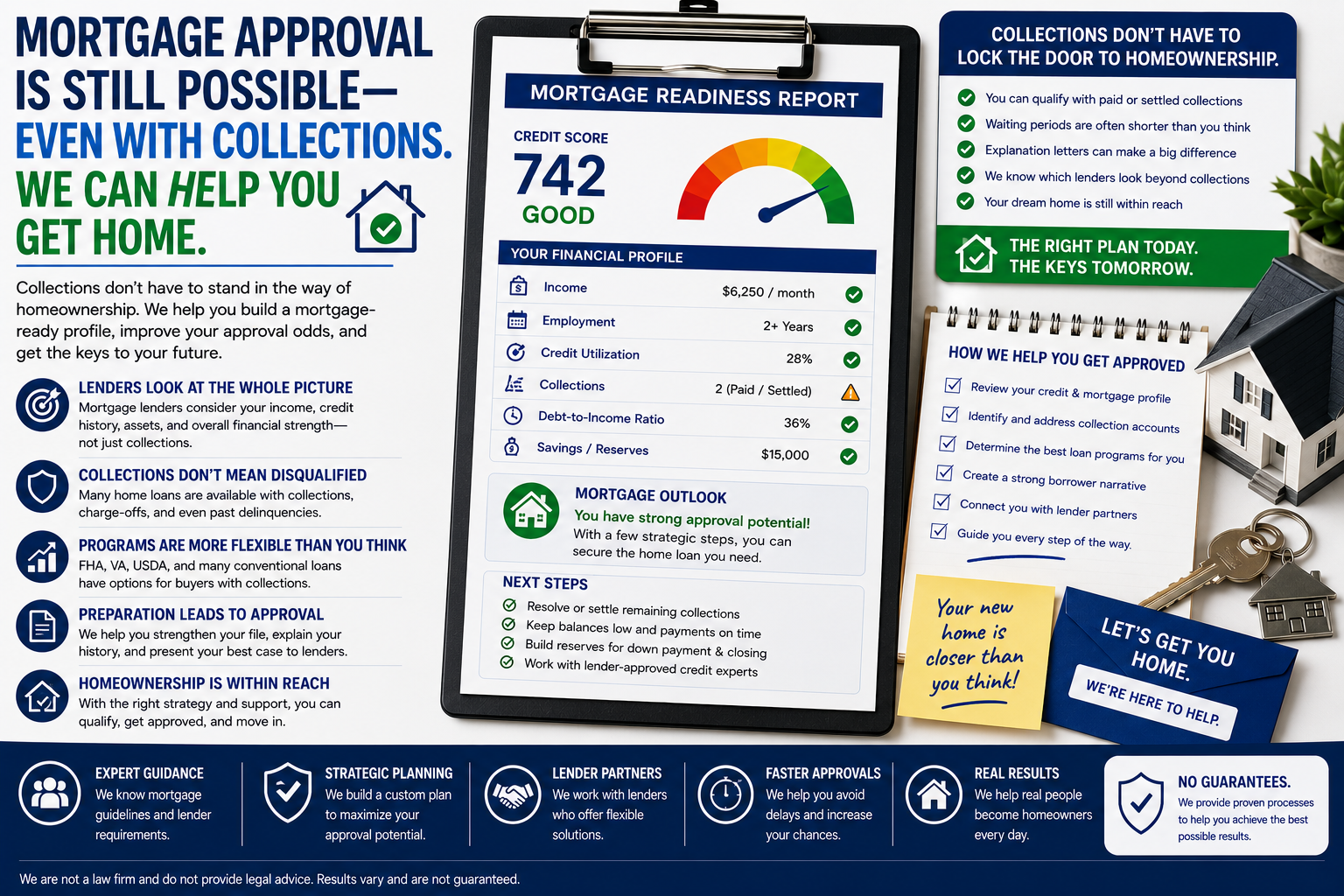
The loan officer’s questions do not replace a bureau dispute
A mortgage applicant may be asked to explain a recent missed payment, identify a large deposit or document the status of an old collection. Those are underwriting requests, and each should be answered with the applicable records. An inaccurate account entry may also deserve a separate correction through the reporting agency. A borrower should not assume that a letter to the bureau satisfies every lender documentation request. The lender can review income, down-payment funds and existing liabilities even when the file is otherwise accurate.
An adverse entry that belongs to the borrower may remain visible after a valid dispute confirms the history. In that case the next step may involve improving current payment behavior and understanding the loan program’s actual requirements. A credit report review before preapproval can identify errors that deserve attention, but cannot determine whether the lender will approve a mortgage. A credit restoration service should distinguish its document role from the loan officer’s underwriting authority.
Debt-to-income and recent late payments
Before a mortgage application, the consumer can compare bureau entries with creditor statements and obtain copies of any corrected information. The lender may request explanations for disputed accounts or unusual payment records. An accurate file is helpful, but income stability, debts, cash needed to close and property eligibility remain independent underwriting considerations. A score shown by a monitoring product may also differ from the model selected for mortgage financing. Applicants should avoid creating new obligations only to manufacture a short-term score movement and should request written information about the actual loan product rather than rely on generic approval estimates.
A bureau correction may remove an administrative discrepancy without assuring that a loan will be approved.
Can I repair credit near me before a mortgage lender orders a tri-merge file?
Review the particular bureaus and account statements; rapid-rescore procedures, where available, are handled through participating lenders. FHA loan terms and the expected monthly housing payment should fit the household budget independently of any reporting correction. Applicants should verify current requirements with their actual lender.
FHA-insured financing has underwriting and mortgage insurance rules that differ from some conventional products. Individual lenders may apply additional standards under their policies.
Questions a loan officer will ask
Alabama homebuyers need custom preparation that distinguishes genuine bureau errors from current income or asset requirements. A mortgage applicant may obtain a creditor’s written correction before the lender’s reporting vendor refreshes the file used in underwriting. Alabama homebuyers benefit from written loan estimates and accurate bureau balances during preparation.
What should I ask my loan officer if I repair credit near me after a payment-status correction?
The lender can explain whether a verified correction has reached its underwriting system and which other application requirements apply.
A credit restoration service supporting mortgage preparation should specify which dated report fields it will verify and how charges are disclosed.
Discuss material financial changes with the lender rather than assuming score tricks are safe.
Keeping the file stable until closing
Homebuyer readiness also depends on income, debts, available funds and loan-program rules. A dispute should not be made merely because an accurate entry may affect pricing. The consumer should ask the loan officer how a corrected account will be considered while keeping the complete application terms in view.
An unresolved dispute flag may prompt lender questions depending on the loan program. The lender may need account statements and investigation outcomes.
A disputed payment should be supported by the lender statement and the corresponding month on the bureau report. The bureau must be approached about actual data errors under its procedures. The borrower can challenge a mistaken balance by comparing the current creditor statement with the actual bureau entry. An evidence-based reporting dispute is different from deciding to open another credit product; the latter introduces separate costs and payment terms.
When rapid rescore procedures are relevant
Some mortgage lenders have access to rapid-rescore procedures through their reporting partners when a creditor has already agreed to correct particular account information. Those processes are not consumer-directed rights to delete any negative item, and availability depends on the lender and circumstances. A borrower should first obtain the creditor’s corrected statement or written confirmation. The lender can then explain whether its procedures permit an expedited update for the relevant report. Submitting repeated unsupported bureau disputes is not the equivalent of that process.
A credit report repair service may organize a documented incorrect tradeline for a homebuyer, but lender approval depends on underwriting and financial facts that a bureau dispute cannot control.
The original loan statement, current balance and correction letter should be retained with the application file. If the lender’s report continues to show the earlier wrong amount, those records help identify the discrepancy. Even after an update, the loan approval depends on other financial facts. A borrower should not take on another high-cost credit product merely to influence a forecasted number before closing. Strong preparation means accurate documents, manageable obligations and clear communication with the lender.
Down payment help and credit limits
Down-payment assistance is governed by the particular program and may depend on income, occupancy, property and funding rules. The lender should explain whether assistance can be combined with the selected loan and which fees remain the borrower’s responsibility. An existing card limit affects some debt and scoring calculations, but it is not the same as the cash needed at settlement. These figures belong on separate parts of the application review.
A mortgage preapproval review may involve the lender examining recent liabilities, balances, income documentation and available funds. Correcting a genuine bureau error can prevent an inaccurate payment from influencing the evaluation, but it does not replace the lender’s assessment of repayment ability. Mortgage programs differ in their requirements for disputed accounts, reserves and the treatment of prior financial events. A consumer should obtain actual guidance from the loan professional rather than assume a favorable score displayed by a mobile app applies to every mortgage product.
A mortgage applicant can preserve corrected reports and lender statements before questions arise about an account in underwriting. Discuss the homebuyer readiness documentation
Down payments and closing reserves differ
The down payment is only one component of the funds a borrower may need. Closing costs, prepaid property expenses, lender-required reserves and moving expenses can create separate demands on cash. A lender may ask where available funds came from and whether a deposit is an acceptable documented source. Reviewing the loan estimate and current account statements helps identify the actual gap without assuming a reporting correction will provide financing.
When a loan estimate differs from a bureau entry, the source of each figure must be identified before requesting correction. A credit report repair service should not treat a pricing term as an inaccurate tradeline.
Separate consultant and lender roles
A custom approach to Alabama homebuyers’ records should preserve actual creditor evidence and avoid speculative score promises. A credit restoration service can organize evidence of inaccurate reporting. Only the actual licensed lender assesses eligibility and offers terms. A credit adviser may organize records, but the lender determines underwriting criteria and whether the application qualifies.
An unexplained collection or old address should be checked against the original creditor or identity records before closing. The borrower should keep proof of corrections and understand whether further documentation is requested by underwriting. In contrast, lowering an accurate revolving balance is a financial choice with its own cash-flow effects, not a report dispute. Housing costs, insurance, taxes and reserves should be considered together with any new installment obligation.
A service agreement must not suggest that report assistance is mortgage approval.
Financing programs have their own requirements
FHA, VA, USDA and conventional mortgages can involve different eligibility standards, documentation requirements and lender overlays. No single consumer score displayed in an app establishes approval under every program. A person deciding between financing options should compare actual loan estimates and ask the lender about outstanding obligations, cash reserves and property-related costs. An accurate bureau file supports that discussion, but cannot replace it. A service promising to obtain an approval date solely through letter preparation is making a claim outside the control of the reporting process.
If a recent collection is disputed, the borrower should identify whether the concern is ownership, amount, date or lender policy for the account. Those questions may require different records. A valid creditor statement can support a bureau correction, while the loan officer can explain how the lender will treat a genuine unpaid obligation in underwriting. Separating those steps avoids asking a reporting agency to decide a mortgage program question that belongs to the lender.
Plan the next practical action
The next action depends on whether the loan officer needs an updated balance, a completed dispute or proof of available funds. If an account field is wrong submit a supported dispute early enough to permit investigation.
If the mortgage file contains a documented reporting mistake, an adviser should identify the specific account field before preparing a dispute. Save the current report, lender questions and creditor responses as separately dated records. A tri-merge report and current servicer payoff letter may show different balances because they reflect different dates; compare those dates before disputing the loan account.
If the file is accurate focus on affordability and lender documentation.
Before a mortgage application, identify the lender’s requirements
Homebuyer readiness involves accurate reporting and affordable borrowing, including income, debts, cash reserves and the selected mortgage program. A consumer score from an app may not be the score used by the underwriter.
Fixing a documented bureau error can help ensure the file is correct, but it does not establish approval or a particular rate. Compare the lender’s written requirements with the actual account statements before submitting another application.
- Remove Collections Legally
- Credit Repair Timeline
- Credit Repair Near Me
- Mortgage Approval Credit Repair
- Bad credit mortgage brokers near me
- Can i get a mortgage with a 550 credit score
- Can you get a joint mortgage if one person has bad credit
- FHA loan bad credit
- FHA loan minimum credit score requirements
- First time home buyer programs bad credit
- Hard money home loans for primary residence
- Home loans for 500 credit score
- How much down payment for a mortgage with bad credit
- How to buy a house with bad credit
- How to fix credit score quickly for a mortgage
- Minimum credit score for home loan
- No credit check mortgage lenders
- Portfolio lenders for bad credit
- Rent to own homes no credit check
- Subprime mortgage lenders
- Unconventional mortgage loans with bad credit
- USDA loan credit score requirements
- VA loan with poor credit
Related account reading: daphne Alabama home loan credit report review · cullman Alabama home loan credit report review · removing medical debt from your credit report legally
Compare the current file with the lender loan estimate
Accurate reporting matters, but the lender still evaluates income, funds to close and the requirements of the particular loan program. Review the homebuyer credit repair concern