Credit-report accuracy and dispute planning nationwide
Start with Date opened in Payment confirmations, then compare Account number fragment against Three current credit reports
Before moving past Payment status, bureau correspondence (letters and other written messages) should support a plain answer to this question: Does the same account appear differently on another bureau report? A mismatch in account number fragment should stay separate from account owner until the entry in furnisher correspondence identifies which value is current. Use account statements as the starting record for payment status; the next comparison belongs in bureau correspondence. Stop if account statements and identity and address records still tell different stories about date opened; the unresolved difference is the next item to investigate. Once the discrepancy (a mismatch between two records) is isolated, “Write one factual explanation for each issue” can be considered as the next step, with three current credit reports kept as the supporting record. A second checkpoint uses three current credit reports for date opened and asks a different question: Has the furnisher already supplied a written explanation? Before moving on, record the entry for date of first delinquency (a payment that is late) from identity and address records and whether “Compare the response with a newly obtained report” follows from that fact.
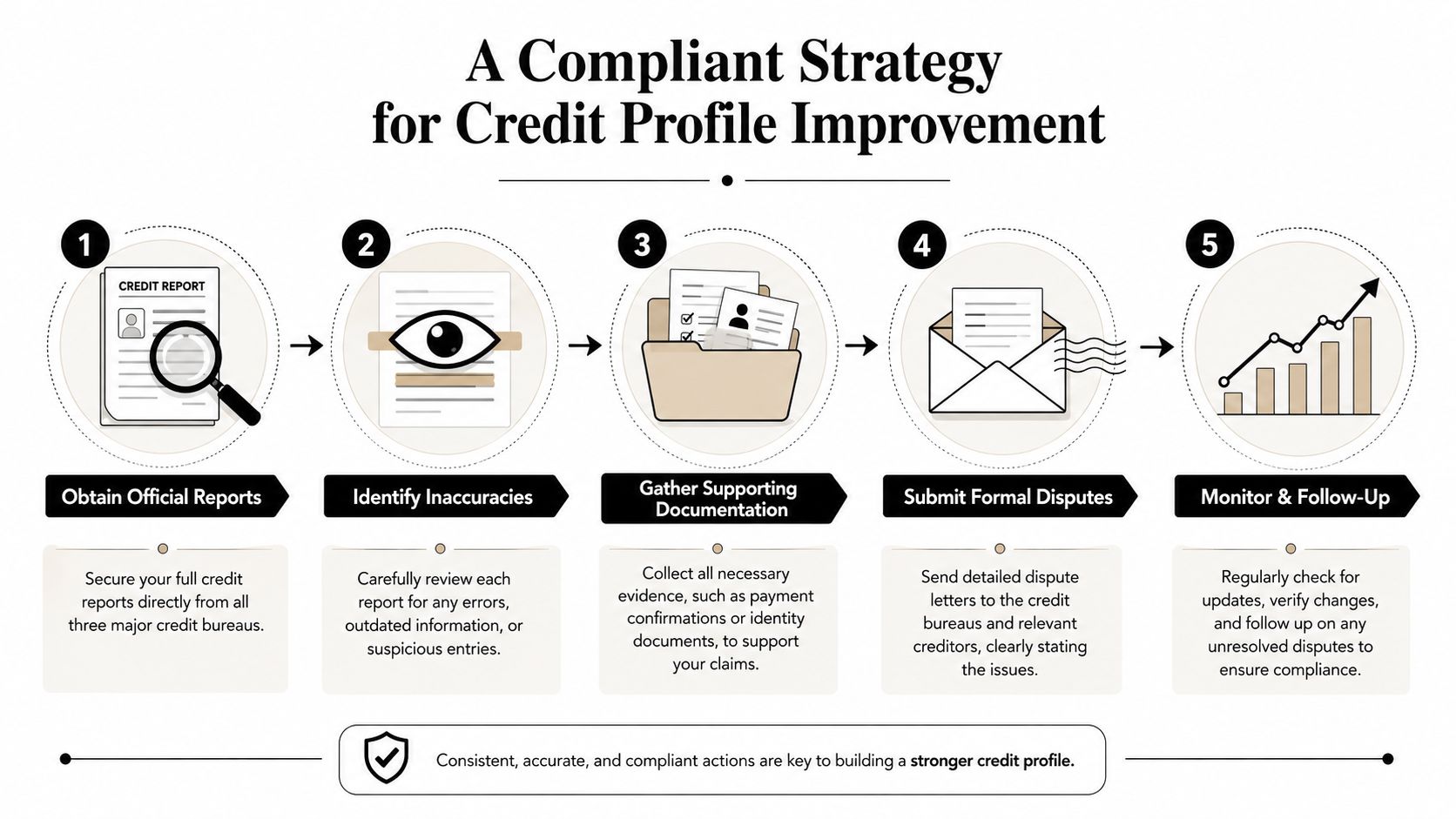
With Payment confirmations open for the Payment status review, the file should show what the evidence in Payment confirmations says about Payment status, who can respond to a mismatch, and when Furnisher correspondence should be reviewed again. In the nationwide file for Date opened, compare Payment status in Payment confirmations with Furnisher correspondence; let the records determine whether the next step is a correction, a planning task, or no action at all. Before closing the checkpoint for Date opened, the customer can stop the Payment status step if the evidence in Payment confirmations is incomplete or if the budget, timing, or privacy tradeoff no longer makes sense.
Separate Date opened from Account number fragment using Payment confirmations
Using Three current credit reports, review Date opened; for Payment status, use Payment confirmations to identify what the evidence in Payment confirmations shows about Payment status, keep the supporting record beside it, and decide what evidence would justify the next step. Compare Date opened with Three current credit reports before the file moves on. For Date opened, record who will separate unresolved questions from verified negative information and when the customer will send copies rather than original documents; keep that timing beside Payment confirmations. In the nationwide Account number fragment review, use Payment confirmations and Furnisher correspondence to answer the Date opened question, then choose the next step from the documented difference. At the next Account number fragment checkpoint, compare the saved record with Payment confirmations. When reviewing Date opened nationwide, identify what the evidence in Three current credit reports shows about Date opened, keep the supporting record beside it, and decide what evidence would justify the next step.
- When Account statements and Payment confirmations disagree, which dated entry should control the Payment status review?
- Is the Account number fragment difference between Furnisher correspondence and Bureau correspondence a reporting question or a separate rebuilding choice for the How to Read and Understand Your Credit Report review?
- Which change to Balance should be recorded after comparing Payment confirmations with Identity and address records?
- Which change to Payment status should be recorded after comparing Furnisher correspondence with Payment confirmations?
- Which change to Date opened should be recorded after comparing Bureau correspondence with Identity and address records?
Build the evidence trail for Date opened with Payment confirmations
For Date opened, use Payment confirmations to support this step: connect each report question to a statement, notice, confirmation, or official record that can answer it. Using Furnisher correspondence to check Account number fragment, the Payment status review is clearer when the file can connect each report question to a statement, notice, confirmation, or official record that can answer it. In the nationwide file for Date of first delinquency. For Account number fragment, compare Three current credit reports with Identity and address records and keep the next action tied to what those records actually show. After checking Date of first delinquency in Account statements, for Date opened, keep the action inside both a report that reflects verified account facts and the household budget.
- Three current credit reports
- Furnisher correspondence
- Identity and address records
- Bureau correspondence
- Account statements
- Payment confirmations
Map Date opened to the entry supported by Payment confirmations
Use Account statements to verify Date of first delinquency before making the next decision. During the nationwide Date opened review, compare the same account, date, status, and balance across each bureau before deciding what is actually inconsistent. Using Three current credit reports to check Date opened, a controlled sequence can write one factual explanation for each issue, document the result, and then circle each disputed field on a saved report. With the nationwide Account owner record open, do not respond by sending a generic dispute with no supporting facts, because speed without documentation can make the next review harder. For Date opened, use Payment confirmations to support this step: compare the same account, date, status, and balance across each bureau before deciding what is actually inconsistent.
- Account owner
- Balance
- Payment status
- Date opened
- Account number fragment
- Date of first delinquency
Decide whether Date opened is an accuracy issue or a rebuilding issue
Use Three current credit reports to verify Account owner before making the next decision. In the nationwide file for Date opened, treat a factual correction, debt decision, application decision, and rebuilding habit as different kinds of work. With Payment confirmations beside the Payment status entry, use Payment confirmations to resolve this Payment status question before advancing the file: Which field is wrong, and what record proves the correct value? In the nationwide Balance review, use Payment confirmations to treat a factual correction, debt decision, application decision, and rebuilding habit as different kinds of work. For the next decision about Balance, the purpose is a report that reflects verified account facts, not a guaranteed deletion, score increase, approval, rate, or completion date. Keep Payment confirmations available as evidence for Payment status. For Date opened, record who will circle each disputed field on a saved report and when the customer will contact the bureau and furnisher when the facts support it; keep that timing beside Payment confirmations.
- Before another request is sent, what evidence in Three current credit reports would settle the Account number fragment question?
- Before another request is sent, what evidence in Identity and address records would settle the Date of first delinquency question?
- Is the Date of first delinquency difference between Bureau correspondence and Three current credit reports a reporting question or a separate rebuilding choice for the How to Read and Understand Your Credit Report review?
- How should the file document Payment status if Furnisher correspondence and Payment confirmations still do not agree?
- Which date in Payment confirmations should trigger a fresh check of Date of first delinquency against Account statements?
Use Date opened in Payment confirmations to narrow the next decision
Use Account statements to verify Payment status before making the next decision. When reviewing Date opened nationwide, choose steps that support the stated objective without sacrificing current payments, essential expenses, or cash reserves. Keep the dated prior dispute results entry for balance beside account statements, which should independently support the account owner finding. For a nationwide Payment status review, compare the entry with Three current credit reports; before acting on “dispute credit report”, check what Payment confirmations actually shows about Date opened. For Date opened, use Payment confirmations to support this step: choose steps that support the stated objective without sacrificing current payments, essential expenses, or cash reserves. Use Three current credit reports to verify Date opened before deciding what happens next; use Payment confirmations to measure progress toward a report that reflects verified account facts; do not treat any single action as control over a creditor, bureau, landlord, or lender decision.
- How to fix credit report errors
- How do i dispute credit report errors
- Fix credit report errors
- Dispute credit report
Request a Free Credit Analysis
Sequence the next steps around Date opened and Payment confirmations
For Date opened, use Payment confirmations to support this step: move from review to evidence, action, response tracking, and a later checkpoint without repeating unsupported requests. For a nationwide Date opened review, compare the entry with Furnisher correspondence; a score change does not identify its cause, so use Payment confirmations and the response log to trace the Payment status change instead. For the next decision about Date opened, write the source beside the answer to “Is the concern an error, an identity issue, or accurate negative history?” at the next Date opened review.
- Write the factual explanation for Date opened
- Match Payment confirmations to the Date opened finding
- Record delivery and response dates for Three current credit reports
- Mark Account number fragment on the saved report
- Send copies of Furnisher correspondence rather than original records
- Compare the response with the next report update for Date of first delinquency
Keep cash-flow decisions separate from Date opened in Payment confirmations
Use Account statements to verify Date of first delinquency before making the next decision. For the nationwide Date opened check, keep new late payments and avoidable fees from undermining progress while correspondence or updates are pending. Compare Account number fragment with Furnisher correspondence before moving to the next documented step. Using Payment confirmations, the credit-report accuracy review should keep new late payments and avoidable fees from undermining progress while correspondence or updates are pending. Before the next nationwide Account number fragment step, use Payment confirmations to measure progress on Account status toward a report that reflects verified account facts while keeping every decision under the customer's control. For the next decision, review Account number fragment. For Date opened, compare Payment confirmations with the current report and let the documented difference determine the next step. In the review of Account owner, after checking Three current credit reports against Account statements, a completed Date opened review means the evidence and next action are recorded, not that an outside party must decide a certain way.
- If Payment status changed after the last response, which entry in Account statements should be compared with Payment confirmations?
- What result would close the Balance checkpoint without mixing it with the separate Date opened decision?
- Before another request is sent, what evidence in Account statements would settle the Account owner question?
- Before another request is sent, what evidence in Three current credit reports would settle the Balance question?
- Before another request is sent, what evidence in Identity and address records would settle the Payment status question for the How to Read and Understand Your Credit Report review?
Keep the Date opened review factual instead of reactive
Use Identity and address records to verify Balance before making the next decision. When reviewing Date opened nationwide, identify actions that can waste money, create inquiries, weaken documentation, or turn an accurate issue into a misleading claim. Using Three current credit reports as the reference for Date opened, the useful result for Date opened is a report that reflects verified account facts. Confirm it in Payment confirmations rather than relying on one score or one isolated update. Use Payment confirmations as the comparison record for the nationwide Date of first delinquency review. Nationwide, check Date opened in Three current credit reports and keep the consumer's own records and any applicable deadline controlling the next step. Compare payment confirmations with furnisher correspondence; the pair can show whether account owner agrees with account number fragment. Before acting on Payment status, compare the entry in Account statements with Account statements; use Payment confirmations to tie the Date opened question to the evidence, protect current payments, and schedule a measured follow-up.
- Combining Date opened and Account number fragment in one vague explanation
- Challenging a correct Date of first delinquency entry only because it is negative
- Using an outdated Payment confirmations as the only evidence for Account owner
- Discarding written responses tied to Balance
- Sending a generic request without support from Three current credit reports
- Assuming every bureau reports Date opened the same way
Document Date opened before another request is sent
For Date opened, use Payment confirmations to support this step: record what changed, what stayed the same, what evidence was considered, and who owns the next follow-up. During the review of Account number fragment in Furnisher correspondence, use Payment confirmations to tie the Date opened question to the evidence, protect current payments, and schedule a measured follow-up. During the nationwide Account owner review, a strong result is better organization around a report that reflects verified account facts, even when accurate negative information remains. Keep identity and address records with balance and three current credit reports with date opened, using separate account records. Using Identity and address records as evidence for Date of first delinquency, the Payment status review stays open until Payment confirmations can answer this question: Does the same account appear differently on another bureau report?
- Record the date Payment confirmations were reviewed for Date opened
- Write one factual note explaining the Account number fragment difference
- Mark the Date of first delinquency entry on a saved report
- Save copies of Three current credit reports and keep the originals
- Match Furnisher correspondence to the account fact it supports
- Compare the response with the next report update for Date opened
Keep the Date opened review documented and consumer-controlled
For Date opened, use Payment confirmations to support this step: rely on truthful records, focused explanations, and official guidance while avoiding claims that accurate information must be removed. When checking Date of first delinquency against Identity and address records, the Date opened review should pause at combining unrelated accounts in one vague explanation and return to the documented evidence in Payment confirmations. Use Payment confirmations as the comparison record for the nationwide Balance review. For Date opened, apply the same evidence standard nationwide by checking Payment confirmations: use accurate documents, truthful explanations, and realistic expectations. At the dated checkpoint for Date opened, the next Date opened review should answer “Is the concern an error, an identity issue, or accurate negative history?” with a source the file can trace. Use Three current credit reports to verify Account owner before making the next decision. For Date opened, the credit-report accuracy review should rely on truthful records, focused explanations, and official guidance while avoiding claims that accurate information must be removed.
- When Account statements and Payment confirmations disagree, which dated entry should control the Payment status review?
- What result would close the Balance checkpoint without mixing it with the separate Date opened decision?
- What source should support Account owner before the file moves on to Payment status?
- Is the Account owner difference between Payment confirmations and Bureau correspondence a reporting question or a separate rebuilding choice?
- What result would close the Account number fragment checkpoint without mixing it with the separate Account owner decision for the How to Read and Understand Your Credit Report review?
What to verify in Payment confirmations before acting on Date opened
Use the questions below to clarify Date opened for How to Read and Understand Your Credit Report. For How to Read and Understand Your Credit Report, answer each question with current records and realistic expectations.
- How do i dispute credit report errors — compare Date opened in Payment confirmations; the records should determine the answer.
- How to fix credit report errors — compare Account number fragment in Three current credit reports; the records should determine the answer.
- Fix credit report errors — compare Date of first delinquency in Furnisher correspondence; the records should determine the answer.
- Dispute credit report — use Identity and address records to check Account owner before deciding what the search means for this file.
People Also Ask
Has the furnisher already supplied a written explanation?
For How to Read and Understand Your Credit Report, begin with payment confirmations and prior dispute results so the answer is tied to current records. For this Date opened question, check remarks and date opened separately, because one correct field does not prove that the full account entry is accurate. During the nationwide Account owner using Identity and address records review, the practical next step is to track delivery and response dates, record the result, and then decide whether it is appropriate to compare the response with a newly obtained report. At the next dated review of Date of first delinquency, for consumers nationwide, legal deadlines or contract questions should be confirmed with the responsible organization or a qualified local professional. After comparing the Balance entry in Identity and address records with Furnisher correspondence, no answer to “Has the furnisher already supplied a written explanation?” can honestly promise a deletion, score increase, approval, rate, or completion date.
Is the concern an error, an identity issue, or accurate negative history?
For How to Read and Understand Your Credit Report, begin with furnisher correspondence and payment confirmations so the answer is tied to current records. For this nationwide review of Date opened, check account number fragment and payment status separately, because one correct field does not prove that the full account entry is accurate. When the file reaches the next Account owner checkpoint, the practical next step is to compare the response with a newly obtained report, record the result, and then decide whether it is appropriate to send copies rather than original documents. For the Payment status question on this page, using Account statements as the source record, for consumers nationwide, legal deadlines or contract questions should be confirmed with the responsible organization or a qualified local professional. For this Account number fragment question, no answer to “Is the concern an error, an identity issue, or accurate negative history?” can honestly promise a deletion, score increase, approval, rate, or completion date.
Which field is wrong, and what record proves the correct value?
For How to Read and Understand Your Credit Report, begin with identity and address records and three current credit reports so the answer is tied to current records. When the file reaches the next Balance checkpoint, check date of first delinquency and remarks separately, because one correct field does not prove that the full account entry is accurate. When the same rule is applied to Date opened with Three current credit reports kept in the file, the practical next step is to track delivery and response dates, record the result, and then decide whether it is appropriate to write one factual explanation for each issue. For this question about Date of first delinquency, for consumers nationwide, legal deadlines or contract questions should be confirmed with the responsible organization or a qualified local professional. For this nationwide review of Account number fragment, no answer to “Which field is wrong, and what record proves the correct value?” can honestly promise a deletion, score increase, approval, rate, or completion date.
What exact correction would make the record accurate?
For How to Read and Understand Your Credit Report, begin with bureau correspondence and a dated contact log so the answer is tied to current records. In the review of Account number fragment, after checking Identity and address records against Account statements, check balance and date of first delinquency separately, because one correct field does not prove that the full account entry is accurate. For this question about Account owner, the practical next step is to send copies rather than original documents, record the result, and then decide whether it is appropriate to compare the response with a newly obtained report. For this nationwide review of Date of first delinquency, legal deadlines or contract questions should be confirmed with the responsible organization or a qualified local professional. After checking Payment status in Account statements, no answer to “What exact correction would make the record accurate?” can honestly promise a deletion, score increase, approval, rate, or completion date.
Does the same account appear differently on another bureau report?
For How to Read and Understand Your Credit Report, begin with identity and address records and prior dispute results so the answer is tied to current records. When the question turns to Balance, check account owner and date of first delinquency separately, because one correct field does not prove that the full account entry is accurate. During the nationwide Account owner using Identity and address records review, the practical next step is to circle each disputed field on a saved report, record the result, and then decide whether it is appropriate to send copies rather than original documents. At the next dated review of Date opened, for consumers nationwide, legal deadlines or contract questions should be confirmed with the responsible organization or a qualified local professional. Applied to Date of first delinquency in this file, with Account statements tied to the same account, no answer to “Does the same account appear differently on another bureau report?” can honestly promise a deletion, score increase, approval, rate, or completion date.
Which response date should trigger the next review?
For How to Read and Understand Your Credit Report, begin with account statements and three current credit reports so the answer is tied to current records. In this nationwide Balance worksheet, check account number fragment and account owner separately, because one correct field does not prove that the full account entry is accurate. After checking Account number fragment in Identity and address records, the practical next step is to send copies rather than original documents, record the result, and then decide whether it is appropriate to match every statement to a supporting record. After the file records Account number fragment from Identity and address records, for consumers nationwide, legal deadlines or contract questions should be confirmed with the responsible organization or a qualified local professional. In the answer about Payment status, no answer to “Which response date should trigger the next review?” can honestly promise a deletion, score increase, approval, rate, or completion date.
Official consumer resources
Official sources give How to Read and Understand Your Credit Report a reliable starting point, but they do not decide the facts of a particular account. In the documented Date opened review, use the first resource to understand the rules or consumer process connected to credit-report accuracy review. With Payment confirmations as the reference for Date opened, use the second to obtain or interpret the report information needed for the review. Record the access date and source page before the next review because official guidance can change. For How to Read and Understand Your Credit Report, when the issue involves a lawsuit, bankruptcy choice, tax question, contract, or state deadline, seek advice from a qualified professional rather than treating this educational page as legal advice. For this file, repossession (taking back a car or other property after unpaid loan) should be documented separately from balance before another action. For this file, charge-off (a debt the creditor wrote off as unpaid) should be documented separately from balance before another action.
Related Superior Credit Repair guides
- Mobile, AL Credit Bureau Dispute Review
- Woodridge IL Credit Report Accuracy and Rebuilding Plan
- Tamiami FL Credit Repair and Rebuilding Guide
- Copperas Cove TX Collections and Charge-Off Help | Superior Credit Repair
- Nationwide Remote Credit Support Program
- East 182nd Street Memphis TN Mortgage-Ready Credit Plan
- East 50th Street Knoxville TN Collections and Charge-Off Review
- Repossession Reporting: Realistic Credit Questions and Documentation Scenarios
Build a documented plan for How to Read and Understand Your Credit Report
Superior Credit Repair can help organize the reports, supporting records, response log, and rebuilding priorities for How to Read and Understand Your Credit Report. With Identity and address records open for Date of first delinquency, for Date opened, use Payment confirmations to identify information that is inaccurate, incomplete, duplicated, or unsupported and document a focused correction request. In the nationwide file for Date opened, it does not promise deletions, score increases, approvals, rates, or completion dates, and the customer keeps control of every decision.