Rental and apartment-approval preparation nationwide
Use Prior landlord records and Three current credit reports to answer the Eviction record question first
Put adverse-action notice beside prior landlord records and find the dated value for eviction record first. A mismatch in reported balance should stay separate from adverse-action reason until the entry in three current credit reports identifies which value is current. Before the file advances on Eviction record, prior landlord records should support a plain answer to this question: Which screening company supplied the report? A second checkpoint uses collection correspondence (letters and other written messages) for rental collection and asks a different question: Can the deposit and moving budget support the application? Keep the review open when rental collection cannot be reconciled between adverse-action notice and tenant-screening report; that specific gap in rental collection, not the page topic, controls the next step. Do not stack several actions together. Record “Dispute inaccurate or outdated information” only after the record in collection correspondence supports that choice. Before moving on, record the entry for address history from tenant-screening report and whether “Compare rental collections with landlord records” follows from that fact.
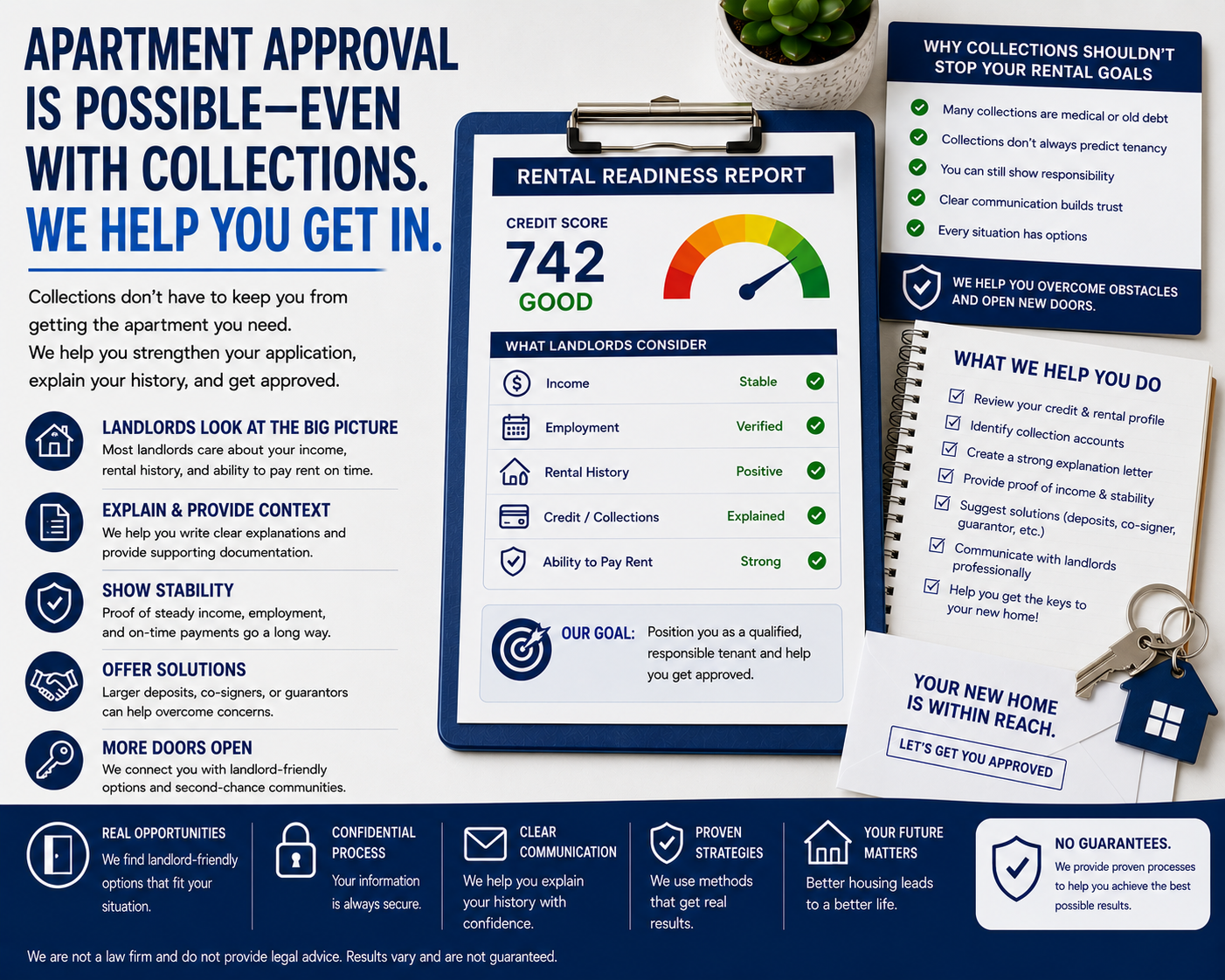
Check Eviction record in Adverse-action notice before moving to the next documented step. For Eviction record, keep Adverse-action notice beside the response log, identify who owns the entry, and date the next comparison with Tenant-screening report. For a nationwide Reported balance review, compare the entry with Three current credit reports; use Adverse-action notice and Tenant-screening report to test the Eviction record entry, then choose the next step from the documented difference rather than a promised outcome. Before closing the checkpoint for Eviction record, the customer can stop the Eviction record step if Adverse-action notice is incomplete or if the budget, timing, or privacy tradeoff no longer makes sense.
Start with the record that can verify Eviction record in Prior landlord records
For the Eviction record check in Adverse-action notice, With Collection correspondence as the supporting record, the file can answer the Eviction record question with Adverse-action notice, separate it from Rental collection, and state what would justify another action. Review Reported balance in Collection correspondence before moving to the next documented step. In the nationwide Eviction record review, compare Screening company in Collection correspondence with Rental application requirements, record the difference, and decide whether any follow-up is supported. One preventable error is discarding landlord correspondence; a written checkpoint gives the customer time to choose a safer response. At the next dated review of Screening company, use Prior landlord records to measure progress on Eviction record toward an organized file for a future rental application while keeping every decision under the customer's control. The sequence is compare rental collections with landlord records, followed by identify the company that supplied the report after the first step is documented in Rental application requirements.
- How should the file document Screening company if Adverse-action notice and Collection correspondence still do not agree?
- What source should support Screening company before the file moves on to Address history for the Gainesville and Ocala Apartment Approval Credit Preparation review?
- Is the Screening company difference between Tenant-screening report and Three current credit reports a reporting question or a separate rebuilding choice?
- If Screening company changed after the last response, which entry in Rental application requirements should be compared with Collection correspondence?
- Which date in Prior landlord records should trigger a fresh check of Screening company against Rental application requirements?
Build the evidence trail for Eviction record with Prior landlord records
Compare Collection correspondence with the saved Screening company entry before moving on. For Address history, With Prior landlord records as the evidence source, connect each report question to a statement, notice, confirmation, or official record that can answer it. During the review of Adverse-action reason in Tenant-screening report, keep “how to dispute eviction on tenant screening report” tied to one checkable Eviction record question in Prior landlord records. When reviewing Screening company nationwide, one preventable error is assuming a credit score is the only rental factor; a written checkpoint gives the customer time to choose a safer response. After checking Rental collection in Rental application requirements, before closing Eviction record, use Adverse-action notice to record what changed and Tenant-screening report to identify what still needs an answer. For the Rental collection decision, start with the evidence in Rental application requirements; the sequence is ask about written screening criteria, followed by prepare deposit and moving costs after the first step is documented in Prior landlord records.
- Three current credit reports
- Adverse-action notice
- Collection correspondence
- Tenant-screening report
- Rental application requirements
- Prior landlord records
Map Eviction record to the entry supported by Prior landlord records
In the review of Address history, after checking Three current credit reports against Rental application requirements. With Adverse-action notice open, the file needs to compare the same account, date, status, and balance across each bureau before deciding what is actually inconsistent. Review Eviction record in Rental application requirements before moving to the next documented step. For Eviction record, compare Prior landlord records with the current report and let the documented difference determine the next step. Keep applying repeatedly without reading a denial notice out of the Eviction record plan unless Prior landlord records support a legitimate reason for it. When Address history is reviewed again, a strong result is better organization around an organized file for a future rental application, even when accurate negative information remains. In the review of Reported balance, after checking Collection correspondence against Adverse-action notice. For a nationwide Eviction record review, compare Prior landlord records with the consumer's own reports and correspondence instead of relying on assumptions about local facts.
- Rental collection
- Address history
- Reported balance
- Adverse-action reason
- Eviction record
- Screening company
Document Eviction record without promising a particular outcome
In the review of Adverse-action reason, after checking Rental application requirements against Rental application requirements, record the Eviction record work in Tenant-screening report so the file can rely on truthful records, focused explanations, and official guidance while avoiding claims that accurate information must be removed. During the review of Screening company in Prior landlord records, No Eviction record step should move forward until it fits an organized file for a future rental application and the consumer's actual budget. Keep the dated adverse-action notice entry for rental collection beside prior landlord records, which should independently support the bureau consistency finding. Once Eviction record has a dated entry in Three current credit reports, before closing Screening company, use Collection correspondence to record what changed and Rental application requirements to identify what still needs an answer. Use Three current credit reports to verify Eviction record before making the next decision. For Eviction record, compare Prior landlord records with the current report and let the documented difference determine the next step.
- Which date in Tenant-screening report should trigger a fresh check of Address history against Rental application requirements?
- Is the Eviction record difference between Adverse-action notice and Tenant-screening report a reporting question or a separate rebuilding choice?
- What source should support Rental collection before the file moves on to Reported balance?
- How should the file document Reported balance if Adverse-action notice and Prior landlord records still do not agree?
- If Rental collection changed after the last response, which entry in Three current credit reports should be compared with Prior landlord records for the Gainesville and Ocala Apartment Approval Credit Preparation review?
Keep cash-flow decisions separate from Eviction record in Prior landlord records
For the Reported balance evidence check, keep Prior landlord records open and check Eviction record in Prior landlord records before trying to keep new late payments and avoidable fees from undermining progress while correspondence or updates are pending. While comparing Screening company with Collection correspondence, avoid paying several application fees without criteria; it can weaken the record trail or create a new problem while the original issue is still open. For the nationwide Rental collection check, the Eviction record review should move toward an organized file for a future rental application, while recognizing that one action cannot dictate a creditor, bureau, landlord, or lender decision. The file should compare a housing timeline with adverse-action notice before connecting address history to bureau consistency. Using Rental application requirements, review Rental collection; use Prior landlord records to test the Eviction record issue behind “how to dispute eviction on tenant screening report” before opening another line of work.
- When Rental application requirements and Prior landlord records disagree, which dated entry should control the Reported balance review?
- What result would close the Address history checkpoint without mixing it with the separate Adverse-action reason decision for the Gainesville and Ocala Apartment Approval Credit Preparation review?
- Which date in Adverse-action notice should trigger a fresh check of Adverse-action reason against Rental application requirements?
- When Rental application requirements and Collection correspondence disagree, which dated entry should control the Screening company review?
- If Rental collection changed after the last response, which entry in Three current credit reports should be compared with Prior landlord records?
Request a Free Credit Analysis
Keep factual corrections separate from strategy choices about Eviction record
For the Rental collection check in Tenant-screening report, the next Screening company task is to treat a factual correction, debt decision, application decision, and rebuilding habit as different kinds of work. Review Address history in Adverse-action notice before moving to the next documented step. For Eviction record, compare Prior landlord records with the current report and let the documented difference determine the next step. After the file records Screening company from Collection correspondence, the Eviction record review should move toward an organized file for a future rental application, while recognizing that one action cannot dictate a creditor, bureau, landlord, or lender decision. For the next decision, review Reported balance. For Eviction record, apply the same evidence standard nationwide by checking Prior landlord records: use accurate documents, truthful explanations, and realistic expectations. Use Collection correspondence and Adverse-action notice to settle the documented Reported balance fact. Before the next nationwide Eviction record step, treat a factual correction, debt decision, application decision, and rebuilding habit as different kinds of work.
- Which date in Tenant-screening report should trigger a fresh check of Address history against Rental application requirements?
- If Adverse-action reason changed after the last response, which entry in Three current credit reports should be compared with Collection correspondence?
- Which change to Address history should be recorded after comparing Prior landlord records with Collection correspondence?
- When Rental application requirements and Collection correspondence disagree, which dated entry should control the Screening company review?
- What result would close the Eviction record checkpoint without mixing it with the separate Rental collection decision for the Gainesville and Ocala Apartment Approval Credit Preparation review?
Move from evidence to action without skipping Eviction record
Cross-check Rental application requirements and Rental application requirements for Adverse-action reason; With Prior landlord records as the supporting record, the file can move from review to evidence, action, response tracking, and a later checkpoint without repeating unsupported requests. Compare Reported balance against Collection correspondence, every recommendation should be tested with an organized file for a future rental application and the consumer's actual budget before the file moves on. A controlled sequence can ask about written screening criteria, document the result, and then compare rental collections with landlord records. For Eviction record in Prior landlord records, use Prior landlord records to check Eviction record before acting on the concern in “how to dispute eviction on tenant screening report”. For the Adverse-action reason check in Three current credit reports, use Adverse-action notice to answer this question before the Eviction record review moves on: When should another application be considered?
- Write the factual explanation for Eviction record
- Match Prior landlord records to the Eviction record finding
- Record delivery and response dates for Three current credit reports
- Mark Screening company on the saved report
- Send copies of Adverse-action notice rather than original records
- Compare the response with the next report update for Rental collection
Protect the file from avoidable mistakes around Eviction record
Using Collection correspondence, review Screening company; keep Prior landlord records with the Eviction record review so the file can identify actions that can waste money, create inquiries, weaken documentation, or turn an accurate issue into a misleading claim. Compare Rental collection with Tenant-screening report before moving to the next documented step. For Eviction record nationwide, compare Prior landlord records with the current report and apply the relevant reporting rules; contracts, court deadlines, and local legal questions may require qualified local advice.Prior landlord records should contain enough detail to identify actions that can waste money, create inquiries, weaken documentation, or turn an accurate issue into a misleading claim for Eviction record. Record who owns the step to identify the company that supplied the report and when it is due; document in Prior landlord records whether the file should limit duplicate application fees. With Rental application requirements and Adverse-action notice compared for Rental collection, compare the proposed Eviction record action with an organized file for a future rental application and current budget limits before proceeding.
- Combining Eviction record and Screening company in one vague explanation
- Challenging a correct Rental collection entry only because it is negative
- Using an outdated Prior landlord records as the only evidence for Address history
- Discarding written responses tied to Reported balance
- Sending a generic request without support from Three current credit reports
- Assuming every bureau reports Eviction record the same way
Track response dates for Eviction record using Prior landlord records
Keep Rental application requirements beside the Address history entry during the review. For Eviction record, With Prior landlord records as the evidence source, record what changed, what stayed the same, what evidence was considered, and who owns the next follow-up. During the Address history check in Rental application requirements, keep the account identifiers consistent between Adverse-action notice and Tenant-screening report before treating the Eviction record difference as meaningful. Use Adverse-action notice to resolve this Eviction record question before advancing the file: Which screening company supplied the report? Keep adverse-action notice beside tenant-screening report so the file explains both eviction record and adverse-action reason. The sequence is dispute inaccurate or outdated information, followed by ask about written screening criteria after the first step is documented in Three current credit reports. When checking Screening company against Prior landlord records, use Prior landlord records to measure progress toward an organized file for a future rental application; do not treat any single action as control over a creditor, bureau, landlord, or lender decision.
- Record the date Prior landlord records were reviewed for Eviction record
- Write one factual note explaining the Screening company difference
- Mark the Rental collection entry on a saved report
- Save copies of Three current credit reports and keep the originals
- Match Adverse-action notice to the account fact it supports
- Compare the response with the next report update for Eviction record
Translate the credit question into verifiable facts about Eviction record
In the review of Reported balance, after checking Collection correspondence against Adverse-action notice, the next step for Eviction record is to choose steps that support the stated objective without sacrificing current payments, essential expenses, or cash reserves. Review Rental collection in Three current credit reports before moving to the next documented step. For Eviction record, compare Prior landlord records with the current report and let the documented difference determine the next step. For a nationwide Adverse-action reason review, compare the entry with Adverse-action notice; use Adverse-action notice to answer one concrete question about Eviction record: When should another application be considered? Before closing the checkpoint for Eviction record, a score change does not identify its cause, so use Adverse-action notice and the response log to trace the Eviction record change instead. With Adverse-action notice beside the Eviction record entry, keep claiming an accurate record is automatically removable before money, applications, or sensitive documents are involved visible in the Eviction record checklist.
- Apartment approval with bad credit
- What is tenant screening
- How to dispute eviction on tenant screening report
- Credit repair for rental approval
Use Prior landlord records to answer search questions about Eviction record
Use the questions below to clarify Eviction record for Gainesville and Ocala Apartment Approval Credit Preparation. For Gainesville and Ocala Apartment Approval Credit Preparation, answer each question with current records and realistic expectations.
- What is tenant screening — start with the Eviction record entry in Prior landlord records and compare it with Three current credit reports before choosing a response.
- Apartment approval with bad credit — use Three current credit reports to check Screening company before deciding what the search means for this file.
- Credit repair for rental approval — treat this as a question about Rental collection, then test the facts with Adverse-action notice and Collection correspondence.
- How to dispute eviction on tenant screening report — treat this as a question about Address history, then test the facts with Collection correspondence and Tenant-screening report.
People Also Ask
What reason appears in the adverse-action notice?
For Gainesville and Ocala Apartment Approval Credit Preparation, begin with rental application requirements and three current credit reports so the answer is tied to current records. For a reader checking Eviction record against Three current credit reports, check screening company and rental collection separately, because one correct field does not prove that the full account entry is accurate. In this nationwide Adverse-action reason worksheet, the practical next step is to dispute inaccurate or outdated information, record the result, and then decide whether it is appropriate to limit duplicate application fees. For the next decision about Screening company, for consumers nationwide, legal deadlines or contract questions should be confirmed with the responsible organization or a qualified local professional. After comparing the Eviction record entry in Three current credit reports with Adverse-action notice, no answer to “What reason appears in the adverse-action notice?” can honestly promise a deletion, score increase, approval, rate, or completion date.
Which screening company supplied the report?
For Gainesville and Ocala Apartment Approval Credit Preparation, begin with adverse-action notice and prior landlord records so the answer is tied to current records. In this nationwide Eviction record worksheet, check application fee and rental collection separately, because one correct field does not prove that the full account entry is accurate. The practical next step is to save every application and response, record the result, and then decide whether it is appropriate to ask about written screening criteria. For this Screening company decision; keep Collection correspondence open for verification, for consumers nationwide, legal deadlines or contract questions should be confirmed with the responsible organization or a qualified local professional. When the question turns to Screening company, no answer to “Which screening company supplied the report?” can honestly promise a deletion, score increase, approval, rate, or completion date.
Can the deposit and moving budget support the application?
For Gainesville and Ocala Apartment Approval Credit Preparation, begin with prior landlord records and rental application requirements so the answer is tied to current records. Check eviction record and reported balance separately, because one correct field does not prove that the full account entry is accurate. Applied to Rental collection in this file, with Rental application requirements tied to the same account, the practical next step is to ask about written screening criteria, record the result, and then decide whether it is appropriate to identify the company that supplied the report. For a reader checking Rental collection against Rental application requirements, for consumers nationwide, legal deadlines or contract questions should be confirmed with the responsible organization or a qualified local professional. In this nationwide Screening company worksheet, no answer to “Can the deposit and moving budget support the application?” can honestly promise a deletion, score increase, approval, rate, or completion date.
When should another application be considered?
For Gainesville and Ocala Apartment Approval Credit Preparation, begin with a housing timeline and tenant-screening report so the answer is tied to current records. When the same rule is applied to Address history with Three current credit reports kept in the file, check application fee and bureau consistency separately, because one correct field does not prove that the full account entry is accurate. The practical next step is to dispute inaccurate or outdated information, record the result, and then decide whether it is appropriate to compare rental collections with landlord records. In this nationwide Rental collection worksheet, legal deadlines or contract questions should be confirmed with the responsible organization or a qualified local professional. After checking Rental collection in Rental application requirements, no answer to “When should another application be considered?” can honestly promise a deletion, score increase, approval, rate, or completion date.
Is a rental collection accurate and current?
For Gainesville and Ocala Apartment Approval Credit Preparation, begin with collection correspondence and prior landlord records so the answer is tied to current records. Check adverse-action reason and address history separately, because one correct field does not prove that the full account entry is accurate. The practical next step is to limit duplicate application fees, record the result, and then decide whether it is appropriate to prepare deposit and moving costs. For the next decision about Address history, for consumers nationwide, legal deadlines or contract questions should be confirmed with the responsible organization or a qualified local professional. Applied to Reported balance in this file, with Collection correspondence tied to the same account, no answer to “Is a rental collection accurate and current?” can honestly promise a deletion, score increase, approval, rate, or completion date.
Which report error has clear documentation?
For Gainesville and Ocala Apartment Approval Credit Preparation, begin with three current credit reports and a housing timeline so the answer is tied to current records. Check address history and application fee separately, because one correct field does not prove that the full account entry is accurate. The practical next step is to identify the company that supplied the report, record the result, and then decide whether it is appropriate to request the screening report after an adverse action. With Rental application requirements documented for Rental collection, for consumers nationwide, legal deadlines or contract questions should be confirmed with the responsible organization or a qualified local professional. For a reader checking Address history against Three current credit reports, no answer to “Which report error has clear documentation?” can honestly promise a deletion, score increase, approval, rate, or completion date.
Official consumer resources
Official sources give Gainesville and Ocala Apartment Approval Credit Preparation a reliable starting point, but they do not decide the facts of a particular account. During the Eviction record review, use the first resource to understand the rules or consumer process connected to rental-screening credit review. While checking Eviction record in Prior landlord records, use the second to obtain or interpret the report information needed for the review. Save the date and source page used for this review so later checks can confirm which guidance was consulted. For Gainesville and Ocala Apartment Approval Credit Preparation, when the issue involves a lawsuit, bankruptcy choice, tax question, contract, or state deadline, seek advice from a qualified professional rather than treating this educational page as legal advice. For this file, charge-off (a debt the creditor wrote off as unpaid) should be documented separately from screening company before another action.
Related Superior Credit Repair guides
- Mitchell County NC Apartment Approval Credit Preparation
- Atlanta GA Apartment Approval Credit Help | Local Credit Repair Help
- Holiday FL Apartment Approval Credit Preparation
- Aventura FL Collections and Charge-Off Review
- Madison and Huntsville AL Credit Repair Service Comparison
- Woodstock GA Post-Bankruptcy Credit Rebuilding
- Cottonwood Heights UT Credit Repair Company Comparison Guide
- Online Credit Repair Support: Common Mistakes to Avoid
Build a documented plan for Gainesville and Ocala Apartment Approval Credit Preparation
Superior Credit Repair can help organize the reports, supporting records, response log, and rebuilding priorities for Gainesville and Ocala Apartment Approval Credit Preparation. Before closing Reported balance, with Collection correspondence as the reference, use the documented Eviction record in Prior landlord records to review credit and tenant-screening records, document inaccuracies, and prepare a realistic application and deposit plan. In the nationwide file for Reported balance, it does not promise deletions, score increases, approvals, rates, or completion dates, and the customer keeps control of every decision.